
Current ARM Mortgage Rates Report for June 1, 2026
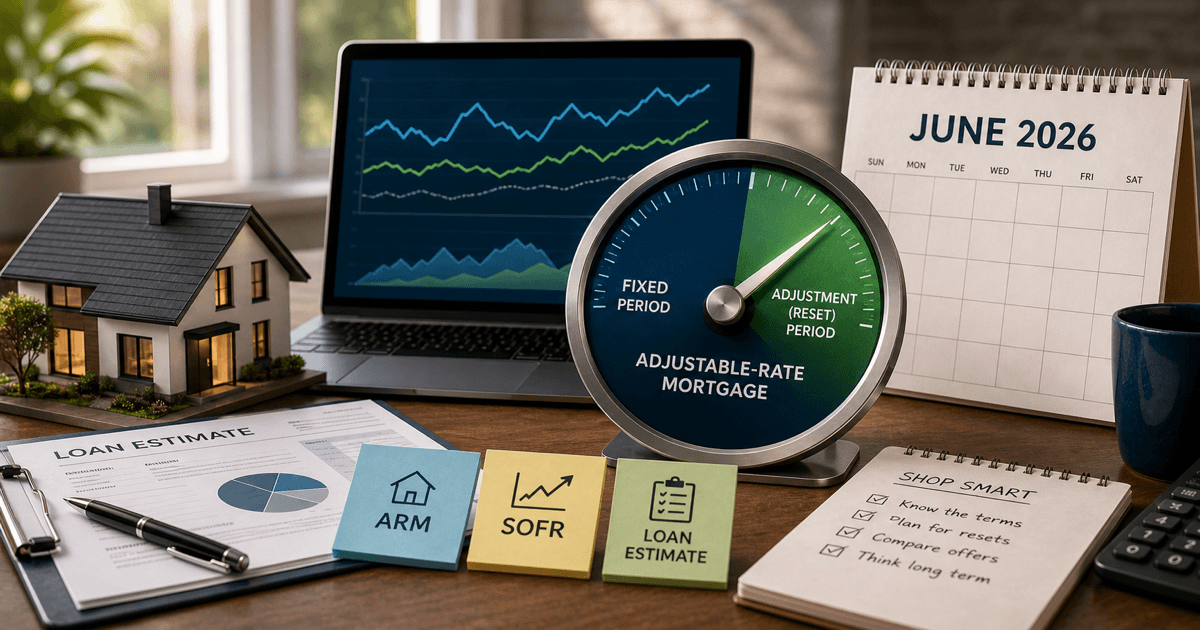
Fortune reported 7/6 ARM and 7-year SOFR ARM rates from 5.875% to 6.500% on June 1, 2026. See the full table, fixed-rate context, payment-shock examples, ARM caps, and shopping checklist.
Guide Oversight & Review Policy
CalculatorWallah guides are written to explain calculator assumptions, source limitations, and when users should move from a rough estimate to an official rule, institution policy, or clinician conversation.
Jitendra Kumar, Founder & Editorial Standards Lead. Updated June 2, 2026. Scope: Sales tax and tax-sensitive estimate tools, Education and GPA planning calculators, Health, protein, and screening-formula pages, Platform-wide publishing standards and methodology.
Finance credentialed review: Named internal reviewer: Laxman Kumawat, Finance & Engineering Calculator Owner. External credentialed professional review is still required before this page is treated as professional advice.
Internal finance formula and engineering methodology reviewer. Review scope: calculator formulas, input labels, rate assumptions, scenario workflows, and user-facing limitations.
Credentials on file: Electrical and power-system related certifications.
Relevant review context: Professional background across engineering, sustainability, and energy-efficiency work; CalculatorWallah finance and engineering calculator owner.
Required professional credentials: CFP professional, CFA charterholder, CPA, licensed financial professional. Scope: assumptions, amortization logic, risk language, offer-comparison language, affordability guidance, and disclosure placement.
This page provides educational estimates, not individualized financial advice, lending advice, investment advice, or a product recommendation.
Professional Review Status
This YMYL page has internal methodology review, but no external credentialed professional review is recorded yet.
- Reliance status
- Credentialed finance review required before advice-like claims
- Required credentials
- CFP professional, CFA charterholder, CPA, licensed financial professional
- Review scope
- assumptions, amortization logic, risk language, offer-comparison language, affordability guidance, and disclosure placement
Current reviewer: Laxman Kumawat, Internal finance formula and engineering methodology reviewer (Electrical and power-system related certifications).
This page provides educational estimates, not individualized financial advice, lending advice, investment advice, or a product recommendation.
On This Page
Current ARM Mortgage Rates: June 1, 2026 Answer Box
Fortune's June 1, 2026 ARM mortgage rates report showed 7/6 ARM and 7-year SOFR ARM sample rates from 5.875% to 6.500%, with APRs from 6.318% to 6.703%. Bank of America had the lowest listed rate in the sample at 5.875% on a 7/6 ARM with a 6.318% APR. U.S. Bank and Wells Fargo listed 6.125% 7/6 ARMs, while Zillow Home Loans and PNC listed 6.500% products.
Treat those numbers as a market snapshot, not a personal quote. Your real ARM rate can change with credit score, points, lender fees, down payment, loan size, property type, lock timing, state, and whether the ARM uses SOFR or another index after the fixed period.
Fortune ARM Mortgage Rate Table for June 1, 2026
Fortune's report reviewed current ARM offers as of May 29, 2026 and published the report on June 1, 2026. The table below preserves the practical comparison a shopper needs: lender, ARM term, advertised rate, APR, and what to verify before relying on the number.
| Lender | Product | Rate | APR | What to verify |
|---|---|---|---|---|
| Bank of America | 7/6 ARM | 5.875% | 6.318% | Lowest advertised rate in Fortune sample; APR still needs fee review. |
| U.S. Bank | 7/6 ARM | 6.125% | 6.411% | Middle of the sample with a relatively tight rate-to-APR spread. |
| Wells Fargo | 7/6 ARM | 6.125% | 6.412% | Nearly identical to U.S. Bank in the sample, but lender fees can differ. |
| Zillow Home Loans | 7/6 ARM | 6.500% | 6.625% | Highest listed rate among the four 7/6 ARM examples, but a narrower APR spread. |
| PNC | 7-year SOFR ARM | 6.500% | 6.703% | SOFR-indexed 7-year ARM example; borrowers should confirm margin and caps. |
The headline insight is not simply "lowest rate wins." The APR spread matters because a lower note rate can come with higher points or fees. For any ARM quote, ask for a full Loan Estimate and compare the projected payments, cash to close, and adjustment terms on the same day.
How These ARM Rates Compare With Fixed-Rate Context
ARM rates should be read beside fixed-rate benchmarks, but the comparison is imperfect. Freddie Mac's Primary Mortgage Market Survey reported a 30-year fixed-rate average of 6.53% and a 15-year fixed-rate average of 5.87% for the week ending May 28, 2026. Fortune's ARM table, meanwhile, used selected lender ARM offers. Different sources, different products, and different assumptions mean this is context, not an apples-to-apples underwriting quote.
| Benchmark | Latest figure | Date | How to use it |
|---|---|---|---|
| Freddie Mac PMMS 30-year fixed | 6.53% | Week ending May 28, 2026 | Useful fixed-rate context, but not a direct quote for any ARM borrower. |
| Freddie Mac PMMS 15-year fixed | 5.87% | Week ending May 28, 2026 | Shows shorter fixed loans were close to some 7-year ARM starting rates. |
| Fortune ARM lender sample | 5.875% to 6.500% | Data reviewed as of May 29, 2026; article dated June 1, 2026 | Use as a shopping signal, then request live Loan Estimates from lenders. |
The practical takeaway: on June 1, some 7-year ARM starting rates were below the Freddie Mac 30-year fixed average, but not all were below it by enough to automatically justify reset risk. A borrower should calculate the dollar savings during the fixed period, then compare that savings with the possible payment increase after year seven.
What the June 1 ARM Report Means for Borrowers
Current ARM search results often stop at a list of rates. The missing piece is whether the ARM actually improves the borrower's risk-adjusted decision. A 7/6 ARM can be useful when the borrower expects to sell or refinance before year seven, but it is not a free discount. It moves some rate risk from the lender to the borrower after the fixed period.
CFPB guidance explains that an adjustable-rate mortgage has an interest rate that can change over time. After the introductory fixed period, the rate usually adjusts based on an index plus a margin. If the index rises, the payment can rise too, subject to caps. If the index falls, the payment may decline, but the loan contract still controls the adjustment date, floor, margin, and cap structure.
Borrower rule of thumb
Do not choose an ARM because the starting payment makes the house barely affordable. Choose it only when the starting savings are real, the reset terms are understood, and the worst reasonable payment still fits the household budget.
7/6 ARM, 7-Year SOFR ARM, 5/1 ARM, and 10/6 ARM Explained
The first number in common ARM shorthand is the initial fixed period. The second number describes how often the loan can adjust after that. A 7/6 ARM usually means seven years fixed, then potential adjustments every six months. A 5/1 ARM usually means five years fixed, then annual adjustments. A lender's "7-year SOFR ARM" label adds that the post-fixed adjustment may be tied to SOFR, the Secured Overnight Financing Rate.
| ARM term | Initial fixed period | Reset pattern | Practical meaning |
|---|---|---|---|
| 7/6 ARM | 7 years | Every 6 months after the fixed period | Good fit only when the 7-year plan is realistic and the reset risk is affordable. |
| 7-year SOFR ARM | Usually 7 years | Based on the note terms, often tied to SOFR plus a margin | Ask for the index, margin, adjustment caps, lookback period, and first possible reset date. |
| 5/1 ARM | 5 years | Usually once per year after year 5 | Shorter protection than a 7/6 ARM; the initial rate must be meaningfully better to justify the earlier reset. |
| 10/6 ARM | 10 years | Every 6 months after year 10 | Longer rate certainty, but the starting rate may be closer to a fixed-rate loan. |
The New York Fed describes SOFR as a broad measure of the cost of borrowing cash overnight collateralized by Treasury securities. For a SOFR-indexed ARM, your contract should explain the SOFR version used, the lender margin added to it, and the caps that limit changes.
Payment-Shock Example: Why the Cap Table Matters
A rate report tells you the starting point. The ARM note tells you what can happen later. The example below uses a US$ 400,000, 30-year mortgage starting at 6.125%, close to two rates in Fortune's sample. The starting payment is estimated with the standard mortgage formula: payment equals principal times monthly rate times the compounding factor, divided by the compounding factor minus one.
| Calculator input | Formula or input needed | Why it matters |
|---|---|---|
| Starting payment | Loan amount, starting annual rate, and 30-year term | This is the payment most shoppers see first, but it is only guaranteed for the fixed period. |
| Remaining balance at reset | Original balance after scheduled payments through month 84 for a 7-year ARM | The reset payment is based on the remaining balance, not the original loan amount. |
| Reset payment | Remaining balance, new annual rate, and remaining term | This shows payment shock if the index plus margin rises or caps allow a higher rate. |
| Full housing payment | Principal and interest plus taxes, insurance, PMI, HOA, and escrow changes | Affordability should be checked against the full payment, not principal and interest alone. |
| Scenario | Assumed rate | Principal and interest | Important note |
|---|---|---|---|
| Start of loan | 6.125% | About US$ 2,430/month | Illustrative 30-year, US$ 400,000 loan; excludes taxes, insurance, HOA, PMI, and fees. |
| After 7 years if reset rate is 8.125% | 8.125% | About US$ 2,880/month | Uses the estimated remaining balance after 84 payments and 23 years left. |
| After 7 years if reset rate is 11.125% | 11.125% | About US$ 3,615/month | This is the kind of stress test borrowers should run against lifetime caps. |
This example is intentionally conservative. It ignores taxes, insurance, HOA dues, PMI, and refinance costs because the point is to isolate rate reset risk. A real affordability test should add the full housing payment and then compare it with income, debt, reserves, and job stability.
Who Should Consider an ARM in June 2026?
An ARM is not automatically good or bad. It is a contract that trades early payment savings for future uncertainty. The right borrower is usually someone with a credible time horizon, strong cash reserves, and enough flexibility to handle an unfavorable reset.
| Borrower type | Signal | Action before choosing an ARM |
|---|---|---|
| Likely ARM candidate | Plans to sell, relocate, or refinance well before the first reset date. | Compare the ARM savings against closing costs and the risk that refinancing is unavailable. |
| Payment-sensitive buyer | Needs the ARM rate to qualify for the home. | Be careful. If the deal works only at the teaser period, the reset risk may be too high. |
| High-cash-reserve borrower | Can absorb a higher payment after the fixed period. | Run cap-based payment scenarios instead of assuming rates fall. |
| Long-term household | Expects to stay in the home for 10 years or more. | A fixed-rate mortgage may be easier to budget unless the ARM discount is large. |
The weakest ARM case is a buyer who needs the temporary starting rate to qualify, has no reserve plan, and assumes a refinance will be available later. That plan can fail if mortgage rates rise, home values fall, income changes, or credit weakens before the reset date.
How to Compare ARM Mortgage Offers Correctly
A useful ARM comparison is built from the Loan Estimate, not from rate snippets. Ask lenders to quote the same day, same lock period, same loan amount, same down payment, and same property assumptions. Then compare the items below.
| Item | Why it matters | What to ask for |
|---|---|---|
| Rate | Determines the starting principal-and-interest payment. | The note rate, how long it is fixed, and whether discount points are required. |
| APR | Reflects rate plus certain loan costs, so it can expose fee-heavy offers. | A Loan Estimate from each lender on the same day with the same lock assumption. |
| Index and margin | After the fixed period, the new rate is generally index plus lender margin. | The exact index, margin, lookback date, and where the index is published. |
| Caps | Caps limit how much the rate can increase at the first reset, later resets, and over the loan life. | Initial adjustment cap, periodic cap, lifetime cap, floor, and maximum payment example. |
| Prepayment and refinance assumptions | An ARM often depends on being able to leave the loan before it resets. | Any prepayment penalty, refinance cost estimate, and whether your plan still works if home values fall. |
- Ask each lender whether the advertised rate requires discount points.
- Compare page 1 projected payment and page 2 closing-cost detail on the Loan Estimate.
- Find the ARM table that shows adjustment frequency, caps, and maximum payment.
- Run the payment at the first-reset cap, not only at the initial rate.
- Check whether the ARM savings beat a fixed-rate loan after expected closing and refinance costs.
Mistakes to Avoid When Reading ARM Rate Reports
Rate reports are useful, but they can create false confidence when they are read like personal approvals. Avoid these mistakes before using a June 2026 ARM rate in an offer, refinance plan, or affordability model.
| Mistake | Better move |
|---|---|
| Comparing only the interest rate | Compare APR, points, lender credits, cash to close, and the payment table. |
| Treating a 7/6 ARM like a 7-year fixed loan with no tail risk | Read the first adjustment date, reset frequency, and lifetime cap before signing. |
| Assuming refinancing will be easy | Stress test the loan if credit scores, income, home value, or rates move against you. |
| Ignoring the index | Know whether the loan uses SOFR, a Treasury index, or another benchmark, then ask for the margin. |
| Using national averages as a quote | Get same-day Loan Estimates from multiple lenders using the same loan amount and lock period. |
Educational Video Reviewed for This Article
I looked for a current government or regulator video devoted specifically to ARM rate shopping and did not find a suitable official embed. The best relevant institutional video found was Khan Academy's adjustable-rate mortgage explainer, embedded below. Use it for mechanics, then rely on CFPB, Freddie Mac, New York Fed, and your lender's Loan Estimate for current rules and numbers.
Khan Academy
Khan Academy: Adjustable rate mortgages ARMs
Educational explanation of how adjustable-rate mortgages work, included because no more relevant government ARM-specific video was found during source review.
Direct ARM Mortgage Rate FAQ
The short answer for AI search and featured snippets: Fortune's June 1, 2026 ARM report showed selected 7/6 ARM and 7-year SOFR ARM offers from 5.875% to 6.500%, with APRs from 6.318% to 6.703%. Borrowers should compare Loan Estimates, ARM caps, index, margin, and payment-shock scenarios before choosing an adjustable-rate mortgage.
Who Wrote This, How It Was Created, and Why It Exists
This CalculatorWallah article was prepared on June 2, 2026 for borrowers comparing ARM offers after reading Fortune's June 1 rate report. It exists to turn a rate snapshot into a decision framework: what changed, what the numbers mean, what can go wrong after the fixed period, and which official documents should be checked before applying.
Methodology: I used Fortune as the primary rate source, Freddie Mac and FRED for fixed mortgage market context, CFPB guidance for ARM definitions, caps, index, margin, and Loan Estimate usage, New York Fed data for SOFR context, and Khan Academy for a supporting educational video. Every rate in this article is a snapshot, not a guarantee. Verify live quotes with lenders because mortgage rates and APRs can change daily.
Quality-control audit: the article answers the main question upfront, separates current rates from borrower-specific quotes, includes official source links, gives a payment-shock example, explains ARM caps, flags common mistakes, and adds a practical checklist for beginner, intermediate, and advanced readers.
Frequently Asked Questions
Related Calculators
Mortgage Calculator
Estimate principal, interest, taxes, insurance, PMI, HOA, and the monthly payment behind a mortgage quote.
Use Mortgage CalculatorMortgage Affordability Calculator
Check whether the ARM starting payment and a higher reset payment fit your income and debt profile.
Use Mortgage Affordability CalculatorMortgage Refinance Break-Even Analyzer
Model whether refinancing before the ARM adjustment date would recover closing costs in time.
Use Mortgage Refinance Break-Even AnalyzerLoan Amortization Calculator
Estimate the remaining balance at the first ARM adjustment and the payment after a reset.
Use Loan Amortization CalculatorDebt-to-Income Ratio Calculator
Pressure test a starting payment and a reset payment against lender-style DTI math.
Use Debt-to-Income Ratio CalculatorSources & References
- 1.Fortune - Current ARM mortgage rates report for June 1, 2026(Accessed June 2, 2026)
- 2.Freddie Mac - Primary Mortgage Market Survey(Accessed June 2, 2026)
- 3.FRED - 30-Year Fixed Rate Mortgage Average in the United States(Accessed June 2, 2026)
- 4.CFPB - What is an adjustable-rate mortgage?(Accessed June 2, 2026)
- 5.CFPB - ARM rate caps and how they work(Accessed June 2, 2026)
- 6.CFPB - ARM index and margin(Accessed June 2, 2026)
- 7.CFPB - What is a Loan Estimate?(Accessed June 2, 2026)
- 8.New York Fed - Secured Overnight Financing Rate Data(Accessed June 2, 2026)
- 9.Federal Reserve and CFPB - Consumer Handbook on Adjustable-Rate Mortgages(Accessed June 2, 2026)
- 10.Khan Academy - Adjustable rate mortgages ARMs(Accessed June 2, 2026)