
How Much Income Do I Need to Qualify for a $500,000 Mortgage?
A practical mortgage affordability guide estimating the income needed to qualify for a $500,000 mortgage in 2026, using current Freddie Mac rate context, principal and interest, property taxes, homeowners insurance, DTI ratios, down payment assumptions, existing debts, and lender qualification rules.
Guide Oversight & Review Policy
CalculatorWallah guides are written to explain calculator assumptions, source limitations, and when users should move from a rough estimate to an official rule, institution policy, or clinician conversation.
Jitendra Kumar, Founder & Editorial Standards Lead. Updated June 24, 2026. Scope: Sales tax and tax-sensitive estimate tools, Education and GPA planning calculators, Health, protein, and screening-formula pages, Platform-wide publishing standards and methodology.
Finance credentialed review: Named internal reviewer: Laxman Kumawat, Finance & Engineering Calculator Owner. External credentialed professional review is still required before this page is treated as professional advice.
Internal finance formula and engineering methodology reviewer. Review scope: calculator formulas, input labels, rate assumptions, scenario workflows, and user-facing limitations.
Credentials on file: Electrical and power-system related certifications.
Relevant review context: Professional background across engineering, sustainability, and energy-efficiency work; CalculatorWallah finance and engineering calculator owner.
Required professional credentials: CFP professional, CFA charterholder, CPA, licensed financial professional. Scope: assumptions, amortization logic, risk language, offer-comparison language, affordability guidance, and disclosure placement.
This page provides educational estimates, not individualized financial advice, lending advice, investment advice, or a product recommendation.
Professional Review Status
This YMYL page has internal methodology review, but no external credentialed professional review is recorded yet.
- Reliance status
- Credentialed finance review required before advice-like claims
- Required credentials
- CFP professional, CFA charterholder, CPA, licensed financial professional
- Review scope
- assumptions, amortization logic, risk language, offer-comparison language, affordability guidance, and disclosure placement
Current reviewer: Laxman Kumawat, Internal finance formula and engineering methodology reviewer (Electrical and power-system related certifications).
This page provides educational estimates, not individualized financial advice, lending advice, investment advice, or a product recommendation.
On This Page
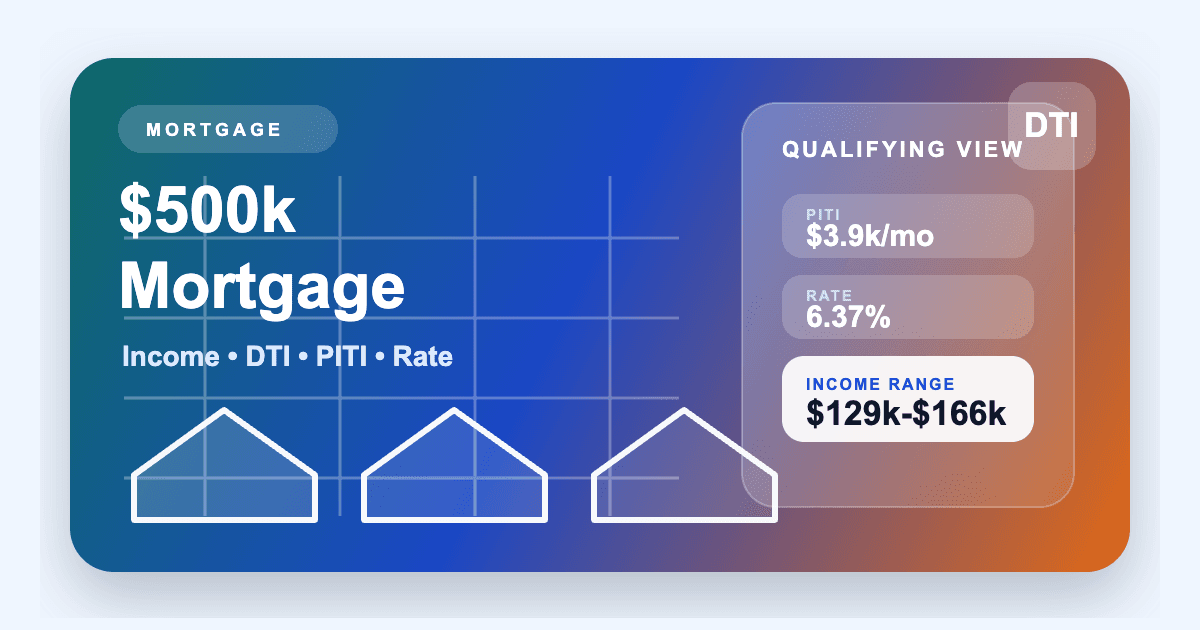
Short Answer: Plan Around $130k to $167k
For a US$ 500,000 mortgage using the June 18, 2026 Freddie Mac weekly average, a realistic qualifying-income range is roughly US$ 130,000 to US$ 167,000 per year before taxes. The lower end assumes no other debts and a total debt-to-income ratio near 36%. The higher end uses a more conservative housing guideline where the full mortgage payment stays near 28% of gross income.
The quick answer changes if you mean a US$ 500,000 home rather than a US$ 500,000 loan. A 500,000 home with 20% down creates a 400,000 mortgage, so the estimated qualifying income can be much lower. A 500,000 mortgage with 20% down implies a 625,000 home.
Assumptions Used for the Estimate
Freddie Mac reported the average 30-year fixed-rate mortgage at 6.47% for the week of June 18, 2026. That is a national weekly average for applications in Freddie Mac's survey, not a promise that your lender will offer the same rate. Credit score, points, loan type, location, down payment, and lender pricing can move your actual payment.
| Item | Value | Why it matters |
|---|---|---|
| Loan amount | US$ 500,000 mortgage | The title says mortgage, so the base case treats 500,000 as the loan amount, not the purchase price. |
| Rate | 6.47% fixed for 30 years | Freddie Mac reported a 6.47% average 30-year fixed rate for the week of June 18, 2026. |
| Purchase price | US$ 625,000 with 20% down | A 500,000 loan with 20% down implies a 625,000 home. |
| Property tax | 1.1% of home value per year | A planning assumption only. Real tax rates are local and can change the income answer materially. |
| Homeowners insurance | US$ 175 per month | A placeholder for estimating PITI. Actual premiums vary by location, property, and coverage. |
Live Rate Check Before You Use the Number
Treat the estimate as a planning model. Before using it for a pre-approval decision, replace every placeholder with a borrower-specific quote and local cost inputs. That makes the mortgage calculator useful instead of a generic payment snapshot.
| Input | Why it matters | Action |
|---|---|---|
| Rate quote | A weekly average is not a personal offer. | Replace 6.47% with your lender quote, including points, APR context, and lock period. |
| Tax and insurance | Local property tax and insurance can move the income answer more than small rate changes. | Use county tax estimates, escrow quotes, HOA dues, PMI, flood insurance, and hazard insurance. |
| Recurring debts | Back-end DTI includes more than the mortgage payment. | Add car, student loan, credit card minimums, personal loans, leases, alimony, and support. |
| Cash reserves | Approval at a high DTI does not prove the budget is comfortable. | Check remaining savings after down payment, closing costs, moving costs, repairs, and reserves. |
Payment Breakdown on a $500,000 Mortgage
Principal and interest are only part of qualification. Lenders usually evaluate the full housing payment, commonly called PITI: principal, interest, property taxes, and insurance. HOA dues, mortgage insurance, flood insurance, and subordinate financing can also count.
| Payment piece | Monthly estimate | Note |
|---|---|---|
| Principal and interest | US$ 3,150 | Based on a 500,000 loan, 30 years, and 6.47%. |
| Property tax | US$ 573 | 1.1% per year on a 625,000 estimated purchase price. |
| Homeowners insurance | US$ 175 | Planning placeholder. Local risk and coverage can move this up or down. |
| Estimated PITI | US$ 3,898 | Before HOA dues, mortgage insurance, flood insurance, or other escrow items. |
Income Needed Under Common DTI Tests
This table shows why the same 500,000 mortgage can produce several different income answers. A lender may approve one borrower at a higher DTI and decline another at a lower DTI because credit, reserves, down payment, income stability, loan program, and property details all matter.
| Scenario | Monthly housing | Monthly debt counted | Annual income needed | Note |
|---|---|---|---|---|
| P&I only, 36% total DTI, no other debt | US$ 3,150 | US$ 3,150 | About US$ 105,000 | Too optimistic because it ignores taxes and insurance. |
| PITI, 36% total DTI, no other debt | US$ 3,898 | US$ 3,898 | About US$ 130,000 | Closer to underwriting math if no other recurring debts exist. |
| PITI, 36% total DTI, US$ 500 other debt | US$ 3,898 | US$ 4,398 | About US$ 147,000 | Car, student loan, credit card minimums, or support payments reduce qualifying power. |
| PITI, 28% housing guideline | US$ 3,898 | Varies | About US$ 167,000 | More conservative and closer to a comfortable household budget. |
| PITI, 43% total DTI, no other debt | US$ 3,898 | US$ 3,898 | About US$ 109,000 | Possible for some loans, but less budget cushion and not guaranteed approval. |
$500,000 Mortgage vs $500,000 Home
The most common misunderstanding is mixing up purchase price and loan amount. If you buy a US$ 500,000 home and put 20% down, the mortgage is US$ 400,000. At the same 6.47% rate, principal and interest are about US$ 2,520 per month. With 1.1% property tax and US$ 175 insurance, estimated PITI is about US$ 3,154 per month.
That 500,000-home version points to about US$ 135,000 per year under a 28% housing guideline, or about US$ 105,000 per year at 36% total DTI with no other debts. The 500,000-mortgage version is larger because the assumed purchase price is 625,000.
How DTI Rules Drive the Answer
The CFPB defines debt-to-income ratio as monthly debt payments divided by gross monthly income. Fannie Mae's Selling Guide says DTI includes the qualifying mortgage payment and other monthly obligations compared with qualifying monthly income.
Fannie Mae's manual underwriting maximum is generally 36%, with possible movement up to 45% when credit score and reserve requirements are met. For Desktop Underwriter loan casefiles, Fannie Mae lists a maximum allowable DTI of 50%. That does not mean every buyer should borrow at 50%; it means some strong applications may be eligible.
Why Existing Debts Change the Income Needed
Existing debts consume the back-end DTI allowance. A US$ 500 car payment does not change the mortgage payment, but it raises the income needed to keep total debts under a given DTI. At a 36% total DTI target, every extra US$ 100 of monthly debt requires roughly US$ 3,333 of additional annual gross income.
Debts that commonly matter include car loans, student loans, personal loans, credit card minimum payments, alimony, child support, lease payments, and other recurring obligations. Utilities, groceries, childcare, healthcare, and retirement savings may not all count in DTI, but they still matter for your real budget.
Rate, HOA, and Down Payment Sensitivity
Mortgage qualification is rate-sensitive. A small rate change can move the income answer by thousands of dollars per year. The same is true for HOA dues, mortgage insurance, property tax rates, and homeowners insurance in high-risk locations.
| Change | P&I impact | Income effect |
|---|---|---|
| Rate rises to 7.00% | US$ 3,327 | Adds about US$ 176 per month before taxes and insurance. |
| Rate falls to 6.00% | US$ 2,998 | Saves about US$ 153 per month before taxes and insurance. |
| US$ 300 monthly car payment | No payment change | Adds about US$ 10,000 income needed at 36% total DTI. |
| US$ 400 monthly HOA dues | No P&I change | Adds about US$ 13,300 income needed at 36% total DTI. |
| 500,000 home, not mortgage | US$ 2,520 | With 20% down, estimated PITI is about US$ 3,154 and 28% guideline income is about US$ 135,000. |
Self-Employed or Variable-Income Buyers
If your income comes from self-employment, commissions, bonuses, overtime, RSUs, seasonal work, or contract work, the qualifying income may not equal your current month's gross deposits. Lenders often average documented income and may subtract business expenses, unreimbursed costs, or unstable income streams.
Before assuming you qualify for the 500,000 mortgage, ask a lender how they will document and average the exact income type you plan to use. A household with US$ 160,000 of stable W-2 income can underwrite differently from a household with US$ 160,000 of newly earned self-employed revenue.
Official Video Context
I looked for official or institutional videos about mortgage affordability and income qualification. The most directly relevant official video I found is Freddie Mac's affordability video below. It is not specific to a 500,000 mortgage, but it supports the same financial-readiness workflow used in this guide.
Freddie Mac: How Much House Can I Afford?
Official Freddie Mac video that reinforces the core point of this guide: affordability starts with your full financial picture, not just a target home price.
Checklist Before You Shop at $500,000
- Confirm whether your target is a 500,000 loan or a 500,000 purchase price.
- Get a personalized mortgage rate quote, not just a national average.
- Estimate full PITI, including taxes, insurance, HOA dues, and mortgage insurance.
- Add car loans, student loans, credit card minimums, and support payments.
- Run both a lender-style DTI test and a take-home-pay household budget.
- Check reserves after down payment, closing costs, and moving costs.
- Stress-test the payment for tax increases, insurance increases, and repairs.
- Get pre-qualified or pre-approved before relying on the estimate.
Mortgage Income FAQ System
The cleanest answer is not a single salary number. Start with the full monthly housing payment, add other recurring debts, divide by the DTI target, and multiply monthly income by 12. Then check the result against your real take-home budget. Lender approval and personal affordability are related, but they are not the same decision.
Trust and Update Notes
This guide was refreshed on June 24, 2026 using Freddie Mac's June 18, 2026 30-year fixed PMMS average, CFPB DTI guidance, Fannie Mae DTI guidance, and Fannie Mae affordability resources. Mortgage rates, property taxes, insurance, HOA dues, loan program rules, and lender overlays can change quickly. Use this as a planning model, then verify with live lender quotes and current local housing costs.
Frequently Asked Questions
Related Calculators
Mortgage Calculator
Estimate principal, interest, taxes, insurance, PMI, HOA, and total monthly mortgage payment.
Use Mortgage CalculatorDebt-to-Income Ratio Calculator
Calculate front-end and back-end DTI after adding a proposed mortgage payment.
Use Debt-to-Income Ratio CalculatorLoan Amortization Calculator
See how a 500,000 mortgage amortizes over 30 years at different rates.
Use Loan Amortization CalculatorBudget Calculator
Test whether the mortgage payment fits your actual monthly spending plan.
Use Budget CalculatorNet Pay Calculator
Translate gross income into expected take-home pay before committing to a housing payment.
Use Net Pay CalculatorSources & References
- 1.Freddie Mac - Primary Mortgage Market Survey(Accessed June 2026)
- 2.Consumer Financial Protection Bureau - What is a debt-to-income ratio?(Accessed June 2026)
- 3.Fannie Mae Selling Guide - Debt-to-Income Ratios(Accessed June 2026)
- 4.Fannie Mae - Mortgage Affordability Calculator(Accessed June 2026)
- 5.Fannie Mae - How Much House Can You Afford?(Accessed June 2026)
- 6.Freddie Mac - How Much House Can I Afford? video(Accessed June 2026)