
How Much Will I Owe in Taxes If I Switch From 1099 to W-2?
A practical 1099-to-W-2 tax guide explaining self-employment tax, W-2 withholding, FICA, lost business deductions, estimated payments, W-4 updates, transition-year cleanup, and how to estimate whether switching from contractor to employee will reduce or increase what you owe.
Guide Oversight & Review Policy
CalculatorWallah guides are written to explain calculator assumptions, source limitations, and when users should move from a rough estimate to an official rule, institution policy, or clinician conversation.
Jitendra Kumar, Founder & Editorial Standards Lead. Updated June 24, 2026. Scope: Sales tax and tax-sensitive estimate tools, Education and GPA planning calculators, Health, protein, and screening-formula pages, Platform-wide publishing standards and methodology.
Tax credentialed review: Named internal reviewer: Iliyas Khan, Chief Operating Officer. External credentialed professional review is still required before this page is treated as professional advice.
Internal tax and sales-tax methodology reviewer. Review scope: calculator assumptions, labels, source context, workflow clarity, and compliance-sensitive disclaimers.
Relevant review context: CalculatorWallah tax and sales-tax calculator workflow owner; Source-first review of IRS, state revenue, rate, and filing-sensitive references; Compliance-sensitive labels, assumptions, and user-facing disclaimer review.
Required professional credentials: CPA, Enrolled Agent, licensed tax professional. Scope: tax formulas, jurisdiction assumptions, withholding language, filing-sensitive examples, and compliance caveats.
This page is educational planning support. A named CPA, EA, or licensed tax professional should review the page before it is positioned as tax advice or used for filing decisions.
Professional Review Status
This YMYL page has internal methodology review, but no external credentialed professional review is recorded yet.
- Reliance status
- Credentialed tax review required before professional reliance
- Required credentials
- CPA, Enrolled Agent, licensed tax professional
- Review scope
- tax formulas, jurisdiction assumptions, withholding language, filing-sensitive examples, and compliance caveats
Current reviewer: Iliyas Khan, Internal tax and sales-tax methodology reviewer.
This page is educational planning support. A named CPA, EA, or licensed tax professional should review the page before it is positioned as tax advice or used for filing decisions.
On This Page
Short Answer: Your Tax Bill Usually Changes in Three Places
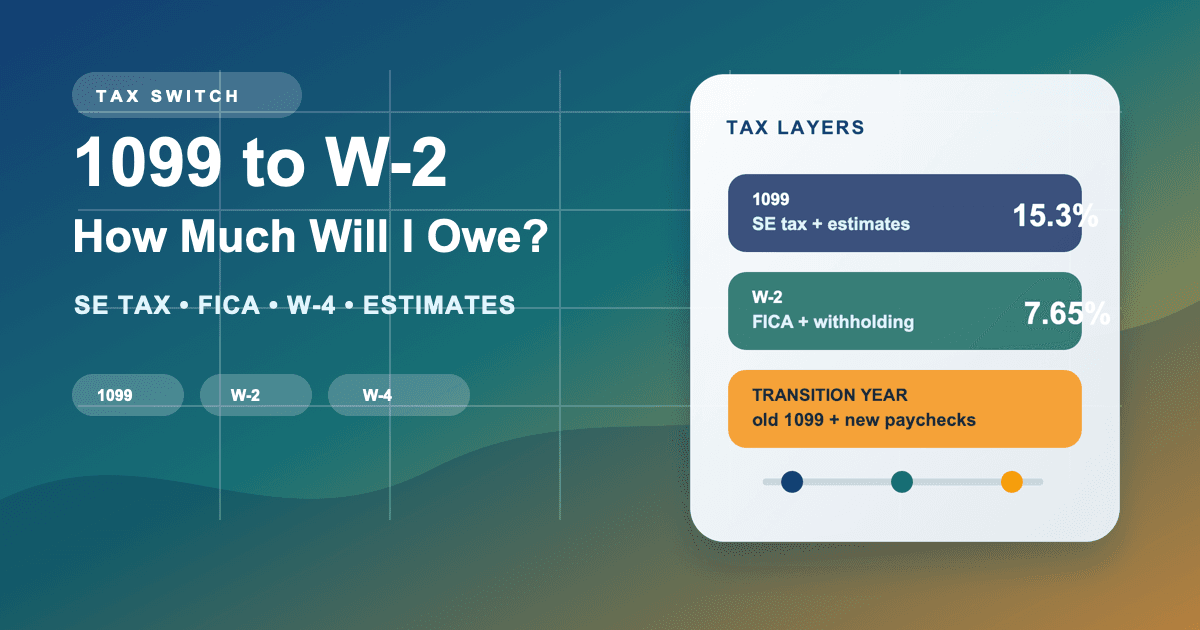
Switching from 1099 contractor income to W-2 wages usually reduces the payroll-tax burden because you stop paying both halves of Social Security and Medicare on that income. But it does not automatically mean your total tax bill falls. Your federal income tax still depends on total taxable income, deductions, credits, state taxes, and how much is withheld from your paycheck.
The clean way to estimate the switch is to compare annual after-tax cash, not just the headline rate. Look at self-employment tax, employee FICA, lost business deductions, benefits, retirement options, state tax, and transition-year estimated payments.
What Changes When You Move From 1099 to W-2
On 1099 income, you are usually treated as self-employed. You report business income and expenses, then pay income tax and self-employment tax on net profit. IRS guidance says self-employment tax generally applies when net earnings from self-employment are at least US$ 400, subject to exceptions and special rules.
On W-2 wages, the employer withholds federal income tax based on Form W-4 and payroll rules. The employer also withholds the employee share of Social Security and Medicare tax and pays the employer share separately. For 2026, IRS guidance lists the Social Security wage base as US$ 184,500. Medicare has no wage base limit.
| Tax issue | 1099 contractor | W-2 employee |
|---|---|---|
| Social Security and Medicare | You usually pay self-employment tax on 92.35% of net profit. | You usually pay the employee FICA share through paycheck withholding. |
| Federal income tax | You pay through estimated taxes, withholding from another job, or at filing. | Your employer withholds based on Form W-4 and payroll tables. |
| Business deductions | Ordinary and necessary business expenses can reduce Schedule C profit. | Many employee job expenses are not deductible federally under current rules, so reimbursements and benefits matter. |
| Benefits | You may deduct or handle health insurance and retirement differently if eligible. | Benefits may reduce taxable wages or change cash compensation. |
| Quarterly payments | Often needed if withholding does not cover the annual tax bill. | May be reduced or eliminated if W-4 withholding covers the annual liability. |
A Practical 1099-to-W-2 Tax Estimate Formula
The formula below is not a tax return. It is a planning workflow for answering the question, "How much will I owe if I switch?"
- Estimate final 1099 gross income earned before the switch.
- Subtract ordinary and necessary business expenses to estimate Schedule C net profit.
- Estimate self-employment tax on that net profit.
- Estimate W-2 wages after the switch and employee FICA withholding.
- Combine 1099 profit, W-2 wages, spouse income, investment income, deductions, and credits.
- Subtract federal withholding and estimated payments already made.
- Review state income tax, city tax, local business tax, and unemployment or disability withholding where relevant.
If the final number is positive, that is the likely amount still due before penalties and state items. If it is negative, you may be on track for a refund, but only if the inputs are complete.
Example: 100,000 on 1099 vs 80,000 on W-2
Suppose someone made US$ 100,000 as a contractor and had US$ 20,000 of business expenses. Their net contractor profit is US$ 80,000. Self-employment tax is not simply 15.3% of gross invoices. It generally applies to 92.35% of net earnings, before the Social Security wage base and Medicare rules are considered.
| Scenario | Gross amount | Expenses | Tax base | Payroll tax layer |
|---|---|---|---|---|
| 1099 contractor | US$ 100,000 | US$ 20,000 | US$ 80,000 net profit | Approx. US$ 11,304 SE tax before income-tax effects |
| W-2 employee | US$ 80,000 wages | Not deducted federally in most employee cases | US$ 80,000 wages | Approx. US$ 6,120 employee FICA before income-tax effects |
In this simplified example, the payroll-tax layer is lower on the W-2 side: about US$ 6,120 of employee FICA on US$ 80,000 of wages versus about US$ 11,304 of self-employment tax on US$ 80,000 of contractor profit. But the complete answer can change after income tax, the deduction for one-half of self-employment tax, possible QBI deduction, lost business deductions, benefits, retirement contributions, and state taxes.
Transition-Year Worksheet
A useful calculator setup should model the whole tax year, not just the new paycheck. Enter the contractor period, the W-2 period, prior estimated payments, current withholding, and any catch-up W-4 amount separately. That prevents the common mistake of assuming new payroll withholding automatically covers earlier 1099 profit.
| Input | Why it matters | Best tool check |
|---|---|---|
| 1099 profit before switch | Self-employment tax and income tax still apply to net contractor profit already earned. | Self-Employment Tax Calculator plus Federal Income Tax Calculator |
| W-2 wages after switch | Payroll withholding and employee FICA apply only to wages paid after the employment start. | Paycheck Calculator and FICA Tax Calculator |
| Estimated payments already made | Quarterly payments can reduce the amount still due after the W-2 job begins. | Tax Refund Calculator with year-to-date payment inputs |
| Extra W-4 withholding | Step 4(c) can catch up a transition-year gap when enough paychecks remain. | Paycheck Calculator and IRS Tax Withholding Estimator |
| Lost contractor deductions | A lower W-2 payroll-tax layer can be offset if business expenses or QBI disappear. | Federal Income Tax Calculator with both income paths modeled separately |
Business Deductions and QBI Can Change the Answer
A 1099 contractor can often deduct ordinary and necessary business expenses on Schedule C. Those expenses reduce net profit, which can reduce both income tax and self-employment tax. A W-2 employee may receive reimbursements or benefits, but unreimbursed employee expenses are often not deductible federally under current rules for many employees.
Contractors may also need to consider the qualified business income deduction if eligible. It is not automatic for every taxpayer, every business, or every income level, but when it applies it can reduce taxable income. That is why a W-2 job with the same cash amount as 1099 profit is not always a simple win or loss.
W-4 Withholding Is the Transition Control Panel
The W-2 switch gives you a new tool: paycheck withholding. The IRS Tax Withholding Estimator can help you update Form W-4 after a new job, major income change, marriage, divorce, child birth, home purchase, or other change. For a 1099-to-W-2 transition, the key is entering earlier self-employment income and payments already made.
If you started W-2 work mid-year, default payroll withholding may only look at the W-2 paycheck. It may not automatically cover tax from contractor income earned earlier. You may need extra withholding on Form W-4 Step 4(c), an estimated tax payment, or both.
Do You Still Need Estimated Taxes After Switching?
Maybe. IRS estimated-tax guidance generally looks at whether you expect to owe at least US$ 1,000 after withholding and refundable credits and whether withholding and credits meet safe-harbor thresholds. A W-2 job can reduce the need for estimated payments, but it does not erase tax on self-employment income already earned.
The practical move is to total your year-to-date estimated payments, expected W-2 withholding, and expected annual tax. If withholding will cover the tax, estimated payments may no longer be needed. If not, make a catch-up estimated payment or add extra W-4 withholding before year-end.
Classification Still Matters
Switching to W-2 should reflect the real working relationship. IRS worker classification guidance looks at behavioral control, financial control, and the relationship of the parties. A business cannot simply label the same worker 1099 or W-2 without considering the underlying facts.
If you believe you were misclassified before the switch, the tax answer may be different. Misclassification can affect employment taxes, benefits, unemployment coverage, and Forms W-2, 1099, or 8919. That is a classification issue, not just a calculator issue.
State Taxes Can Move in Either Direction
Federal payroll tax often gets the most attention, but state and local rules can change the result. As a 1099 contractor, you may have had state estimated payments, city business taxes, gross receipts taxes, sales tax exposure, or local license costs. As a W-2 employee, you may have state withholding, local wage tax, disability insurance, paid leave withholding, or unemployment-related payroll items.
Do the state calculation separately. A federal win can be partly offset by state tax, local tax, commuting cost, benefit value, or the loss of deductible business expenses.
Official IRS Videos
I looked for official IRS video material relevant to switching from 1099 to W-2. The best fits are the IRS estimated-tax video, because transition-year 1099 income may still need payment coverage, and the IRS sharing economy video, because it explains tax obligations for gig and contractor income.
IRS: Estimated Tax Payments
Official IRS video on quarterly estimated tax payments for income not fully covered by withholding.
IRS: Your Taxes in the Sharing Economy
Official IRS video on gig and sharing economy tax obligations, including taxable income and whether work is employee or contractor activity.
1099-to-W-2 Switch Checklist
- Estimate final 1099 gross income and expenses through the switch date.
- Set aside self-employment tax for contractor profit already earned.
- Collect 1099-NEC, 1099-K, platform records, invoices, and bank records.
- Complete Form W-4 using your full-year income picture, not just new wages.
- Compare estimated payments plus W-2 withholding against annual tax.
- Review health insurance, retirement contributions, reimbursements, and benefits.
- Check state and local tax rules separately.
1099 to W-2 Tax FAQ System
The core answer is that W-2 status shifts part of Social Security and Medicare tax to the employer and adds paycheck withholding, but it can also remove contractor deductions and change benefits. The right estimate compares the whole year: contractor profit before the switch, W-2 wages after the switch, withholding, estimated payments, deductions, credits, and state tax.
Trust and Update Notes
This guide was refreshed using official IRS sources available on June 24, 2026. Payroll tax wage bases, withholding rules, deductions, credits, state taxes, and worker classification facts can change. Use this guide for planning and verify your exact filing position with current IRS forms, state guidance, payroll records, and a qualified tax professional when the transition year is material.
Frequently Asked Questions
Related Calculators
Self-Employment Tax Calculator
Estimate the Social Security and Medicare tax side of 1099 contractor profit.
Use Self-Employment Tax CalculatorPaycheck Calculator
Estimate W-2 paycheck withholding and employee FICA after the switch.
Use Paycheck CalculatorFICA Tax Calculator
Compare employee FICA and self-employment tax assumptions side by side.
Use FICA Tax CalculatorFederal Income Tax Calculator
Estimate federal income tax after wages, contractor profit, deductions, and credits.
Use Federal Income Tax CalculatorTax Refund Calculator
Compare annual tax liability against W-2 withholding and estimated payments.
Use Tax Refund CalculatorSources & References
- 1.IRS - Topic No. 554, Self-Employment Tax(Accessed June 2026)
- 2.IRS - Topic No. 751, Social Security and Medicare Withholding Rates(Accessed June 2026)
- 3.IRS - Self-Employed Individuals Tax Center(Accessed June 2026)
- 4.IRS - Worker Classification 101: Employee or Independent Contractor(Accessed June 2026)
- 5.IRS - Gig Economy Tax Center(Accessed June 2026)
- 6.IRS - Tax Withholding Estimator(Accessed June 2026)
- 7.IRS - Estimated Tax FAQ for Individuals(Accessed June 2026)
- 8.IRS - About Form W-4(Accessed June 2026)