
IRS Tax Deadlines 2026: Filing Dates, Extensions, Estimated Taxes, and Entity Deadlines
A practical 2026 IRS tax deadline guide with federal filing dates, quarterly estimated tax dates, extension rules, state-deadline checks, entity-specific checklists, calculators, official IRS videos, and penalty warnings.
Guide Oversight & Review Policy
CalculatorWallah guides are written to explain calculator assumptions, source limitations, and when users should move from a rough estimate to an official rule, institution policy, or clinician conversation.
Reviewed by Jitendra Kumar, Founder & Editorial Standards Lead. Page updated May 7, 2026. Trust-critical pages are reviewed when official rates or rules change. Evergreen calculator guides are checked on a recurring quarterly or annual cycle depending on topic volatility. Topic ownership: Sales tax and tax-sensitive estimate tools, Education and GPA planning calculators, Health, protein, and screening-formula pages, Platform-wide publishing standards and methodology.
Tax credentialed review: Named internal reviewer: Iliyas Khan, Chief Operating Officer. External credentialed professional review is still required before this page is treated as professional advice.
Internal tax and sales-tax methodology reviewer. Review scope: calculator assumptions, labels, source context, workflow clarity, and compliance-sensitive disclaimers.
Relevant review context: CalculatorWallah tax and sales-tax calculator workflow owner; Source-first review of IRS, state revenue, rate, and filing-sensitive references; Compliance-sensitive labels, assumptions, and user-facing disclaimer review.
Required professional credentials: CPA, Enrolled Agent, licensed tax professional. Scope: tax formulas, jurisdiction assumptions, withholding language, filing-sensitive examples, and compliance caveats.
This page is educational planning support. A named CPA, EA, or licensed tax professional should review the page before it is positioned as tax advice or used for filing decisions.
Source expectation: Review should cite current IRS, state revenue department, payroll-tax, or official tax authority sources where applicable.
On This Page
IRS Tax Deadlines 2026: Deadline Summary
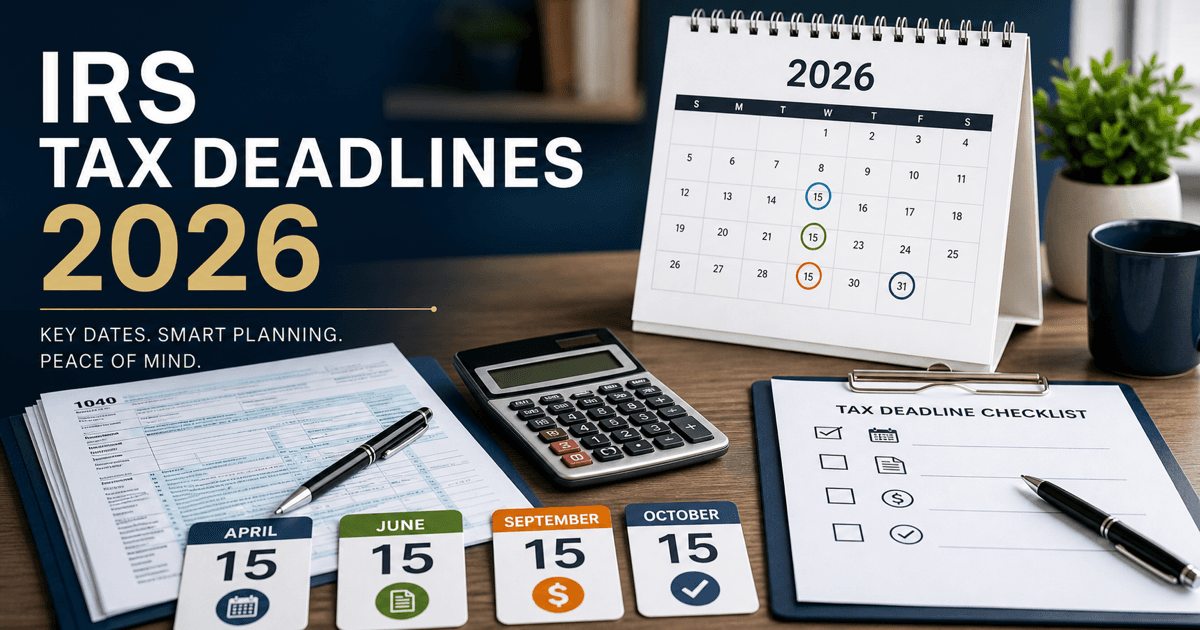
For most calendar-year individual taxpayers, the main federal deadline for the 2025 tax year was April 15, 2026. That date covered filing the federal return, paying the estimated balance due, and requesting an extension when the return was not ready. A valid extension generally moves the filing deadline to October 15, 2026, but it does not move the April payment deadline.
This guide is updated as of May 7, 2026. That means the original April deadline has already passed. If you did not file or extend by April 15, the practical priority is to file now, pay what you can, and reduce penalty exposure. If you did extend, use the remaining time to finish the return, gather missing forms, and avoid waiting until the October deadline.
Countdown Timer
The tracked 2026 IRS deadline sequence is complete.
Filing Status Alert
Filed and paid
Keep confirmations, payment records, and refund tracking details. Use the IRS refund tool only after the return has been accepted or processed.
Filing Status Alert
Extended but not filed
The extension protects filing time, not payment time. Finish the return before October 15 and review whether unpaid tax has generated penalties or interest.
Filing Status Alert
Missed the deadline
File as soon as possible. The failure-to-file penalty can be more damaging than waiting because you cannot pay the full balance.
CTA Buttons
Start with estimates, then verify with IRS forms, tax software, or a qualified tax professional before filing.
Important 2026 IRS Dates Table
The tables below separate federal dates, state-date checks, quarterly estimated payments, and extension dates. The dates assume calendar-year taxpayers unless noted. Fiscal-year businesses, disaster-relief taxpayers, and taxpayers with state or local obligations should verify their own due dates.
Federal Dates
| Date | Deadline | Applies To | Action |
|---|---|---|---|
| January 15, 2026 | 2025 Q4 estimated tax payment | Self-employed taxpayers, investors, and others using estimated payments | Pay the final 2025 estimated tax installment if required. |
| March 16, 2026 | Partnership and S corporation returns | Calendar-year Form 1065 and Form 1120-S filers | File the entity return or request an extension. March 15 fell on a Sunday in 2026. |
| April 15, 2026 | Individual federal returns and tax payments | Most Form 1040, Form 1040-SR, and many Form 1040-NR taxpayers | File the return, pay tax due, or request an extension by this date. |
| April 15, 2026 | Calendar-year C corporation deadline | Many calendar-year Form 1120 filers | File or extend the return and confirm payment obligations. |
| June 15, 2026 | Certain nonresident and abroad-filer deadlines | Some Form 1040-NR filers and taxpayers outside the United States | Confirm whether the June filing rule applies before relying on it. |
| September 15, 2026 | Extended partnership and S corporation deadline | Calendar-year partnerships and S corporations with valid extensions | File the completed entity return and issue owner/shareholder information as needed. |
| October 15, 2026 | Extended individual and many C corporation returns | Taxpayers with a valid extension | File the completed federal return. This is not an extension to pay tax due. |
State Dates
| Date | Deadline | Applies To | Action |
|---|---|---|---|
| State-specific | State individual income tax returns | Residents, part-year residents, and nonresidents with state filing duties | Check the state revenue agency. Do not assume the IRS deadline controls the state return. |
| State-specific | State estimated tax payments | Self-employed taxpayers and taxpayers with nonwage income | Confirm state quarterly dates and safe-harbor rules separately from federal dates. |
| State-specific | State extensions and disaster postponements | Taxpayers in states with different extension, payment, or relief rules | Verify whether filing and payment are both extended. Many states separate the two. |
| Local-specific | Local payroll, city income, franchise, and business taxes | Businesses and taxpayers in local tax jurisdictions | Check city, county, payroll, franchise, and local business filings before year-end close. |
Quarterly Payments
| Date | Deadline | Applies To | Action |
|---|---|---|---|
| April 15, 2026 | 2026 Q1 estimated tax payment | Income received January 1 through March 31, 2026 | Pay Q1 estimated federal tax if withholding will not cover the liability. |
| June 15, 2026 | 2026 Q2 estimated tax payment | Income received April 1 through May 31, 2026 | Update the estimate if income, deductions, or withholding changed after Q1. |
| September 15, 2026 | 2026 Q3 estimated tax payment | Income received June 1 through August 31, 2026 | Reconcile year-to-date income and avoid underpayment pressure before Q4. |
| January 15, 2027 | 2026 Q4 estimated tax payment | Income received September 1 through December 31, 2026 | Pay the final 2026 installment unless filing and payment timing eliminates the need. |
Extension Dates
| Date | Deadline | Applies To | Action |
|---|---|---|---|
| March 16, 2026 | Partnership and S corporation extension request | Calendar-year Form 1065 and Form 1120-S filers | Request an entity extension if the return was not ready. |
| April 15, 2026 | Individual extension request | Most Form 1040 and Form 1040-SR taxpayers | Request the extension and pay the estimated balance due. |
| September 15, 2026 | Extended partnership and S corporation returns | Calendar-year entities with a valid extension | File the completed entity return by the extended date. |
| October 15, 2026 | Extended individual returns | Individuals with a valid extension | File the completed return. Late payment penalties can still apply to unpaid April tax. |
Calculator Tools
Calculator tools do not replace tax filing software or IRS instructions, but they are useful before a deadline because they expose the biggest moving parts: taxable income, withholding, credits, self-employment tax, and refund or balance-due direction.
Related Calculator
Use the Federal Income Tax Calculator to create a rough federal liability estimate before deciding how much to pay with a late return or extension.
Refund and Withholding Review
Pair the Tax Refund Calculator with the Paycheck Calculator to compare refund direction with wage withholding assumptions.
Freelance and Contractor Planning
Use the Self-Employment Tax Calculator when Schedule C income, 1099 income, or quarterly payments drive the filing plan.
Payroll Tax Context
The FICA Tax Calculator helps employees and employers separate income tax withholding from Social Security and Medicare tax assumptions.
Action Checklist
Deadline work should be operational. Do not start with a vague goal like "do taxes." Start with documents, return status, payment status, entity obligations, and the next IRS date that affects the taxpayer.
Documents Needed
- W-2s, 1099s, K-1s, SSA-1099, brokerage forms, and bank interest forms.
- Business revenue, expense, mileage, home office, inventory, and asset records.
- Estimated tax payment confirmations and prior-year overpayment credits.
- Mortgage interest, property tax, charitable giving, medical, tuition, and credit records.
- IRS notices, identity-protection PINs, extension confirmations, and refund notices.
Filing Steps
- Confirm whether the taxpayer filed, extended, or missed the April 15 deadline.
- Estimate total federal liability and compare it with withholding and payments.
- File electronically when possible and choose direct deposit for refunds.
- Pay any balance as soon as practical, even if the full amount is not available.
- Save filing acknowledgments, payment confirmations, and extension records.
Mistakes to Avoid
- Assuming an extension delays payment. It usually delays filing, not payment.
- Ignoring state, city, payroll, franchise, or sales tax deadlines.
- Waiting for one missing form when the return can be extended or estimated.
- Forgetting estimated payments after a one-time income event.
- Using a refund estimate as if it were a completed filing position.
Business Checklist
- Confirm entity classification: sole proprietor, partnership, S corp, C corp, or disregarded entity.
- Check payroll deposits, Forms 941, Forms 940, W-2s, 1099s, and state payroll filings.
- Reconcile books before the entity return and owner/shareholder information forms.
- Verify whether state annual reports, franchise taxes, or gross receipts taxes apply.
- Document reasonable compensation and owner distributions for S corporations.
Regional and Entity Sections
Tax deadlines change by taxpayer type. A useful 2026 calendar should not mix employees, freelancers, LLCs, corporations, and nonresidents into one generic "tax day" rule.
Individuals
Most individual taxpayers had an April 15, 2026 filing and payment deadline for the 2025 federal return. Taxpayers with a valid extension should use October 15, 2026 as the federal filing deadline, while remembering that late payment costs can still run from April.
Freelancers
Freelancers usually face both annual filing and quarterly estimated tax planning. The deadline risk is not just April 15. June 15 and September 15 matter if 2026 income is already running ahead of withholding or prior estimates.
LLCs
LLC deadlines depend on tax classification. A single-member LLC commonly rides on the owner return. A multi-member LLC taxed as a partnership usually follows the Form 1065 calendar. An LLC electing S corporation or C corporation treatment follows the elected entity calendar.
Corporations
Calendar-year S corporations generally had a March 16, 2026 deadline because March 15 was a Sunday. Calendar-year C corporations commonly had an April 15, 2026 deadline. Extended calendar-year S corporation returns generally point to September 15, while many extended calendar-year C corporation returns point to October 15.
Non-residents
Nonresident deadlines can split by income type. A Form 1040-NR taxpayer with wages subject to U.S. income tax withholding generally had an April 15, 2026 deadline. A Form 1040-NR taxpayer without wages as an employee subject to withholding may have a June 15, 2026 deadline. Treaty positions, dual-status years, and state filings should get professional review.
State and Regional Checks
State deadlines can look similar to the federal calendar but still differ on extensions, payment due dates, estimated payments, disaster relief, local taxes, and entity-level filings. Use the IRS state-agency directory to reach the official revenue department, then verify the specific state page.
Official IRS Videos
These embedded videos are from the official IRS YouTube channel. They are relevant because deadline decisions often turn on payment options, filing even when a balance cannot be paid, and not losing a refund by waiting too long.
IRS: Options for Paying Your Federal Taxes
Official IRS overview of federal tax payment options, useful for taxpayers who owe by a deadline.
IRS: Owe Taxes but Can't Pay?
Official IRS context for why filing still matters even when a taxpayer cannot immediately pay the balance.
IRS: Refund - Claim it or Lose It
Official IRS reminder that refund claims and filing windows can expire if taxpayers wait too long.
FAQ System
The FAQ schema for this article is organized around four groups: deadline questions, penalty questions, extension questions, and refund questions. The visible FAQ block below the article uses the same answers that are emitted in structured data.
Schema, Trust, and Updates
This article is built as a tax guide, not individualized tax advice. The page uses article metadata, FAQ structured data, breadcrumb structured data, and VideoObject structured data for the official IRS videos embedded above. CalculatorWallah also displays source citations and the page update date so deadline-sensitive facts can be rechecked.
Trust caveat: tax deadlines can shift because of weekends, holidays, disaster relief, state law, taxpayer residence, entity classification, fiscal years, military service, foreign-address rules, and IRS announcements. Before filing or paying, verify the date with the IRS, the state revenue agency, tax software, or a qualified tax professional.
Update policy: this article should be reviewed whenever the IRS releases a new filing season announcement, updates Publication 509, changes extension guidance, publishes disaster relief, or updates penalty/refund procedures.
Frequently Asked Questions
Related Calculators
Federal Income Tax Calculator
Estimate 2025 federal income tax before filing or extension review.
Use Federal Income Tax CalculatorTax Refund Calculator
Estimate whether withholding and credits point toward a refund or balance due.
Use Tax Refund CalculatorFICA Tax Calculator
Review Social Security and Medicare tax withholding in a payroll context.
Use FICA Tax CalculatorSelf-Employment Tax Calculator
Plan self-employment tax and quarterly estimated tax pressure.
Use Self-Employment Tax CalculatorPaycheck Calculator
Check withholding, take-home pay, and payroll deduction assumptions.
Use Paycheck CalculatorSources & References
- 1.IRS - Publication 509, Tax Calendars(Accessed May 2026)
- 2.IRS - Extension of Time To File Your Tax Return(Accessed May 2026)
- 3.IRS - Estimated Taxes(Accessed May 2026)
- 4.IRS - Tax Withholding Estimator(Accessed May 2026)
- 5.IRS - Failure to File Penalty(Accessed May 2026)
- 6.IRS - Failure to Pay Penalty(Accessed May 2026)
- 7.IRS - Refunds(Accessed May 2026)
- 8.IRS - Instructions for Form 1040-NR(Accessed May 2026)
- 9.IRS - State Government Websites(Accessed May 2026)