
UN Salary Scale 2026 Pay Tables
Official-source guide to the 2026 UN salary scale, P-1 to D-2 pay tables, post adjustment, General Service limits, and calculator workflow.
Guide Oversight & Review Policy
CalculatorWallah guides are written to explain calculator assumptions, source limitations, and when users should move from a rough estimate to an official rule, institution policy, or clinician conversation.
Jitendra Kumar, Founder & Editorial Standards Lead. Updated June 24, 2026. Scope: Sales tax and tax-sensitive estimate tools, Education and GPA planning calculators, Health, protein, and screening-formula pages, Platform-wide publishing standards and methodology.
Finance credentialed review: Named internal reviewer: Laxman Kumawat, Finance & Engineering Calculator Owner. External credentialed professional review is still required before this page is treated as professional advice.
Internal finance formula and engineering methodology reviewer. Review scope: calculator formulas, input labels, rate assumptions, scenario workflows, and user-facing limitations.
Credentials on file: Electrical and power-system related certifications.
Relevant review context: Professional background across engineering, sustainability, and energy-efficiency work; CalculatorWallah finance and engineering calculator owner.
Required professional credentials: CFP professional, CFA charterholder, CPA, licensed financial professional. Scope: assumptions, amortization logic, risk language, offer-comparison language, affordability guidance, and disclosure placement.
This page provides educational estimates, not individualized financial advice, lending advice, investment advice, or a product recommendation.
Professional Review Status
This YMYL page has internal methodology review, but no external credentialed professional review is recorded yet.
- Reliance status
- Credentialed finance review required before advice-like claims
- Required credentials
- CFP professional, CFA charterholder, CPA, licensed financial professional
- Review scope
- assumptions, amortization logic, risk language, offer-comparison language, affordability guidance, and disclosure placement
Current reviewer: Laxman Kumawat, Internal finance formula and engineering methodology reviewer (Electrical and power-system related certifications).
This page provides educational estimates, not individualized financial advice, lending advice, investment advice, or a product recommendation.
On This Page
UN Salary Scale 2026 Summary
Quick answer: how the 2026 UN salary scale works
The 2026 UN salary scale for internationally recruited Professional and Director staff starts with the official ICSC base scale effective January 1, 2026. In that scale, P-1 entry net base salary is US$ 43,834 and D-2 top net base salary is US$ 153,845 before duty-station post adjustment. General Service and local roles use local scales, so the P/D table is not a final take-home-pay promise.
The UN salary scale is not one single number. For internationally recruited Professional and higher category staff, compensation starts with the ICSC base salary scale, then adds a duty-station post adjustment. For General Service and other locally recruited categories, salary is normally set by local salary scales rather than the P and D international scale.
As of the June 24, 2026 source review, the current ICSC Professional and higher category salary scale is effective January 1, 2026. The table below summarizes the entry and top values for P-1 through D-2 from the official ICSC scale. Use it as a map of the system, not as a final payroll promise.
What does the advertised grade mean?
Use the professional salary scale for P and D roles. The grade and step define the base net salary before duty-station post adjustment.
Why does the same grade pay differently in two countries?
Professional staff receive a post adjustment that changes by duty station and month. Local General Service roles use separate local salary scales.
Is the salary taxable?
UN salary uses a staff assessment system inside the UN common system. Personal tax treatment can still depend on nationality, residence, and local rules, so staff should verify their own situation.
Can a calculator replace the official offer?
No. It can estimate structure and compare scenarios, but the appointment letter, staff rules, duty station, dependency status, and official payroll office control the final number.
| Exact query | Best answer | Next step | GSC signal |
|---|---|---|---|
| un salary scale 2026 | Use the ICSC Professional and higher categories scale effective January 1, 2026 for P-1 through D-2 base salary. | Read the P and D table, then add duty-station post adjustment. | 202 impressions, 5 clicks |
| undp salary calculator | Use calculator logic only after confirming whether the role is local, international, NPSA, IPSA, P, D, NO, or GS. | Open the UN Salary Calculator or the UNDP salary guide. | 138 impressions, 0 clicks |
| salary calculator undp | UNDP estimates depend on contract modality, duty station, grade, step, dependency status, insurance, and pension. | Compare the UNDP guide with the salary calculator workflow. | 120 impressions, 0 clicks |
| un salary scale excel | Start with the official ICSC data file or salary-scale page instead of copying an old spreadsheet. | Verify the source date before using any downloaded table. | low-CTR support query |
| un under-secretary-general salary scale 2025 or 2026 | Use the current ICSC 2026 scale for 2026 planning; older 2025 references should not control a current estimate. | Check the official scale and appointment context. | low-CTR support query |
| Salary question | Official source to use | Why it controls |
|---|---|---|
| P and D base salary table | ICSC Professional and higher categories salary scale, effective January 1, 2026; source rechecked June 24, 2026 | Controls the base gross and net salary figures by grade and step before duty-station post adjustment. |
| Post adjustment | ICSC post adjustment data; source rechecked June 24, 2026 | Controls the duty-station multiplier used to estimate international Professional net remuneration. |
| General Service and local categories | ICSC salary scales and UN local salary survey references; source rechecked June 24, 2026 | Controls why local staff should not use the P/D international scale as a final salary answer. |
| Benefits and job classification | UN Careers and UN policy portal | Controls benefits, allowances, staff category context, and the limits of calculator estimates. |
| Offer-level final answer | Appointment letter and hiring organization HR/payroll office | Controls the actual grade, step, duty station, dependency status, contract type, and payroll implementation. |
2026 Professional and Director Salary Scale
Professional grades generally run from P-1 to P-5. Director grades are D-1 and D-2. Each grade has steps. A new appointment may start at a specific step based on the rules, experience, and the appointment decision. Movement within a grade is normally handled through step increments, while promotion changes the grade.
The ICSC 2026 scale lists gross and net base salary. The net base salary is especially important for post adjustment because post adjustment is applied to net base salary.
| Grade | Entry net base | Top net base | Entry gross | Top gross | Steps |
|---|---|---|---|---|---|
| P-1 | US$ 43,834 | US$ 59,617 | US$ 53,071 | US$ 73,838 | 13 |
| P-2 | US$ 56,046 | US$ 74,640 | US$ 69,139 | US$ 93,605 | 12 |
| P-3 | US$ 71,335 | US$ 92,127 | US$ 89,257 | US$ 118,039 | 12 |
| P-4 | US$ 86,027 | US$ 108,485 | US$ 109,324 | US$ 141,407 | 12 |
| P-5 | US$ 103,165 | US$ 126,441 | US$ 133,807 | US$ 168,092 | 12 |
| D-1 | US$ 117,953 | US$ 145,310 | US$ 155,101 | US$ 196,272 | 11 |
| D-2 | US$ 130,477 | US$ 153,845 | US$ 174,088 | US$ 209,737 | 10 |
Source: ICSC Professional and higher categories salary scales, effective January 1, 2026. Figures are annual and shown in U.S. dollars before duty-station post adjustment.
Gross Salary, Net Salary, and Staff Assessment
UN salary pages can be confusing because the scale shows both gross and net amounts. In the UN common system, staff assessment is an internal assessment that explains why the official scale distinguishes gross salary from net salary. For most planning questions, the net base salary is the number you use before adding post adjustment.
This does not mean every person has the same personal tax situation. Nationality, residence, visa status, host-country agreements, and local rules can matter. If the question is personal tax filing, use official payroll guidance and qualified advice rather than assuming the UN scale answers every tax question.
Post Adjustment Is the Biggest Duty-Station Variable
Post adjustment is the part of UN Professional compensation that changes by duty station. It is designed to help equalize purchasing power for internationally recruited staff across locations with different prices, exchange rates, and living conditions.
A practical estimate follows this structure: start with net base salary, multiply it by the current post adjustment multiplier for the duty station, divide by 100, then add that amount to the net base salary. The official ICSC post adjustment schedule controls the multiplier and can change over time, so a 2026 estimate should use the current duty-station data, not an old blog post or a copied spreadsheet.
Example: if a staff member has a net base salary of US$ 80,000 and the duty-station multiplier is 60, the post adjustment amount is US$ 48,000. Estimated net remuneration before other assignment items would be US$ 128,000. The formula is simple; the official multiplier and staff context are what make the real case specific.
General Service and Local Staff Use Local Scales
A common mistake is using a P-grade salary table for every UN job. General Service, National Professional Officer, and related local categories do not use the same international Professional scale in the same way. Local categories are normally linked to local salary survey methodology and local salary scales for the duty station.
That is why a G-5 job in one country should not be compared directly to a P-3 job in another country just by looking at grade labels. The category, local scale, contract type, duty station, dependency context, and benefits package all matter.
Benefits and Allowances Can Change the Real Package
Salary is only one part of a UN compensation package. Depending on category and assignment, staff may need to understand rental subsidy, dependency allowances, education grant, mobility or hardship elements, pension participation, health insurance, relocation travel, home leave, and separation payments.
These items are rule-based and can be conditional. A calculator can help compare scenarios, but it should not treat every benefit as automatic. Read the vacancy notice, appointment letter, staff rules, and official HR guidance before making a budget decision.
Steps, Increments, and Promotion Are Different
A step is a position inside a grade. A staff member may move from one step to the next under the applicable increment rules. A promotion is different because it changes the grade itself, such as from P-3 to P-4. A lateral move may keep the grade but change the duty station and therefore the post adjustment.
This distinction matters when forecasting pay. A step increment might change base salary modestly. A duty station move can change post adjustment materially. A promotion changes the grade band and may reset how future steps are viewed.
How to Use a UN Salary Calculator
Start with the UN Salary Calculator when you know the grade, step, duty station, and family/dependency assumptions. Use the output as a structured estimate, then compare it against the vacancy notice and official HR documents.
- Confirm whether the role is Professional, Director, General Service, or another category.
- Use the official 2026 ICSC base salary scale for P and D roles.
- Use the current ICSC post adjustment data for the duty station and month.
- Separate base salary, post adjustment, allowances, deductions, and pension assumptions.
- Do not use a country tax calculator as a substitute for UN staff assessment rules.
Official Video Search
I re-checked on June 24, 2026 for an official or institutional video from the UN, ICSC, UN Careers, or a recognized UN HR source that directly explains the 2026 salary scale, post adjustment system, and local-scale limits. I did not find a suitable official video to embed. Rather than place an unrelated creator video on a compensation guide, this article relies on the official written ICSC, UN Careers, and UN policy sources listed below.
Common Mistakes When Reading UN Salary Pages
- Using the P and D scale for a General Service vacancy.
- Forgetting that post adjustment changes by duty station and period.
- Comparing gross salary to net remuneration as if they were the same number.
- Assuming every allowance applies to every staff member.
- Using an old post adjustment multiplier for a current 2026 estimate.
- Ignoring currency conversion and local cost-of-living assumptions when budgeting.
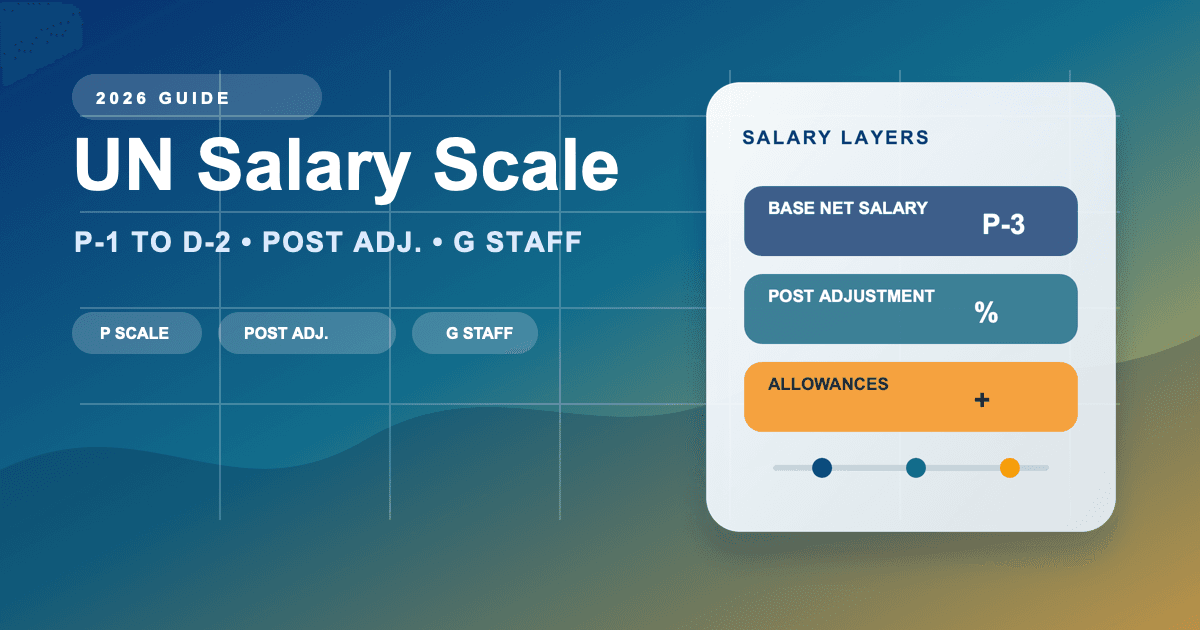
The safest approach is to treat the official scale as the base layer, the ICSC post adjustment schedule as the location layer, and the appointment package as the controlling document for the actual case.
UN Salary Scale FAQ
The FAQ below answers the salary-scale questions that usually come after the tables: whether gross and net pay are the same, why post adjustment changes by duty station, how steps affect progression, and why General Service salaries cannot be read from the P and D professional scale.
Use those answers with the official ICSC scale and the calculator workflow above. A current offer should still be checked against the appointment letter and the HR office for the hiring organization.
Trust and Update Notes
This guide was prepared using official ICSC and United Nations sources and materially updated on June 24, 2026 with search-intent, official-source comparison, and methodology notes. Salary scales, post adjustment schedules, allowances, and staff rules can change. For a live offer, verify the grade, step, duty station, dependency status, contract type, and payroll treatment with the official UN organization or HR office handling the appointment.
Methodology: the article starts with the official ICSC 2026 Professional and higher category scale, separates post adjustment from base salary, and treats General Service, National Officer, and local categories as local-scale questions rather than forcing them into the P/D table. Reviewer context follows CalculatorWallah finance-source standards owned by Laxman Kumawat and editorial source standards owned by Jitendra Kumar.
Frequently Asked Questions
Related Calculators
UN Salary Calculator
Estimate UN base salary, post adjustment, grade, step, dependency context, and duty-station scenarios.
Use UN Salary CalculatorSalary Calculator
Convert annual, monthly, weekly, and hourly salary figures when comparing offers or budgets.
Use Salary CalculatorNet Salary Calculator
Estimate monthly or annual take-home salary after tax and deduction assumptions outside the UN system.
Use Net Salary CalculatorCurrency Converter
Convert salary and cost-of-living assumptions when comparing UN duty stations across currencies.
Use Currency ConverterSources & References
- 1.ICSC - Salary Scales(Accessed June 2026)
- 2.ICSC - Professional and higher categories salary scales, effective 1 January 2026(Accessed June 2026)
- 3.ICSC - Post Adjustment(Accessed June 2026)
- 4.ICSC - Post Adjustment Data(Accessed June 2026)
- 5.United Nations - Salaries, Allowances, Benefits and Job Classification(Accessed June 2026)
- 6.UN Careers - Salary, Benefits and Job Classification(Accessed June 2026)