
0-60 Calculator
Estimate 0-60 mph and 0-100 km/h acceleration from power, test weight, drivetrain, tires, road condition, launch control, elevation, timing mode, and a quarter-mile sanity check.
Last Updated: June 2026
Use rated peak power when wheel horsepower is unknown.
Use the empty vehicle weight with fluids.
Driver, passenger, cargo, and fuel allowance.
Use 60 for classic 0-60 or 62.1 for 0-100 km/h.
Used for combustion-engine power loss.
Rollout mimics many instrumented performance tests.
Estimated 0-60 mph
5.4 s
Likely real-world range
4.89-6.22 s
0-100 km/h estimate
5.79 s
Average acceleration
0.51 g
Power-to-weight
85.4 hp/1000 lb
Quarter-mile cross-check
13.23s @ 103.1 mph
Estimate Breakdown
Assumptions
| Metric | Value |
|---|---|
| Total test weight | 4,150 lb |
| Adjusted engine power | 355 hp |
| Estimated wheel power | 305 hp |
| Pounds per horsepower | 11.7 lb/hp |
| Estimated distance by target speed | 237 ft |
| Main limit | Power delivery |
Model Inputs Used
| Assumption | Value | Why it matters |
|---|---|---|
| Total test weight | 4150 lb | Curb weight plus payload. |
| Adjusted engine power | 355 hp | Power after the elevation adjustment. |
| Estimated wheel power | 305 hp | Power after drivetrain efficiency. |
| Usable traction coefficient | 0.93 g | Combined tire, road, drivetrain, vehicle, and launch estimate. |
| Main limit | Power delivery | The larger time floor controls the estimate. |
Acceleration Estimate Safety Notice
This 0-60 calculator is an educational estimator, not a vehicle test certification or safety instruction. Do not test acceleration on public roads. Real results depend on the driver, tire condition, tire temperature, surface, weather, vehicle calibration, state of charge or fuel quality, gearing, and measurement equipment.
Checked by Jitendra Kumar
0-60 Calculator is checked for formula labels, source links, and result limits.
Jitendra Kumar, Founder & Editorial Standards Lead. Updated June 2026. Scope: automotive calculators.
How to Use the 0-60 Calculator
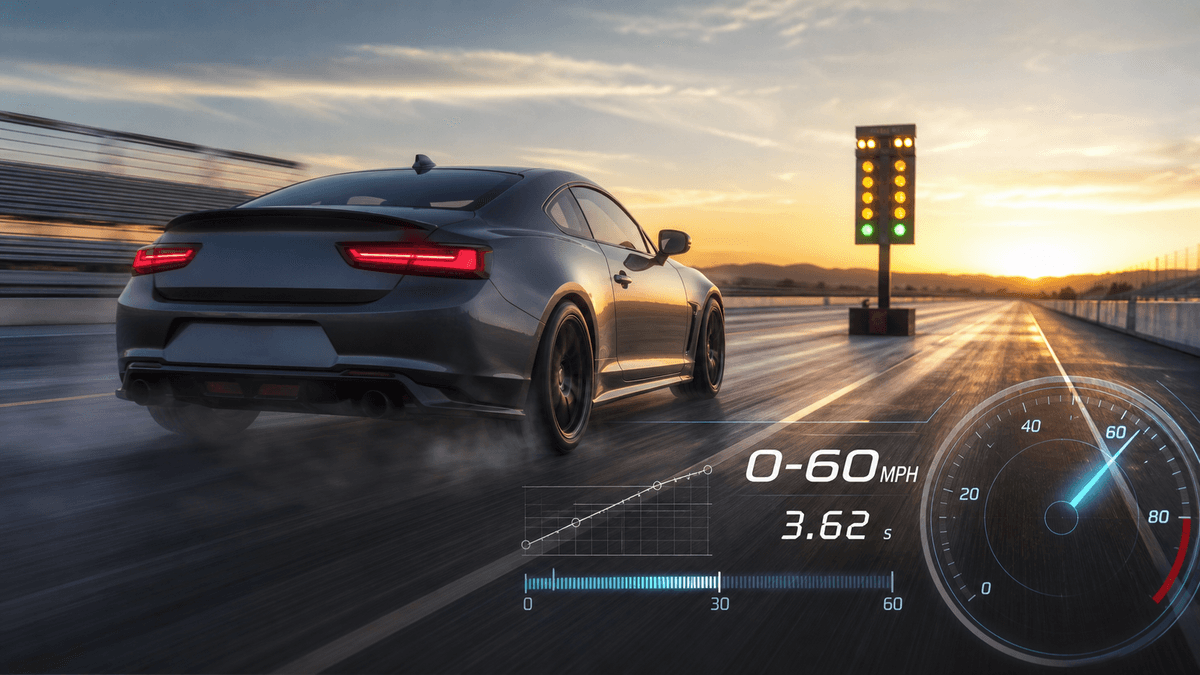
Enter the vehicle's peak power, curb weight, expected payload, drivetrain, tire type, road condition, and transmission. The calculator estimates the classic 0-60 mph time, the nearby 0-100 km/h time, a likely result range, power-to-weight, average acceleration, and a quarter-mile cross-check.
The most useful feature is the limiting-factor breakdown. If the traction floor is higher than the power floor, the first part of the launch is tire-limited. If the power floor is higher, reducing weight or adding power is more likely to move the estimate.
Step 1: Enter power and total test weight
Use rated horsepower or kilowatts, then add curb weight plus driver, passenger, cargo, and fuel allowance.
Step 2: Choose drivetrain, motor, and transmission
These inputs affect drivetrain loss, launch grip, shift time, and power delivery behavior.
Step 3: Select tire and surface conditions
Tire grip and road condition often control the launch, especially for powerful cars.
Step 4: Set timing mode and elevation
Use street-start timing for a conservative result or rollout for a magazine-style estimate. Elevation adjusts combustion-engine power.
Step 5: Read the estimate and the limiting factor
Use the range, power floor, traction floor, and quarter-mile cross-check before changing assumptions.
0-60 Formula and Model
A pure physics lower bound starts with kinetic energy. To reach 60 mph, the vehicle must add kinetic energy equal to 0.5 x mass x speed squared. Dividing that energy by available wheel power gives an ideal time floor, but real vehicles cannot deliver peak power continuously from rest.
This calculator therefore combines a power-limited estimate with a traction-limited launch floor. The final estimate uses the slower of those two floors, then adjusts for transmission shift time and optional one-foot rollout. That makes the tool more useful than a simple horsepower divided by weight shortcut.
| Model part | Formula or rule | Why it matters |
|---|---|---|
| Theoretical energy floor | Time floor = kinetic energy at target speed / wheel power | This is the physics lower bound before traction, gear shifts, drivetrain loss, and launch behavior. |
| Kinetic energy | KE = 0.5 x mass x speed^2 | A heavier vehicle or higher target speed needs much more energy before it reaches 60 mph. |
| Power-to-weight | hp per 1000 lb = adjusted horsepower / total test weight x 1000 | This makes a light 300 hp car different from a heavy 300 hp SUV. |
| Traction floor | Minimum time = target speed / usable tire acceleration | If tires cannot transmit more force, extra horsepower will not fully improve the launch. |
| Quarter-mile cross-check | ET roughly scales with (weight / power)^(1/3) | The calculator uses this only as a sanity check, not as a drag-strip prediction. |
How to Interpret 0-60 Results
Quick Answer: What Counts as a Good 0-60 Time?
For a normal daily vehicle, anything around 6-8 seconds feels reasonably quick. Around 4-6 seconds is performance-car territory, and under 4 seconds usually requires strong power-to-weight, traction, and launch control. The same number can mean different things depending on whether the test uses a true street start or one-foot rollout.
| Vehicle type | Typical 0-60 range | What usually limits it |
|---|---|---|
| Economy car | 9-12+ seconds | Usually power-limited, sometimes transmission-limited. |
| Mainstream sedan or crossover | 6.5-9 seconds | Typical daily-driver range with moderate power-to-weight. |
| Sport sedan or hot hatch | 4.5-6.5 seconds | Power, tire, and launch technique all start to matter. |
| High-performance AWD EV or sports car | 2.5-4 seconds | Often traction-limited at launch despite high power. |
| Race-prepped or drag-focused vehicle | Under 2.5 seconds | Needs dedicated tires, surface preparation, and safety controls. |
Worked Example
Suppose a rear-drive sport sedan has 360 hp, weighs 3,800 lb empty, carries 350 lb of driver/passenger/fuel payload, uses an automatic transmission, and launches on summer tires on dry pavement. The total test weight is 4,150 lb, so the calculator checks both the energy/power floor and the tire-grip floor before adding shift time.
| Input | Example value | How to read it |
|---|---|---|
| Power | 360 hp combustion engine | Elevation-adjusted before wheel-power estimate. |
| Weight | 3,800 lb curb + 350 lb payload | Total test weight is 4,150 lb. |
| Setup | RWD, automatic, summer tires, dry road | Good dry grip but not AWD launch traction. |
| Result interpretation | About mid-4 to mid-5 second range | Exact time depends on launch, gearing, temperature, and tire condition. |
How to Improve an Acceleration Estimate
The best change depends on the limiting factor. If the model says traction is the main limit, tires and launch setup can matter more than horsepower. If the model says power is the main limit, weight reduction and power gains are more likely to reduce the time.
| Change | When it helps | Common mistake |
|---|---|---|
| Add horsepower only | Helps most when the result is power-limited. | May do little for the first 60 mph if traction is already the bottleneck. |
| Reduce weight | Improves power-to-weight and energy demand. | Payload, fuel, wheels, and cargo can move the estimate more than people expect. |
| Improve tires | Often improves launch repeatability. | Tire compound, temperature, pressure, and surface matter more than the tire label alone. |
| Use AWD or launch control | Can reduce wheelspin and improve the first part of the run. | Added drivetrain weight can offset some benefits on low-power vehicles. |
| Use rollout timing | Matches some magazine-style instrumented figures more closely. | It is not the same as a true street-start 0-60 time. |
Mistakes to Avoid
- Comparing rollout and no-rollout times as if they were the same test.
- Using curb weight only when passengers, cargo, or fuel add meaningful mass.
- Assuming peak horsepower is available at every road speed from zero.
- Ignoring tire compound, tire temperature, road surface, and weather.
- Using an acceleration estimate as permission to test on public roads.
For related vehicle planning, pair this page with the tire size and gear ratio calculator, the fuel cost calculator, and the speed converter.
Keep the research moving with Tire Size, Gear Ratio & Speed/Odometer Calculator, Fuel Cost / Gas Mileage Calculator, Fuel Consumption Converter, and Speed Converter.
Frequently Asked Questions
Related Calculators
Tire Size, Gear Ratio & Speed/Odometer Calculator
Check tire diameter, gearing, speedometer error, and RPM changes that can affect acceleration feel.
Use Tire Size, Gear Ratio & Speed/Odometer CalculatorFuel Cost / Gas Mileage Calculator
Estimate trip fuel cost, annual fuel spend, tank range, and cost per mile for the same vehicle.
Use Fuel Cost / Gas Mileage CalculatorFuel Consumption Converter
Convert MPG, km/L, and L/100km when comparing performance and efficiency data across regions.
Use Fuel Consumption ConverterSpeed Converter
Convert mph, km/h, m/s, and knots when comparing 0-60 mph with 0-100 km/h figures.
Use Speed ConverterSources & References
- 1.SAE International - J1491 Vehicle Acceleration Measurement Procedure(Accessed June 2026)
- 2.NHTSA - Tire Safety(Accessed June 2026)
- 3.NIST - SI Units and measurement references(Accessed June 2026)
- 4.FuelEconomy.gov(Accessed June 2026)