
Miles per Year Calculator
Calculate annual mileage from period miles, odometer readings, or a commute plan, then estimate monthly miles, fuel cost, CO2, lease overage, maintenance cadence, and mileage reimbursement value.
Last Updated: July 2026
Mileage Planning Notice
Annual mileage affects fuel budgets, maintenance timing, insurance questions, lease limits, reimbursement, and resale context. Use odometer history for the best real-world estimate when your driving pattern is stable.
Annual mileage, fuel, and ownership planning
Estimate miles per year from real driving evidence
Compare known period mileage, odometer history, and commute assumptions, then turn the chosen estimate into monthly miles, fuel cost, CO2, lease overage, maintenance cadence, and mileage reimbursement context.
Estimate Source
The selected method drives the main annual-mileage result; the other methods remain visible for comparison.
Use 15,000 for the EPA fuel-label assumption or your own policy, lease, or household target.
Use the number of days between the two odometer readings.
Commute and Trip Inputs
Subtract vacation, remote-work weeks, and weeks when the vehicle is not used.
Fuel, Lease, and Reimbursement Inputs
Oil, tire rotation, or service interval you want to budget around.
Approximate share of annual miles that are business-use miles.
Estimated Annual Miles
13,500 mi
Based on known period mileage: about 1,125 miles per month and 259 miles per week.
Mileage category
Typical personal-use range
Monthly Miles
1,125 mi
Daily Average
37 mi
Annual Fuel Cost
$1,699.14
Fuel Cost per Mile
$0.126
Tailpipe CO2 Estimate
4.14 t/yr
Business Mileage Value
$0.00
Review Before You Budget
- Your period, odometer, and commute estimates differ by more than 25%. Use the odometer method when you have a representative date range; use the commute method when your future routine is changing.
- This pace is above the entered lease or policy limit by 1,500 miles per year. Check excess-mileage fees before the contract ends.
Estimate Comparison
Use the spread to decide whether your monthly guess matches odometer reality.
Commute Plan Breakdown
This shows the annual mileage created by your commute model.
Annualized Estimates
| Method | Annual miles | How it is calculated |
|---|---|---|
| Known period mileage | 13,500 mi/year | Period miles multiplied by the matching annual factor. |
| Odometer history | 13,697 mi/year | Odometer miles divided by elapsed days, then annualized. |
| Commute + errands plan | 9,844 mi/year | Commute days plus weekly errands and annual road trips. |
Ownership Planning
| Planning check | Result | Why it matters |
|---|---|---|
| EPA label comparison | 1,500 mi below | EPA new-car labels use a 15,000-mile annual assumption for fuel-cost estimates. |
| Custom benchmark comparison | 1,500 mi below | 10% difference from the entered benchmark. |
| Lease or policy overage | 1,500 mi over | $375.00 estimated fee/year |
| Maintenance pace | 1.8 services/year | About every 6.7 months at the entered interval. |
Method Notes
- Odometer history is usually strongest when the period covers typical work, school, and trip behavior.
- Monthly mileage can be misleading when it includes one unusual vacation or a temporary commute change.
- Fuel cost uses your entered MPG and fuel price; EPA label estimates use standardized assumptions.
- Tax and reimbursement outputs are planning estimates. Keep records and verify current rules before claiming deductions.
Annual Mileage Planning Notice
This calculator is for personal planning, insurance preparation, lease screening, fuel budgeting, and educational estimates. It is not tax advice, insurance advice, legal advice, lease interpretation, or a substitute for actual odometer logs, employer policy, insurer rules, tax records, or professional advice.
Checked by Jitendra Kumar
Miles per Year Calculator is checked for formula labels, source links, and result limits.
Jitendra Kumar, Founder & Editorial Standards Lead. Updated July 2026. Scope: automotive calculators.
How to Use the Miles per Year Calculator
Quick answer
To calculate miles per year, multiply the miles driven in a known period by the number of those periods in a year. For example, 1,000 miles per month equals 12,000 miles per year. For a stronger estimate, subtract your starting odometer from your ending odometer, divide by elapsed days, and multiply by 365.2425. Then compare the result with your fuel budget, insurance estimate, lease allowance, maintenance interval, and business-mileage records.
Start with the method you trust most. Use known period mileage if you only have a monthly or weekly number. Use odometer history if your driving pattern has been stable. Use the commute method if you are starting a new job, moving, switching to hybrid work, or planning a new vehicle. The calculator keeps all three estimates visible so you can spot unrealistic assumptions.
For fuel-specific trip planning, open the Gas Calculator. For commute cost and time tradeoffs, pair this with the Commute Calculator.
Step 1: Choose the primary estimate method
Select known period mileage, odometer history, or commute planning. The selected method drives the main annual-mileage result.
Step 2: Enter the mileage evidence
For period mileage, enter the miles and period. For odometer history, enter starting odometer, ending odometer, and elapsed days. For a commute plan, enter commute miles, workdays, workweeks, errands, and road trips.
Step 3: Add ownership assumptions
Enter MPG, fuel price, maintenance interval, lease or policy mileage limit, excess-mileage fee, business-use percentage, and mileage rate.
Step 4: Compare the annualized estimates
Review period, odometer, and commute estimates side by side. Large differences usually mean one assumption is not representative.
Step 5: Use the planning outputs
Check monthly miles, fuel cost, CO2, service cadence, lease overage, and reimbursement value before budgeting or quoting insurance.
Miles per Year Formulas and Methodology
The calculator annualizes mileage three ways because real users arrive with different evidence. A monthly estimate is quick. Odometer history is usually more reliable. Commute math is best for future changes. The selected method becomes the main result, while the other two remain visible for sanity checking.
| Metric | Formula | Why it matters |
|---|---|---|
| Period method | period miles x periods per year | Fast when you know daily, weekly, monthly, quarterly, six-month, or annual mileage. |
| Odometer method | (ending odometer - starting odometer) / elapsed days x 365.2425 | Best when the date range represents normal driving behavior. |
| Commute method | round-trip commute x days/week x weeks/year + errands/week x 52.18 + road trips/year | Best when future driving will be different from past odometer history. |
| Annual fuel gallons | annual miles / miles per gallon | Turns mileage into fuel demand for budgeting. |
| Annual fuel cost | annual gallons x fuel price per gallon | Shows how mileage changes household transportation cost. |
| Tailpipe CO2 | annual gallons x kg CO2 per gallon / 1,000 | Uses EPA gasoline and diesel tailpipe CO2 factors for a planning estimate. |
| Lease overage | max(0, annual miles - annual limit) x excess fee | Screens whether the current pace may create end-of-lease fees. |
Worked example
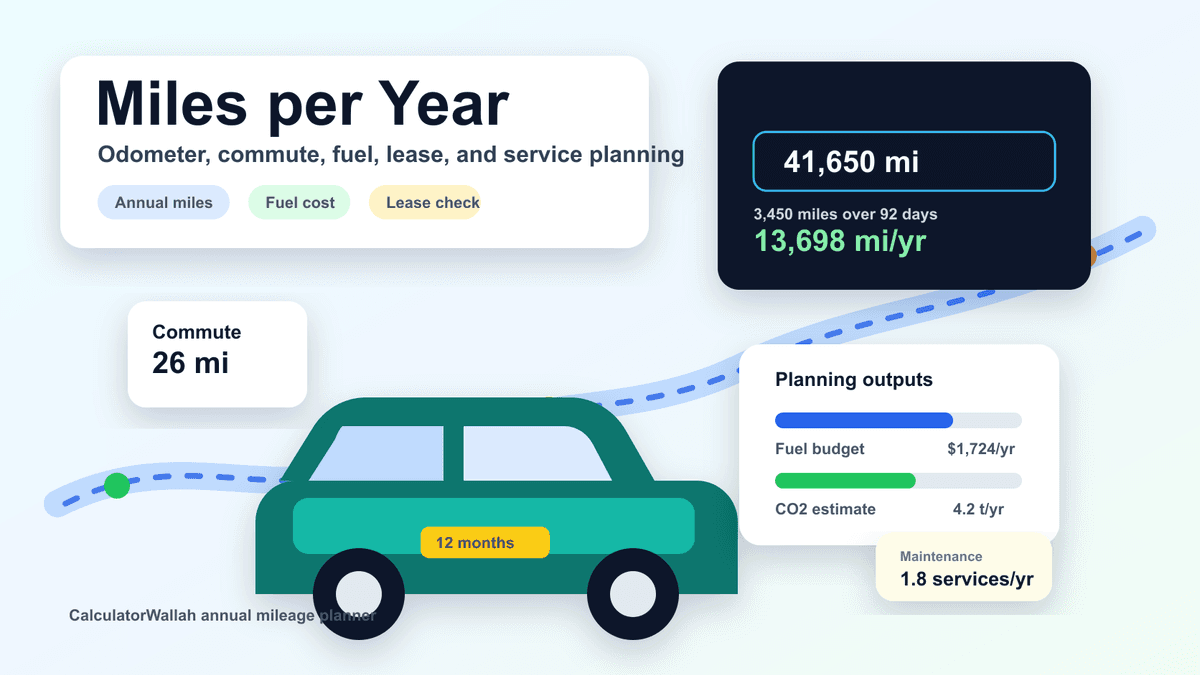
Suppose your odometer was 38,200 miles on April 1 and 41,650 miles on July 2. That is 3,450 miles across 92 days. Annual mileage is 3,450 / 92 x 365.2425 = about 13,698 miles per year. If your car gets 29 mpg and gas costs $3.65 per gallon, the annual fuel estimate is 13,698 / 29 x $3.65 = about $1,724 per year.
| Scenario | Input | Result |
|---|---|---|
| Monthly mileage known | 1,125 miles per month | 1,125 x 12 = 13,500 miles per year. |
| Odometer history | 41,650 - 38,200 = 3,450 miles over 92 days | 3,450 / 92 x 365.2425 = about 13,698 miles per year. |
| Hybrid commute plan | 26-mile round trip, 4 days/week, 48 weeks/year, 70 errand miles/week, 1,200 road-trip miles | Commute miles plus errands and trips equals about 9,843 miles per year. |
| Lease risk | 16,800 miles per year on a 12,000-mile lease at $0.25/mile | 4,800 excess miles could cost about $1,200 per year if that pace continues. |
EPA fuel-economy labels use 15,000 miles per year when estimating annual and five-year fuel costs. That is why the calculator shows a separate EPA label comparison. EPA also notes that real fuel economy and emissions vary with driving style, maintenance, weather, road conditions, accessory use, and load. The CO2 estimate is therefore a planning estimate, not a measured emissions test.
How to Use Annual Mileage in Real Decisions
Miles per year is not just trivia. It affects insurance questions, lease fees, fuel budgets, tire wear, maintenance timing, depreciation assumptions, and business-mileage records. The right estimate depends on the decision you are making.
| Use case | How to apply the result |
|---|---|
| Insurance quote | Use odometer history if available, then compare against low-mileage or high-mileage bands from the insurer. |
| Fuel budget | Use annual miles, MPG, and fuel price to estimate yearly and monthly fuel spend. |
| Lease planning | Compare current pace against the allowed annual mileage and excess-mileage charge. |
| Maintenance calendar | Divide annual miles by the service interval to estimate how many mileage-based services happen each year. |
| Work reimbursement | Estimate business miles and reimbursement value, then keep actual mileage logs for recordkeeping. |
Video note
I looked for a suitable official or institutional video focused on annual mileage estimation, odometer annualization, or mileage planning. I did not find a credible official video that directly matched this calculator, so no video is embedded.
Common Miles per Year Mistakes
| Mistake | Better approach |
|---|---|
| Using one unusual month | Exclude one-off vacation, repair, relocation, or temporary commute months unless they will repeat. |
| Forgetting non-commute miles | Errands, school runs, weekend trips, airport runs, and family visits often add more miles than expected. |
| Ignoring odometer dates | Odometer miles only become annual mileage after you divide by elapsed days and annualize. |
| Treating EPA fuel cost as personal fuel cost | EPA label costs use standardized assumptions. Your fuel price, MPG, trip mix, and annual miles may differ. |
| Missing lease or insurance thresholds | Compare annual miles with your lease allowance, low-mileage insurance band, or employer policy before relying on the number. |
| Using estimated business miles as tax records | Business deductions and reimbursements need actual logs, not just annual projections. |
Better Than a Basic Period Converter
The competitor tool answers the basic conversion question. This page is designed for the next decisions people actually make after finding annual miles: whether their fuel budget is realistic, whether a lease allowance is safe, whether maintenance will come due more often, and whether business mileage is large enough to require cleaner records.
| Tool | Inputs | Practical output |
|---|---|---|
| Basic miles-per-year calculator | Period selector and distance driven in that period | Good for a quick annualized number, but it does not compare odometer history with future commute changes, lease limits, service cadence, reimbursement value, or CO2 impact. |
| This Miles per Year Calculator | Period miles, odometer readings, elapsed days, commute routine, errands, road trips, MPG, fuel price, lease limit, excess fee, maintenance interval, business-use share, and mileage rate | Shows annual/monthly/weekly/daily mileage, estimate spread, fuel gallons, annual fuel cost, cost per mile, CO2, maintenance visits, lease overage, business-mileage value, and practical warnings. |
| Best real-world method | Representative odometer readings plus a future-routine check | Use odometer history when your routine is stable. Use commute planning when a move, new job, hybrid schedule, or new vehicle changes your future mileage. |
Keep the research moving with Gas Calculator, Drive Time Calculator, Commute Calculator, and Engine Hours to Miles Converter.
Frequently Asked Questions
Related Calculators
Gas Calculator
Turn annual mileage into fuel gallons, fuel stops, trip fuel cost, and annual fuel spend.
Use Gas CalculatorDrive Time Calculator
Estimate trip duration, rest stops, average speed, and schedule buffers for long drives.
Use Drive Time CalculatorCommute Calculator
Compare commute cost, time, fuel, parking, transit, and emissions for work travel.
Use Commute CalculatorEngine Hours to Miles Converter
Convert idle-heavy engine hours to mileage equivalents for work trucks and service planning.
Use Engine Hours to Miles ConverterSources & References
- 1.Omni Calculator - Miles per Year Calculator(Accessed July 2, 2026)
- 2.EPA - Fuel Economy Label Annual Mileage Assumption(Accessed July 2, 2026)
- 3.DOE Alternative Fuels Data Center - Annual Vehicle Miles Traveled(Accessed July 2, 2026)
- 4.EPA - Greenhouse Gas Emissions from a Typical Passenger Vehicle(Accessed July 2, 2026)
- 5.IRS - 2026 Standard Mileage Rates(Accessed July 2, 2026)