
Crosswind Calculator
Calculate runway crosswind, headwind, tailwind, gust component, left/right side, reciprocal-runway comparison, personal-limit margin, and crab-angle context from runway heading and wind.
Last Updated: June 2026
All speed inputs and outputs use this unit.
Use charted heading if known. Runway 27 is roughly 270 deg.
Direction the wind is coming from.
Enter 0 if no gust is reported.
Ignored in same-reference mode.
Used only for approximate crab-angle context.
Gust crosswind
16.7 kt
Steady crosswind
11.6 kt
Runway-axis component
19.9 kt headwind
Wind angle
40 deg
Limit margin
-4.7 kt
Risk read
Crosswind limit exceeded
- Use the gust crosswind for go/no-go margin, not only the steady wind component.
- Gust crosswind exceeds the most conservative entered crosswind limit.
- Use charted runway heading and official weather/ATC data for real operations. Runway numbers are rounded and can be materially different near limits.
Wind Component Breakdown
| Step | Value | Interpretation |
|---|---|---|
| Runway heading used | 270 deg | Use charted runway heading when margins are close; runway numbers are rounded. |
| Wind direction used | 310 deg | Wind and runway direction are treated as the same reference system. |
| Angle off runway | 40 deg | from the right; signed angle is 40 deg. |
| Steady crosswind | 11.6 kt | Formula: wind speed x sin(angle). Wind is from the right. |
| Gust crosswind | 16.7 kt | 5.1 kt added crosswind from gust spread. |
| Runway-axis component | 19.9 kt headwind | Positive component is headwind; negative component is tailwind. |
| Approximate crab angle | 14.9 deg crab right | Landing planning estimate at 65 kt approach/takeoff speed. |
Limit and Margin Checks
| Check | Value | What to review |
|---|---|---|
| Most conservative entered crosswind limit | 12 kt | -4.7 kt margin against gust crosswind. |
| Demonstrated or aircraft crosswind limit | 17 kt | 0.3 kt margin against gust crosswind. |
| Personal crosswind limit | 12 kt | -4.7 kt margin against gust crosswind. |
| Tailwind limit | 5 kt | 5 kt margin against active tailwind. |
| Runway surface | Dry paved runway: still verify POH/AFM, runway condition, and pilot proficiency. | Use POH/AFM and airport condition reports for actual performance decisions. |
Runway End Comparison
| Runway | Heading | Component |
|---|---|---|
| Selected runway | 270 deg | 16.7 kt from the right; 19.9 kt headwind. |
| Reciprocal runway | 90 deg | 16.7 kt from the left; 19.9 kt tailwind. |
| Runway-selection note | Selected runway near 270 deg avoids the reciprocal tailwind. | Crosswind magnitude is the same on the reciprocal runway, but headwind/tailwind changes sign. |
| Steady selected runway | 270 deg | 11.6 kt from the right; 13.8 kt headwind. |
| Steady reciprocal runway | 90 deg | 11.6 kt from the left; 13.8 kt tailwind. |
Mental Math Cross-Check
| Angle | Rule | Example |
|---|---|---|
| 30 deg off runway | Crosswind is about half the wind speed. | sin(30 deg) = 0.50. A 20 kt wind gives about 10 kt crosswind. |
| 45 deg off runway | Crosswind is about 70% of wind speed. | sin(45 deg) = 0.707. A 20 kt wind gives about 14 kt crosswind. |
| 60 deg off runway | Crosswind is about 87% of wind speed. | sin(60 deg) = 0.866. A 20 kt wind gives about 17 kt crosswind. |
| 90 deg off runway | Nearly all wind speed is crosswind. | At a direct 90 deg crosswind, the headwind component is near zero. |
Use personal minimums
Aircraft capability, pilot recency, runway width, lighting, and workload can matter more than a single calculated component.
Use charted data
Runway numbers are rounded. Use charted heading, official weather, ATIS, or ATC wind for real operations.
Gusts drive workload
Gust spread can turn a comfortable steady component into a near-limit or over-limit situation.
Aviation Safety Notice
This calculator is an educational planning tool. It is not a flight clearance, POH/AFM substitute, instructor endorsement, weather briefing, or go/no-go decision. Use official weather, ATIS/ATC, charted runway data, aircraft performance data, runway condition, training, proficiency, and alternate planning for real operations.
Checked by Jitendra Kumar
Crosswind Calculator is checked for formula labels, source links, and result limits.
Jitendra Kumar, Founder & Editorial Standards Lead. Updated June 2026. Scope: everyday calculators.
How to Use the Crosswind Calculator
Quick answer
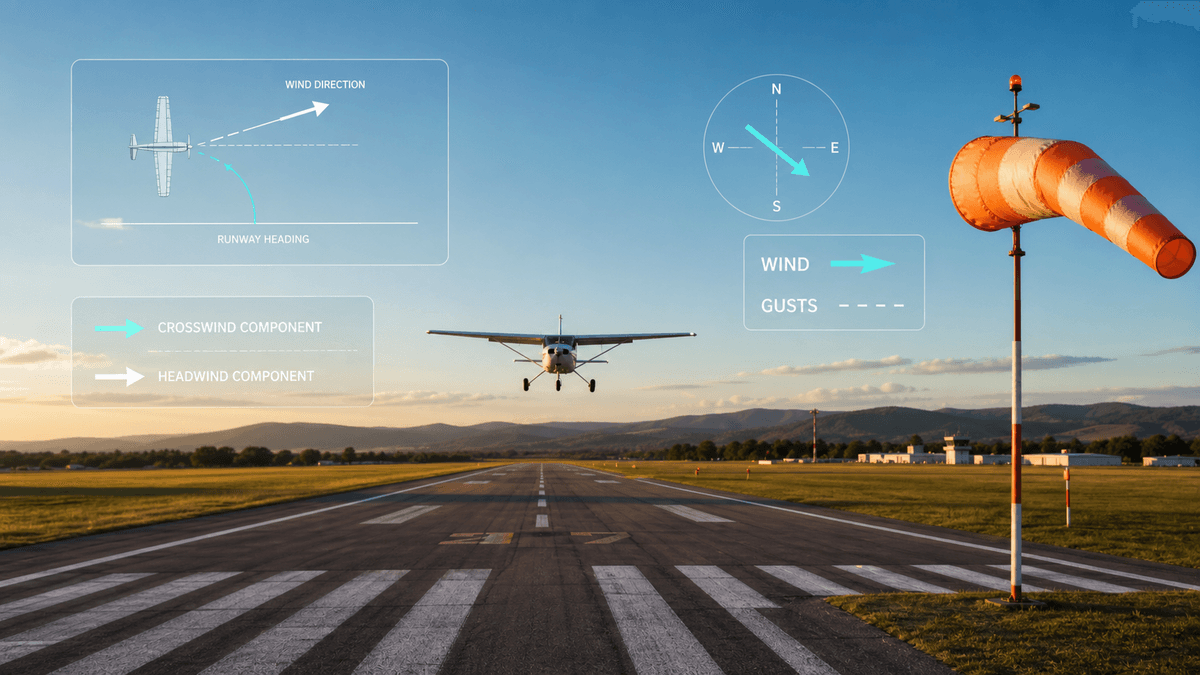
Crosswind component is wind speed multiplied by the sine of the angle between the runway heading and wind direction. Headwind or tailwind is wind speed multiplied by the cosine of that angle. This calculator also checks gusts, left/right side, reciprocal runway, tailwind, personal limits, magnetic variation, and approximate crab-angle context.
Enter the runway heading and the wind direction the wind is coming from. If you only know the runway number, multiply by 10 as a rough start, but use charted runway heading when the margin is close.
Add steady wind, gust speed, aircraft or demonstrated crosswind limit, personal minimum, tailwind limit, operation type, runway surface, and approach or takeoff speed. If your wind source is METAR/TAF true wind and your runway heading is magnetic, enable the magnetic-variation correction.
Step 1: Enter runway heading
Use the actual charted heading if available, not only the rounded runway number.
Step 2: Enter wind direction and speed
Use the direction the wind is coming from, plus steady wind and gust speed when reported.
Step 3: Match direction references
Keep wind and runway in the same true or magnetic reference, or use the magnetic-variation correction.
Step 4: Review gust and tailwind components
Use gust crosswind for margins and treat tailwind as a performance warning.
Step 5: Compare against limits
Check aircraft, demonstrated, personal, runway-surface, and training limits before using the result operationally.
Crosswind Component Formula
Wind can be split into two right-angle components relative to the runway: a sideways crosswind and a runway-axis headwind or tailwind. The formulas are simple, but the operational interpretation depends on gusts, surface, aircraft data, and pilot margins.
This calculator improves on a basic component tool by making the hidden assumptions visible: reference direction, gusts, reciprocal runway, tailwind, and personal limits.
| Step | Formula | Why it matters |
|---|---|---|
| Wind angle | angle = smallest difference between runway heading and wind direction | The calculator normalizes angles around 360 degrees so 350 vs 010 is treated as 20 degrees, not 340. |
| Crosswind component | crosswind = wind speed x sin(angle) | Positive/negative side is tracked internally; the result explains whether the wind is from the left or right. |
| Headwind or tailwind component | headwind = wind speed x cos(angle) | Positive means headwind. Negative means tailwind and should trigger performance checks. |
| Gust crosswind | gust crosswind = gust speed x sin(angle) | Use gust component for margin checks when gusts are reported. |
| Approximate crab angle | crab angle = arcsin(crosswind / approach speed) | This is only planning context. Actual control technique depends on aircraft, training, and conditions. |
| True wind to magnetic runway correction | magnetic wind = true wind - east variation, or true wind + west variation | Useful when comparing METAR/TAF true wind with magnetic runway heading. |
How to Interpret Crosswind, Headwind, Tailwind, and Gusts
What This Adds Beyond the Competitor
The competitor page answers the core trigonometry question: wind speed, runway direction, and wind direction produce crosswind and headwind/tailwind. For pilots and students, that is only the first layer. The more useful question is whether the gust component is inside aircraft and personal margins, whether the selected runway creates a tailwind, and whether the wind direction is being compared in the same true/magnetic reference.
| Tool level | Inputs considered | What it helps decide |
|---|---|---|
| Basic crosswind calculator | Runway heading, wind direction, and wind speed | Gives crosswind and headwind/tailwind components, but usually stops before operational margin checks. |
| This calculator | Runway heading, wind direction, steady wind, gust, units, magnetic variation, crosswind limits, tailwind limit, surface, and approach speed | Adds left/right side, gust component, runway-end comparison, personal-limit margin, tailwind warnings, and crab-angle context. |
| Real-world aviation decision | POH/AFM, ATIS/ATC, runway condition, pilot proficiency, traffic, terrain, turbulence, and alternates | Prevents treating a clean trigonometry result as a go/no-go clearance. |
Practical Examples
| Scenario | Setup | What the result teaches |
|---|---|---|
| Runway 27, wind 310 at 18G26 | Wind is 40 degrees from the right | The gust crosswind is materially higher than the steady number, so margin checks should use the gust component. |
| Runway 18, wind 230 at 12G18 | Light-sport or student-pilot personal limit | A safe aircraft number can still exceed the pilot's personal minimum. |
| Runway 09, wind 260 at 12G18 | Mostly tailwind on the selected runway | The reciprocal runway may turn the tailwind into headwind if available and cleared. |
| METAR true wind vs magnetic runway | True wind 250, runway heading 220 magnetic, 10 degrees west variation | The calculator can convert the wind direction before solving components. |
Common Crosswind Mistakes
| Mistake | Why it matters |
|---|---|
| Using runway number instead of charted heading near a limit | Runway numbers are rounded to the nearest 10 degrees. That can matter when wind is close to a limit. |
| Ignoring gusts | A steady component may be acceptable while the gust component exceeds a personal or demonstrated limit. |
| Mixing true and magnetic directions | METAR/TAF wind and runway headings may not use the same north reference. |
| Forgetting tailwind performance | A small tailwind can increase takeoff or landing distance and may exceed POH/AFM assumptions. |
| Treating maximum demonstrated crosswind as personal ability | Pilot recency, runway width, surface condition, aircraft loading, turbulence, and workload still matter. |
Related Aviation Video Context
AOPA's official channel has a focused video on crosswind takeoff and landing technique. It is a relevant companion because this calculator gives the component math, while technique still requires training, aircraft-specific procedures, and instructor guidance.
Related Planning Tools
Use the Speed Converter when a report uses mph or km/h instead of knots, the Wind Chill / Heat Index Calculator for ground-weather context, and the Time Hours Calculator for training, duty, or schedule math.
Keep the research moving with Speed Converter, Wind Chill / Heat Index Calculator, Boat Speed Calculator, and Time Hours Calculator.
Frequently Asked Questions
Related Calculators
Speed Converter
Convert knots, mph, km/h, m/s, and other speed units for wind and travel math.
Use Speed ConverterWind Chill / Heat Index Calculator
Estimate feels-like temperature from air temperature, wind speed, humidity, and sun.
Use Wind Chill / Heat Index CalculatorBoat Speed Calculator
Estimate boat speed, prop slip, hull speed, fuel burn, and trip range.
Use Boat Speed CalculatorTime Hours Calculator
Add or subtract time blocks for flight planning, training logs, or schedule checks.
Use Time Hours CalculatorSources & References
- 1.Omni Calculator - Crosswind Calculator(Accessed June 30, 2026)
- 2.FAA - Airplane Flying Handbook(Accessed June 30, 2026)
- 3.FAA - Surface Weather Observation Stations (ASOS/AWOS)(Accessed June 30, 2026)
- 4.NOAA Aviation Weather Center(Accessed June 30, 2026)
- 5.AOPA - Crosswind Takeoff and Landing Techniques(Accessed June 30, 2026)