
Ticket Optimizer
Find the cheapest way to pay for public transport by comparing single fares, day tickets, short passes, weekly caps, monthly passes, setup fees, and mixed ticket plans.
Last Updated: July 2026
Public Transport Ticket Optimizer
Compare singles, day tickets, short passes, weekly caps, monthly passes, and mixed combinations for consecutive riding days.
Trip Pattern
Consecutive days where the pass could be valid.
Count paid boardings after free transfers.
Adds extra expected paid trips for uncertain plans.
Regular one-way paid fare.
Use 0 if none applies.
Optional transit-versus-fallback context.
Ticket Products and Caps
Example: day pass or daily cap.
Set 0 to disable.
Example: 3-day pass or 10-ride bundle.
Set 0 to disable.
Calendar days covered.
Weekly pass or fare cap.
Example: weekly ticket or 7-day cap.
Usually 7 days, but agency rules vary.
Example: monthly pass or 30-day cap.
Set 0 to disable.
Use actual agency validity period.
Optimized cost
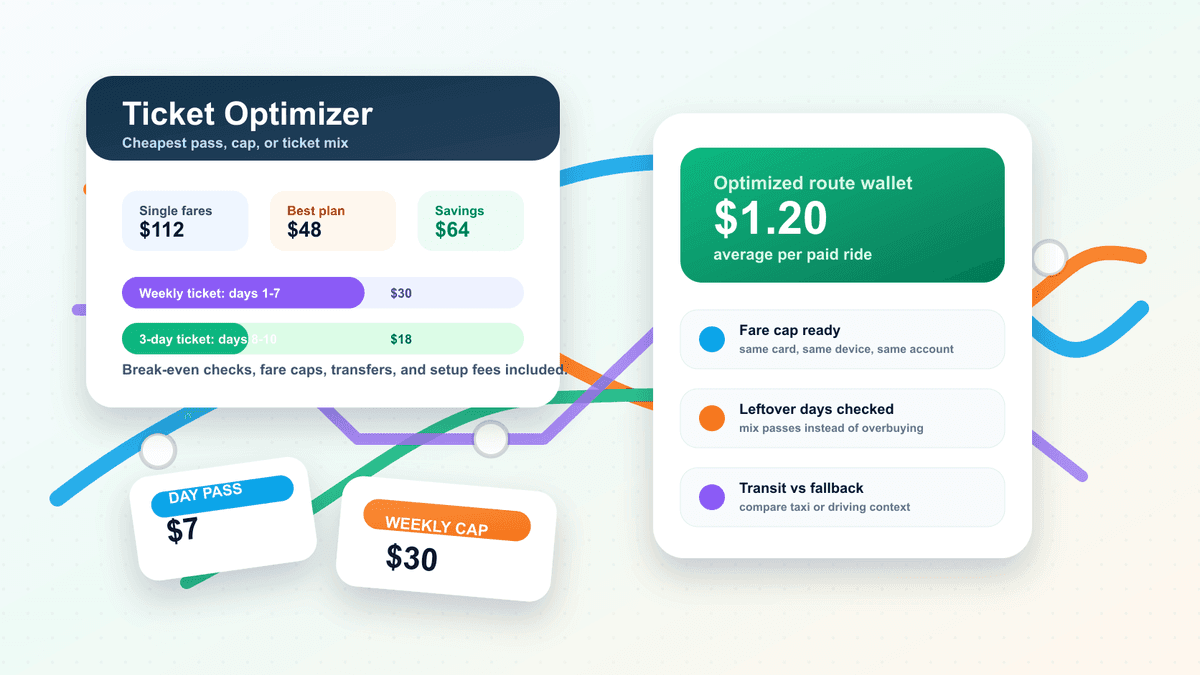
$48.00
Savings vs singles
+$64.00
Average cost per trip
$1.200
Paid trips planned
40 trips
Purchase plan
2
Ticket products or individual singles to buy across the trip.
Cost per day
$4.80
Includes the entered card/app setup fee if applicable.
Taxi fallback savings
+$132.00
Compared with $180.00 total fallback cost.
Practical Checks
- The fare inputs are internally consistent. Still confirm official prices, validity windows, transfer rules, reduced-fare eligibility, fare caps, and zone coverage before buying.
Recommended Purchase Plan
| When | Product | Quantity | Cost |
|---|---|---|---|
| Days 1-3 | 3-day ticket | 1 product | $18 |
| Days 4-10 | Weekly ticket | 1 product | $30 |
Strategy Comparison
| Strategy | Cost | Meaning |
|---|---|---|
| Optimized mix | $48 | Cheapest combination from dynamic planning. |
| All single fares | $112 | 40 paid trips. |
| All day tickets/caps | $70 | 10 day products. |
| 3-day ticket | $72 | 4 product(s). |
| Weekly ticket | $60 | 2 product(s). |
| Monthly ticket | $95 | 1 product(s). |
Product Inputs
| Product | Coverage | Cost | Planning note |
|---|---|---|---|
| Single fares | 4 paid trips/day | $11.2 | Pay for each expected boarding. |
| Day ticket | 1 day(s) | $7 | $1.75 per planned ride if fully used. |
| 3-day ticket | 3 day(s) | $18 | $1.5 per planned ride if fully used. |
| Weekly ticket | 7 day(s) | $30 | $1.07 per planned ride if fully used. |
| Monthly ticket | 30 day(s) | $95 | $0.79 per planned ride if fully used. |
Break-Even Checks
| Product | Break-even paid trips | Interpretation |
|---|---|---|
| Day ticket | 3 paid trips | Minimum paid trips in one day before it can beat singles. |
| 3-day ticket | 7 paid trips | Across 3 valid day(s). |
| Weekly ticket | 11 paid trips | Across 7 valid day(s). |
| Monthly ticket | 34 paid trips | Across 30 valid day(s). |
Transit Fare Planning Notice
This calculator is for fare planning and education. It does not replace official transit agency fare tables, route planners, transfer rules, refund policies, reduced fare eligibility checks, zone maps, or service advisories.
Checked by Jitendra Kumar
Ticket Optimizer is checked for formula labels, source links, and result limits.
Jitendra Kumar, Founder & Editorial Standards Lead. Updated July 2026. Scope: everyday calculators.
How to Use the Ticket Optimizer
Quick answer
A ticket optimizer finds the lowest-cost transit payment plan by comparing single fares with day tickets, weekly caps, monthly passes, and mixed combinations. Enter paid trips per day after free transfers, riding days, single fare, pass prices, and validity periods. The result shows the cheapest purchase plan, savings versus singles, break-even trip counts, and warnings for fare-cap or transfer rules you should verify before buying.
Start with the preset that looks closest to your trip, then replace the fares with official prices from the transit agency. If your city uses automatic fare capping, enter the cap as a day, weekly, or monthly product rather than a prepaid pass.
The key input is paid trips per day. If a bus-to-train transfer is free, it may still be one paid trip. If an airport train, express bus, or regional rail segment charges a separate fare, run a second scenario or increase the average single fare.
Step 1: Count paid trips
Estimate paid taps or ticket uses per day after free transfer windows and add a small ride buffer if plans may change.
Step 2: Enter official ticket products
Add the single fare, card setup fee, day product, short pass, weekly cap, and monthly pass from the transit agency fare page.
Step 3: Review the optimized plan
Use the purchase plan, strategy comparison, break-even rows, and warnings to confirm whether singles, a pass, a cap, or a mixed plan is cheapest.
Ticket Optimizer Formulas
Transit ticket math is a small optimization problem. A single day may favor pay-as-you-go, a heavy day may favor a daily cap, a seven-day stretch may favor a weekly pass, and a 10-day stay may be cheapest with a weekly product plus a short product for the remaining days. The calculator tests enabled products across the riding period and picks the lowest total cost.
| Calculation | Formula | Why it matters |
|---|---|---|
| Paid trips per day | ceil(trips per day x (1 + buffer percent / 100)) | Use paid boardings after free transfers, not every vehicle movement. |
| Single-fare cost | paid trips per day x riding days x single fare + setup fee | Baseline cost if you never use a pass or fare cap. |
| Day product break-even | ceil(day product price / single fare) | Minimum paid trips in one day before a day pass or daily cap can beat singles. |
| Pass-only cost | ceil(riding days / pass validity days) x pass price + setup fee | Useful for quick weekly or monthly pass comparisons. |
| Optimized plan | min cost by day across enabled ticket products | The calculator tests mixed plans, such as one weekly cap plus day tickets for leftover days. |
| Savings versus singles | single-fare cost - optimized cost | Positive savings means the optimized ticket mix beats buying every ride separately. |
Example: if a single fare is $2.80 and a day ticket is $7.00, the day ticket starts to make sense at ceil(7 / 2.8) = 3 paid rides in that day. A weekly ticket at $30 starts to beat single fares at ceil(30 / 2.8) = 11 paid rides across its validity period, assuming it covers every ride you need.
| Scenario | Inputs | Planning insight |
|---|---|---|
| 10-day city break | 4 paid rides/day, $2.80 single, $7 day, $18 three-day, $30 weekly | The optimizer can beat the classic weekly-plus-days answer by checking a weekly plus a three-day ticket. |
| Hybrid commuter | 22 riding days, 2 paid rides/day, weekly cap and monthly pass available | A monthly pass is not automatic. Hybrid days, holidays, and fare caps can keep pay-as-you-go competitive. |
| Fare-capping city | $1.75 single, $5 daily cap, $18 seven-day cap, card setup fee | The best plan may be a tap-to-pay cap instead of prepaid tickets, provided every tap uses the same card or device. |
| Light visitor | 5 days, 1 to 2 paid rides/day, occasional walking | Singles often win when ride frequency is low, especially if the pass covers calendar days you will not use. |
Fare Caps, Passes, and Real-World Buying Decisions
The competitor calculator covers the core idea: compare single tickets with short-term and long-term ticket prices. That is useful, but modern fare systems often include automatic capping, card setup costs, reduced-fare eligibility, free transfers, zone pricing, and pass windows that do not align neatly with a trip.
| Tool | What it covers | Quality gap or advantage |
|---|---|---|
| Omni Ticket Optimizer | Trips, duration or total trips, single fare, short-term and long-term ticket validity and price | Good simple model, but it does not surface fare caps, card setup fees, monthly pass edge cases, transfer-aware paid trips, taxi fallback context, or break-even diagnostics. |
| This Ticket Optimizer | Paid trips per day, ride buffer, single fare, setup fee, day product, short product, weekly product, monthly product, fallback cost, and mixed purchase plan | Adds dynamic ticket mixing, fare-cap style inputs, plan rows by day range, break-even tables, official-rule cautions, example presets, copyable results, and related workflows. |
| Best real-world workflow | Calculator result plus official agency fare page, route planner, transfer policy, reduced-fare eligibility, and service calendar | Use the calculator for planning. Buy only after confirming official prices, validity windows, zones, peak rules, and tap/card requirements. |
Fare Capping Examples to Model Carefully
Official fare-cap programs can be better than prepaid passes because they charge only until a daily or weekly limit is reached. They also have rules. OMNY and TfL both stress using the same card or device for cap tracking, while LA Metro publishes daily and seven-day cap amounts for riders who tap to ride.
| Agency example | What to learn | How to enter it here |
|---|---|---|
| OMNY in New York | Weekly fare-cap systems can stop charging after a threshold if the rider uses the same card or device. | Enter the weekly cap as a seven-day product and count only paid trips that qualify for the cap. |
| Transport for London | Daily and weekly caps depend on contactless or Oyster usage, zones, time period, and touch-in/touch-out behavior. | Run separate scenarios for zone sets or peak/off-peak patterns if the average fare changes. |
| LA Metro | Metro publishes simple one-way fare, daily cap, weekly cap, and transfer rules for TAP/contactless payment. | Use the cap prices as day and weekly products, then include any card setup cost if it applies. |
Official Video: Fare Capping With OMNY
The official MTA video below is relevant because fare capping changes the decision from "buy a pass in advance" to "tap consistently and stop paying after the cap." That is exactly the kind of rule this optimizer is designed to compare.
Common Mistakes to Avoid
| Mistake | Why it matters |
|---|---|
| Counting free transfers as paid trips | A transfer within a free transfer window may not require a second fare. Count paid taps, not every bus or train boarded. |
| Mixing rolling and calendar validity | Some passes start when first used, while others reset on a calendar day or week. The validity window can change the best purchase. |
| Ignoring the same-card rule | Fare caps often require the same card, phone, watch, or transit account. Splitting taps can prevent the cap from applying. |
| Using one average fare for different zones | Airport, express, regional rail, peak, or zone trips can cost more than the base fare. Run a separate scenario when fares differ materially. |
| Buying a monthly pass for a short stay | A cheap monthly product can win mathematically, but refund rules, start dates, ID requirements, and coverage limits still matter. |
Methodology and Editorial Note
This page was built as a practical fare-planning tool after reviewing the competitor workflow and official agency examples from OMNY, TfL, and LA Metro on July 2, 2026. It exists to help riders test assumptions before they buy. Because agencies change prices, caps, and eligibility rules, every fare claim on this page points users back to official sources for final confirmation.
Related workflows
Use the Commute Calculator when the choice is transit versus driving for work. Use the Carpooling Calculator for group trips, the Drive Time Calculator for door-to-door timing, and the Gas Calculator when comparing transit fares with driving cost.
Keep the research moving with Commute Calculator, Carpooling Calculator, Drive Time Calculator, and Gas Calculator.
Frequently Asked Questions
Related Calculators
Commute Calculator
Compare transit, driving, parking, time cost, emissions, and workday commute totals.
Use Commute CalculatorCarpooling Calculator
Split shared ride costs when public transport is not the best option for a group trip.
Use Carpooling CalculatorDrive Time Calculator
Plan door-to-door drive time, stops, delay buffer, fuel stops, and latest departure time.
Use Drive Time CalculatorGas Calculator
Estimate fuel cost when comparing a transit ticket plan against driving or rideshare.
Use Gas CalculatorSources & References
- 1.Omni Calculator - Ticket Optimizer(Accessed July 2, 2026)
- 2.OMNY - Weekly Fare Cap(Accessed July 2, 2026)
- 3.Transport for London - Fare Capping(Accessed July 2, 2026)
- 4.LA Metro - Fares(Accessed July 2, 2026)
- 5.MTA Official Video - How Does Fare Capping Work With OMNY?(Accessed July 2, 2026)