
How to Calculate Taxes When You Have Two Jobs
A practical two-job tax guide explaining how to combine wages, complete Form W-4 Step 2, use the IRS Tax Withholding Estimator, handle FICA and the Social Security wage base, avoid under-withholding, account for a working spouse, and estimate federal, state, and local tax when you have two jobs.
Guide Oversight & Review Policy
CalculatorWallah guides are written to explain calculator assumptions, source limitations, and when users should move from a rough estimate to an official rule, institution policy, or clinician conversation.
Jitendra Kumar, Founder & Editorial Standards Lead. Updated June 25, 2026. Scope: Sales tax and tax-sensitive estimate tools, Education and GPA planning calculators, Health, protein, and screening-formula pages, Platform-wide publishing standards and methodology.
Tax credentialed review: Named internal reviewer: Iliyas Khan, Chief Operating Officer. External credentialed professional review is still required before this page is treated as professional advice.
Internal tax and sales-tax methodology reviewer. Review scope: calculator assumptions, labels, source context, workflow clarity, and compliance-sensitive disclaimers.
Relevant review context: CalculatorWallah tax and sales-tax calculator workflow owner; Source-first review of IRS, state revenue, rate, and filing-sensitive references; Compliance-sensitive labels, assumptions, and user-facing disclaimer review.
Required professional credentials: CPA, Enrolled Agent, licensed tax professional. Scope: tax formulas, jurisdiction assumptions, withholding language, filing-sensitive examples, and compliance caveats.
This page is educational planning support. A named CPA, EA, or licensed tax professional should review the page before it is positioned as tax advice or used for filing decisions.
Professional Review Status
This YMYL page has internal methodology review, but no external credentialed professional review is recorded yet.
- Reliance status
- Credentialed tax review required before professional reliance
- Required credentials
- CPA, Enrolled Agent, licensed tax professional
- Review scope
- tax formulas, jurisdiction assumptions, withholding language, filing-sensitive examples, and compliance caveats
Current reviewer: Iliyas Khan, Internal tax and sales-tax methodology reviewer.
This page is educational planning support. A named CPA, EA, or licensed tax professional should review the page before it is positioned as tax advice or used for filing decisions.
On This Page
Short Answer: Combine the Jobs First
When you have two jobs, calculate income tax from the full-year total, not from each job separately. Add wages from both jobs, apply one filing status, one standard deduction or itemized deduction choice, one set of credits, and then subtract withholding from both paychecks.
The biggest risk is under-withholding. Each employer may withhold as if its job is your only job. That can be fine for simple low-income cases, but it can leave a gap when the second job pushes household income into higher brackets.
Add both jobs before applying brackets
Federal income tax is based on total taxable income for the year, not each job in isolation.
Use only one standard deduction
A common two-job mistake is mentally giving each paycheck its own full standard deduction.
Coordinate both W-4 forms
Use the IRS estimator, the multiple jobs worksheet, or the Step 2(c) checkbox when appropriate.
Check FICA separately
Each employer withholds FICA independently, so income tax and payroll tax need separate checks.
Why Two Jobs Can Cause Under-Withholding
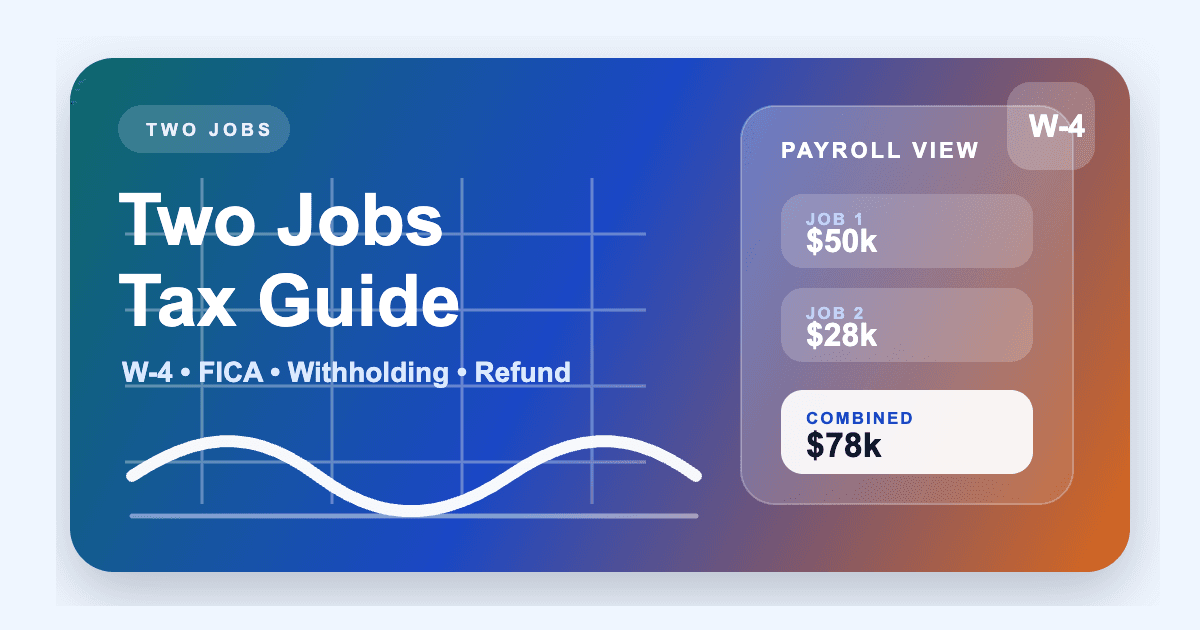
Payroll systems usually do not know what another employer pays you. If Job 1 sees US$ 50,000 and Job 2 sees US$ 28,000, each payroll system may calculate withholding using only that job's wages and your Form W-4 entries. But your tax return sees US$ 78,000 of wages before deductions and credits.
IRS Publication 505 says people with more than one job or a spouse who also works are more likely to need increased withholding. It also explains that you can apply extra withholding to one job or divide it between jobs.
| Issue | Why it happens | Planning fix |
|---|---|---|
| Federal income tax | Each job may withhold as if it is your only job. | Use Form W-4 Step 2, the IRS Tax Withholding Estimator, or extra withholding. |
| Standard deduction | Two payroll systems can under-withhold if both assume too much low-rate income. | Calculate annual household income once, then update one or both W-4 forms. |
| Social Security tax | Multiple employers may withhold Social Security until each job reaches the wage base. | Claim excess Social Security tax withheld on the return if total wages exceed the annual wage base. |
| Additional Medicare tax | Employers withhold 0.9% only when that employer pays wages above the threshold. | High-income taxpayers may need extra withholding if combined wages trigger the tax. |
| State and local tax | A second job in another state or city can create separate withholding rules. | Check state W-4 equivalents, reciprocity rules, local wage taxes, and resident credits. |
How to Calculate Taxes When You Have Two Jobs
- Add expected annual wages from Job 1 and Job 2.
- Add spouse wages if filing jointly and any other taxable income.
- Subtract the standard deduction or expected itemized deductions.
- Apply federal tax brackets to estimated taxable income.
- Subtract credits such as child tax credit, education credits, or other expected credits.
- Estimate FICA separately for each job and check Social Security wage base issues.
- Subtract federal income tax already withheld and expected withholding for the rest of the year.
- Adjust Form W-4 or estimated payments if the result shows a gap.
Calculator workflow: use a paycheck calculator for each job, then use a federal income tax calculator or tax refund calculator to combine the year. The paycheck view shows cash flow; the annual tax view shows whether withholding is enough.
Example: One Person With Two W-2 Jobs
Suppose Job 1 pays US$ 50,000 and Job 2 pays US$ 28,000. If both Forms W-4 are filled out like single-job forms with no multiple-jobs adjustment, each employer may withhold too little federal income tax because neither payroll system sees the combined US$ 78,000 wage year.
| Income source | Annual pay | Payroll view | Tax planning view |
|---|---|---|---|
| Job 1 | US$ 50,000 | Payroll may withhold as a single 50,000 job. | Part of a 78,000 total wage year. |
| Job 2 | US$ 28,000 | Payroll may withhold as a single 28,000 job. | Adds income that may be taxed at higher marginal brackets. |
| Combined | US$ 78,000 | No single employer sees the whole picture unless W-4 forms are adjusted. | Use total income, one filing status, one standard deduction, and all credits. |
The fix is not to guess a flat percentage. Use the IRS Tax Withholding Estimator or the Form W-4 multiple jobs worksheet. If extra tax is needed, divide the gap by remaining pay periods and enter that amount as additional withholding on Form W-4 Step 4(c), often on the higher-paying job.
W-4 Control Sheet: Inputs a Useful Calculator Needs
The most useful two-job calculator produces a W-4 action, not just a warning. The working formula is extra withholding per paycheck = remaining annual tax gap / remaining paychecks. The annual gap should be based on combined wages, one filing status, one deduction choice, credits, other income, and withholding already taken.
| Input | Why it matters | Calculator move |
|---|---|---|
| Current paystubs from both jobs | Year-to-date wages and withholding show what has already happened, not just the annual salary promise. | Run each job through the paycheck calculator, then combine the annual totals in the tax refund calculator. |
| Remaining pay periods | The same annual tax gap creates a very different per-check W-4 amount in July than it does in January. | Use extra withholding per check = remaining annual tax gap / remaining paychecks. |
| Credits, dependents, deductions, and other income | Two similar wages can still need different withholding if credits, itemized deductions, interest, or side income change the return. | Use the taxable income calculator before deciding how much to put on Form W-4 Step 4(c). |
| FICA and wage-base exposure | Each employer withholds Social Security separately, while Additional Medicare tax depends on combined facts. | Use the FICA calculator separately from the income-tax estimate so payroll tax is not confused with withholding. |
| State and local job locations | A second job across a state or city line can create a state withholding problem even when federal W-4 is correct. | Treat state withholding as a separate follow-up after the federal estimate is balanced. |
For an internal workflow, estimate each job with the Paycheck Calculator, combine the annual return with the Tax Refund Calculator, and use the W-4 Withholding Adjustment Calculator when you need a per-check Step 4(c) amount.
Form W-4 Options for Two Jobs
Form W-4 Step 2 is the main two-job control. The 2026 Form W-4 points workers with more than one job to the online estimator, the multiple jobs worksheet, or the Step 2(c) checkbox for simpler cases. The form also notes that withholding is most accurate when the worksheet result is entered on the Form W-4 for the highest-paying job.
- Use the IRS Tax Withholding Estimator for the most complete two-job setup.
- Use the multiple jobs worksheet when you want a paper workflow.
- Use the Step 2(c) checkbox carefully when jobs are similar enough for that simplified method.
- Use Step 4(c) to add a flat extra amount per paycheck when the annual gap is known.
FICA, Social Security Wage Base, and Additional Medicare Tax
Federal income tax and FICA are different. For 2026, IRS Topic 751 lists Social Security tax at 6.2% for the employee and 6.2% for the employer, Medicare at 1.45% for each, and the Social Security wage base at US$ 184,500. Medicare has no wage base limit.
With two jobs, each employer withholds Social Security tax independently. If your combined wages exceed the Social Security wage base, you may have excess Social Security tax withheld and claim it on your return. Additional Medicare tax is different: employers must begin withholding it when wages from that employer exceed US$ 200,000, but your filing status threshold may be different when all income is combined.
Two Jobs Can Mean Your Job Plus Your Spouse's Job
For married filing jointly, the two-job problem can be one person with two jobs, or two spouses with one job each. The tax return combines household income. If both spouses fill out W-4 forms as if only one income exists, withholding can be too low.
Use the estimator with both spouses' most recent paystubs. If the estimator recommends extra withholding, decide whether to apply it to one paycheck or split it. Publication 505 explicitly allows the additional amount to be applied to one job or divided between jobs.
When Two Jobs Still Need Estimated Tax Payments
Most W-2 workers can solve the two-job problem through Form W-4 withholding. Estimated payments become more relevant when there is also nonwage income, self-employment income, investment income, rental income, or a mid-year change that leaves too few pay periods to catch up through withholding.
IRS estimated-tax guidance generally asks whether you expect to owe at least US$ 1,000 after withholding and refundable credits and whether withholding and credits meet the current-year or prior-year safe-harbor thresholds. If not, estimated payments may be needed.
State and Local Tax With Two Jobs
State withholding does not always follow the federal W-4. Some states have their own forms, some rely on federal information, and some have no state income tax. A second job in a different city or state can add resident credits, local wage tax, paid leave withholding, disability withholding, or reciprocity issues.
Check state rules separately. A federal W-4 adjustment may fix federal withholding but leave state tax underpaid, especially when a second job is in a different jurisdiction.
Official Video Context
I looked for official or institutional video material about two-job withholding and Form W-4. The IRS has current written and video-script guidance for updating Form W-4 and using the Tax Withholding Estimator. The most relevant embeddable official IRS video I found is the estimated-tax video below, which is useful when withholding from two jobs may not cover the annual tax bill.
IRS: Estimated Tax Payments
Official IRS video on estimated tax payments, useful when wage withholding from two jobs or other income does not fully cover the annual tax bill.
Two-Job Tax Checklist
- Collect the latest paystub from each job.
- Estimate full-year wages, bonuses, overtime, tips, and commissions for both jobs.
- Run the IRS Tax Withholding Estimator or complete the W-4 multiple jobs worksheet.
- Apply extra withholding to one job or split it between jobs.
- Check Social Security wage base and Additional Medicare tax exposure for high wages.
- Review spouse income, credits, deductions, and nonwage income.
- Check state and local withholding separately.
- Re-run the estimate after a raise, job change, bonus, or major life event.
Two-Job Tax FAQ System
The short answer is that two jobs are not taxed by adding two isolated paycheck estimates. They are taxed by combining annual income on one return. Use each paycheck estimate for cash-flow planning, then use a full-year tax estimate to decide whether Form W-4 needs a multiple jobs adjustment or extra withholding.
Trust and Update Notes
This guide was refreshed on June 25, 2026 using official IRS and Federal Reserve educational sources. Tax brackets, Form W-4 instructions, FICA wage bases, credits, estimated-tax safe harbors, and state withholding rules can change. Use this guide for planning, then verify your live withholding with current IRS tools, state guidance, and payroll records.
Frequently Asked Questions
Related Calculators
Paycheck Calculator
Estimate withholding, FICA, and take-home pay for each job before combining annual results.
Use Paycheck CalculatorFederal Income Tax Calculator
Combine both jobs, filing status, deductions, and credits into one annual federal tax estimate.
Use Federal Income Tax CalculatorFICA Tax Calculator
Review Social Security, Medicare, wage base, and Additional Medicare tax assumptions.
Use FICA Tax CalculatorTax Refund Calculator
Compare expected total tax with withholding from both jobs and estimated payments.
Use Tax Refund CalculatorNet Pay Calculator
Estimate combined monthly take-home pay after taxes, deductions, and benefit assumptions.
Use Net Pay CalculatorW-4 Withholding Adjustment Calculator
Turn an annual two-job tax gap into a practical extra withholding amount per remaining paycheck.
Use W-4 Withholding Adjustment CalculatorTaxable Income Calculator
Estimate taxable income after deductions before deciding whether the second job creates a bracket jump.
Use Taxable Income CalculatorSources & References
- 1.IRS - Publication 505, Tax Withholding and Estimated Tax(Accessed June 2026)
- 2.IRS - Tax Withholding Estimator(Accessed June 2026)
- 3.IRS - Topic No. 753, Form W-4(Accessed June 2026)
- 4.IRS - 2026 Form W-4(Accessed June 2026)
- 5.IRS - Topic No. 751, Social Security and Medicare Withholding Rates(Accessed June 2026)
- 6.IRS - Estimated Tax FAQ for Individuals(Accessed June 2026)
- 7.IRS - Do I Need to Fill Out a New W-4? video text script(Accessed June 2026)
- 8.Federal Reserve Education - Forms 101: Filling Out the W-4(Accessed June 2026)