
Self-Employment Tax Calculator: How Much Do I Actually Owe?
A practical self-employment tax calculator guide explaining how much freelancers, independent contractors, sole proprietors, and gig workers may actually owe after expenses, Schedule SE, Social Security wage base limits, Medicare tax, income tax, deductions, and estimated payments.
Guide Oversight & Review Policy
CalculatorWallah guides are written to explain calculator assumptions, source limitations, and when users should move from a rough estimate to an official rule, institution policy, or clinician conversation.
Jitendra Kumar, Founder & Editorial Standards Lead. Updated June 25, 2026. Scope: Sales tax and tax-sensitive estimate tools, Education and GPA planning calculators, Health, protein, and screening-formula pages, Platform-wide publishing standards and methodology.
Tax credentialed review: Named internal reviewer: Iliyas Khan, Chief Operating Officer. External credentialed professional review is still required before this page is treated as professional advice.
Internal tax and sales-tax methodology reviewer. Review scope: calculator assumptions, labels, source context, workflow clarity, and compliance-sensitive disclaimers.
Relevant review context: CalculatorWallah tax and sales-tax calculator workflow owner; Source-first review of IRS, state revenue, rate, and filing-sensitive references; Compliance-sensitive labels, assumptions, and user-facing disclaimer review.
Required professional credentials: CPA, Enrolled Agent, licensed tax professional. Scope: tax formulas, jurisdiction assumptions, withholding language, filing-sensitive examples, and compliance caveats.
This page is educational planning support. A named CPA, EA, or licensed tax professional should review the page before it is positioned as tax advice or used for filing decisions.
Professional Review Status
This YMYL page has internal methodology review, but no external credentialed professional review is recorded yet.
- Reliance status
- Credentialed tax review required before professional reliance
- Required credentials
- CPA, Enrolled Agent, licensed tax professional
- Review scope
- tax formulas, jurisdiction assumptions, withholding language, filing-sensitive examples, and compliance caveats
Current reviewer: Iliyas Khan, Internal tax and sales-tax methodology reviewer.
This page is educational planning support. A named CPA, EA, or licensed tax professional should review the page before it is positioned as tax advice or used for filing decisions.
On This Page
Short Answer: Your Actual Bill Has Two Layers
A self-employment tax calculator answers one important question: how much Social Security and Medicare tax do you owe on your self-employed net profit? For most freelancers, contractors, gig workers, and sole proprietors, that is only the first layer. Your actual amount due also includes federal income tax, state or local tax, and any penalty if you paid too little during the year.
The practical shortcut is: estimate net profit, calculate Schedule SE tax, then run the same profit through a full-year income tax estimate. If you only calculate 15.3% and stop, you will usually understate the real amount to save for taxes.
Start with net profit
Use business income minus ordinary and necessary business expenses, usually from Schedule C.
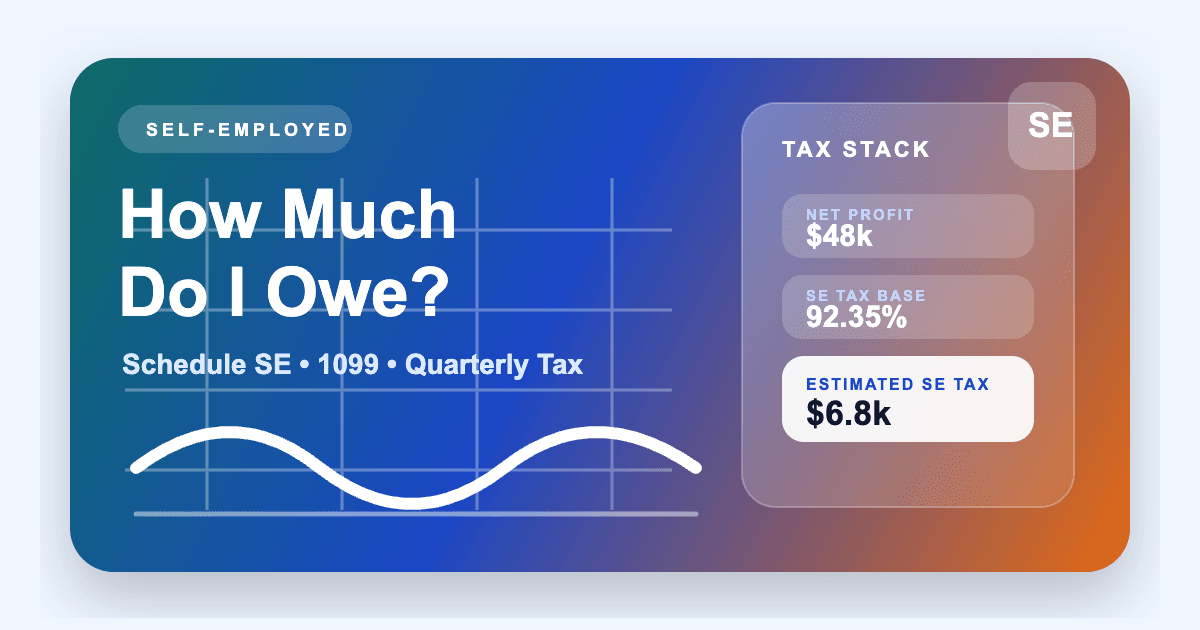
Multiply by 92.35%
Schedule SE generally applies self-employment tax to 92.35% of net earnings, not 100% of gross receipts.
Apply Social Security and Medicare
For 2026, Social Security is capped by the wage base, while Medicare continues without a wage base limit.
Add income tax separately
Self-employment tax is not the whole bill. Federal income tax, state tax, and credits sit on top of the SE tax estimate.
What Counts as Self-Employment Income
IRS guidance treats you as self-employed when you carry on a trade or business as a sole proprietor or independent contractor, are a member of a partnership carrying on a trade or business, or are otherwise in business for yourself. This can include full-time work, part-time freelance projects, gig platform income, consulting, creator income, and single-member LLC activity that is disregarded for federal income tax purposes.
The starting point is not every bank deposit. Start with gross business income, subtract ordinary and necessary trade or business expenses, and use the resulting net profit or loss. Schedule C is the common form for a sole proprietor. Schedule SE is the form that computes the Social Security and Medicare side.
Self-Employment Tax Calculator Formula
The regular-method calculator flow is compact, but every line matters:
- Net profit = gross self-employed income minus deductible business expenses.
- Net earnings for SE tax = net profit x 92.35%.
- If net earnings are under US$ 400, self-employment tax usually does not apply.
- Social Security portion = 12.4% of the SE base up to the annual Social Security wage base.
- Medicare portion = 2.9% of the SE base, with no wage base limit.
- Additional Medicare tax may apply above the filing-status threshold.
- Deduct one-half of self-employment tax as an income-tax adjustment.
For 2026, IRS Topic 751 lists the Social Security wage base at US$ 184,500. If you also have W-2 wages, those wages use the wage base first before self-employment income is tested against the remaining Social Security cap.
Examples: How Much SE Tax Different Profits Create
These examples isolate self-employment tax only. They do not include federal income tax, state tax, credits, retirement contributions, health insurance deductions, QBI, or prior year safe-harbor planning.
| Scenario | Net profit | Schedule SE base | Estimated SE tax | Important note |
|---|---|---|---|---|
| Part-time freelance profit | US$ 12,000 | US$ 11,082 | About US$ 1,696 | Income tax may still apply after deductions and credits. |
| Independent contractor | US$ 48,000 | US$ 44,328 | About US$ 6,782 | Half of SE tax is an income-tax adjustment, not a direct credit. |
| Full-time solo business | US$ 100,000 | US$ 92,350 | About US$ 14,130 | Income tax and possible state tax are separate. |
| High-profit single filer | US$ 220,000 | US$ 203,170 | About US$ 28,799 | This reflects the 2026 Social Security wage base and possible Additional Medicare tax. |
What You Actually Owe Is Bigger Than SE Tax
The phrase self-employment tax is easy to misread. IRS guidance uses it for Social Security and Medicare tax, not for your entire federal tax bill. A contractor with US$ 48,000 of net profit might estimate about US$ 6,782 of self-employment tax, but the actual amount due can be higher after regular income tax and state tax are included.
| Part of the bill | What it covers | Where it usually shows up |
|---|---|---|
| Self-employment tax | Social Security and Medicare for people working for themselves. | Schedule SE, then Schedule 2 of Form 1040. |
| Federal income tax | Regular income tax on taxable income after deductions and credits. | Form 1040 after Schedule C profit flows into income. |
| State and local tax | State income tax, local tax, gross receipts tax, or business registration charges where applicable. | State and local returns or separate business filings. |
| Estimated tax penalty risk | Possible penalty when quarterly payments and withholding are too low. | Usually resolved through Form 1040-ES planning and Form 2210 if needed. |
Calculator Workflow: From Schedule C Profit to Cash Reserve
A useful self-employment calculator should not stop at one output. The working formula is reserve target = self-employment tax + federal income tax + state/local tax - withholding - credits - estimated payments already made. After that, divide the remaining gap by the estimated-tax dates that are still open.
| Step | Inputs to gather | Best calculator use | Useful output |
|---|---|---|---|
| 1. Reconcile profit | Gross receipts minus Schedule C expenses, refunds, platform fees, inventory, mileage, and home office support. | Use the Schedule C profit reserve calculator before estimating tax if deposits and 1099s do not match cleanly. | A defensible net profit number instead of a rough gross-income percentage. |
| 2. Estimate Schedule SE | Net profit, W-2 Social Security wages, filing status, and any earnings above the Medicare thresholds. | Use the self-employment tax calculator to separate Social Security, Medicare, and the half-SE-tax deduction. | Estimated SE tax and the income-tax adjustment that flows to Form 1040. |
| 3. Add income tax | Filing status, taxable income, credits, retirement contributions, health insurance, QBI, and other income. | Use the federal income tax calculator after Schedule SE so the full tax bill is not understated. | Federal income tax layered on top of self-employment tax. |
| 4. Convert to cash reserve | Total estimated tax minus withholding, refundable credits, and estimated payments already made. | Use the quarterly payment calculator to divide the remaining gap across the open 2026 payment dates. | A reserve target per payment date, not a generic 25% rule. |
This is where internal tools work best together: start with the Schedule C profit tax reserve calculator, check Schedule SE with the self-employment tax calculator, then use the quarterly payment calculator before April, June, September, or January cash leaves the business.
What If You Also Have W-2 Income?
W-2 wages and self-employed profit interact for Social Security tax. If your employer already withheld Social Security tax on wages, those wages count against the same annual Social Security wage base. Medicare does not have that wage base limit, so Medicare still applies to covered wages and net self-employment earnings.
A second planning point is withholding. If you have a W-2 job and a side business, you may be able to increase Form W-4 withholding at the job instead of making separate estimated payments. The goal is the same: cover the combined annual tax from wages, business profit, credits, and deductions.
Deductions That Change the Calculator Result
Business deductions reduce Schedule C profit before self-employment tax is calculated. Examples can include supplies, software, advertising, contractor costs, business insurance, payment processing fees, mileage or vehicle expenses, and a qualified home office. The key is that the expense must be business-related and supported by records.
Other deductions can reduce income tax without directly reducing self-employment tax. The one-half SE tax deduction, self-employed health insurance deduction, retirement contributions, and qualified business income deduction can affect taxable income, but they are not all entered at the same step. That is why a good estimate separates Schedule C profit, Schedule SE tax, and Form 1040 income-tax calculations.
Quarterly Estimated Payments for 2026
IRS Form 1040-ES says estimated tax is used for income that is not subject to withholding, including self-employment and gig economy earnings. In most cases, estimated payments are required when you expect to owe at least US$ 1,000 after withholding and refundable credits and your withholding and credits are below the applicable safe-harbor amount.
| Income period | 2026 federal estimated payment due date |
|---|---|
| January 1 to March 31, 2026 | April 15, 2026 |
| April 1 to May 31, 2026 | June 15, 2026 |
| June 1 to August 31, 2026 | September 15, 2026 |
| September 1 to December 31, 2026 | January 15, 2027 |
Equal quarterly payments work for steady income. If income is seasonal or uneven, the annualized income installment method may fit better, but it requires cleaner records by period. State estimated tax deadlines may be similar, but they are not guaranteed to match the federal schedule.
Common Self-Employment Tax Calculator Mistakes
| Mistake | Better calculator treatment |
|---|---|
| Using gross revenue as the tax base | Subtract legitimate business expenses first. Self-employment tax starts from net profit, not total deposits. |
| Forgetting income tax | A self-employment tax calculator estimates Social Security and Medicare. Add federal and state income tax separately. |
| Ignoring W-2 wages | W-2 wages can use part or all of the Social Security wage base before Schedule SE applies the self-employed portion. |
| Treating the half-SE-tax deduction as a refund | The deduction reduces adjusted gross income for income tax. It does not reduce self-employment tax dollar for dollar. |
| Waiting until April | Use estimated payments or W-2 withholding during the year if you expect to owe at least US$ 1,000. |
Official IRS Videos
I found two relevant official IRS videos for this topic. The estimated-tax video explains why self-employed and gig income may need quarterly payments. The Small Business Self-Employed Tax Center video points to IRS resources for forms, deductions, recordkeeping, and business tax obligations.
IRS: Estimated Tax Payments
Official IRS video on estimated payments for income without withholding, including self-employment and gig income.
IRS: Small Business Self-Employed Tax Center
Official IRS video introducing the small business and self-employed tax center, forms, publications, deductions, and recordkeeping resources.
Self-Employment Tax Calculator Checklist
- Separate business revenue from personal transfers and loans.
- Track deductible expenses before estimating tax.
- Use net profit, not gross revenue, as the starting point.
- Multiply net profit by 92.35% for the regular Schedule SE base.
- Apply the 2026 Social Security wage base and Medicare rules.
- Add federal income tax, state tax, and credits to estimate the real bill.
- Account for W-2 wages if you also have a job.
- Review quarterly estimated payment deadlines before cash leaves the business.
- Recalculate after a major income swing, new deduction, or business structure change.
Self-Employment Tax FAQ System
The safest way to estimate what you actually owe is to split the problem into two calculators. First, calculate self-employment tax from net business profit on Schedule SE. Second, calculate full-year income tax using filing status, deductions, credits, W-2 wages, estimated payments, and state rules. The combined result is much closer to the cash you need to reserve.
Trust and Update Notes
This guide was refreshed on June 25, 2026 using IRS sources, including Topic 554, Topic 751, 2026 Form 1040-ES, Publication 334, Schedule SE guidance, and official IRS video scripts. Self-employment tax rates, wage bases, estimated-tax thresholds, deductions, and state rules can change. Use this guide for planning, then verify current numbers with IRS forms, state guidance, payroll records, and a qualified tax professional when your situation is complex.
Frequently Asked Questions
Related Calculators
Self-Employment Tax Calculator
Estimate Schedule SE Social Security and Medicare tax from self-employed net profit.
Use Self-Employment Tax CalculatorFederal Income Tax Calculator
Add ordinary federal income tax after business profit, deductions, credits, and filing status.
Use Federal Income Tax CalculatorTax Refund Calculator
Compare total tax with estimated payments, withholding, credits, and expected refund or balance due.
Use Tax Refund CalculatorFICA Tax Calculator
Compare employee FICA with self-employment Social Security and Medicare assumptions.
Use FICA Tax CalculatorPaycheck Calculator
Model W-2 withholding if you also have a job or want paycheck withholding to cover contractor income.
Use Paycheck CalculatorSchedule C Profit Tax Reserve Calculator
Turn receipts, deductions, and payment history into a practical tax reserve target before quarterly dates.
Use Schedule C Profit Tax Reserve CalculatorQuarterly Tax Payment Calculator for Freelancers
Split the remaining tax gap across open 2026 estimated-tax dates after withholding and prior payments.
Use Quarterly Tax Payment Calculator for FreelancersSources & References
- 1.IRS - Topic No. 554, Self-Employment Tax(Accessed June 2026)
- 2.IRS - Self-Employed Individuals Tax Center(Accessed June 2026)
- 3.IRS - 2026 Form 1040-ES, Estimated Tax for Individuals(Accessed June 2026)
- 4.IRS - Publication 334, Tax Guide for Small Business(Accessed June 2026)
- 5.IRS - Topic No. 751, Social Security and Medicare Withholding Rates(Accessed June 2026)
- 6.IRS - About Schedule SE (Form 1040), Self-Employment Tax(Accessed June 2026)
- 7.IRS - Estimated Tax Payments video script(Accessed June 2026)
- 8.IRS - Small Business Self-Employed Tax Center video script(Accessed June 2026)