
What's the 2-2-2 Rule for Mortgages and How Does It Affect Me?
A practical guide to the mortgage 2-2-2 rule, explaining two-year income history, two-year tax or W-2 documentation, two-month bank statements, lender verification, self-employed files, job changes, large deposits, and what borrowers should prepare before underwriting.
Guide Oversight & Review Policy
CalculatorWallah guides are written to explain calculator assumptions, source limitations, and when users should move from a rough estimate to an official rule, institution policy, or clinician conversation.
Jitendra Kumar, Founder & Editorial Standards Lead. Updated June 24, 2026. Scope: Sales tax and tax-sensitive estimate tools, Education and GPA planning calculators, Health, protein, and screening-formula pages, Platform-wide publishing standards and methodology.
Finance credentialed review: Named internal reviewer: Laxman Kumawat, Finance & Engineering Calculator Owner. External credentialed professional review is still required before this page is treated as professional advice.
Internal finance formula and engineering methodology reviewer. Review scope: calculator formulas, input labels, rate assumptions, scenario workflows, and user-facing limitations.
Credentials on file: Electrical and power-system related certifications.
Relevant review context: Professional background across engineering, sustainability, and energy-efficiency work; CalculatorWallah finance and engineering calculator owner.
Required professional credentials: CFP professional, CFA charterholder, CPA, licensed financial professional. Scope: assumptions, amortization logic, risk language, offer-comparison language, affordability guidance, and disclosure placement.
This page provides educational estimates, not individualized financial advice, lending advice, investment advice, or a product recommendation.
Professional Review Status
This YMYL page has internal methodology review, but no external credentialed professional review is recorded yet.
- Reliance status
- Credentialed finance review required before advice-like claims
- Required credentials
- CFP professional, CFA charterholder, CPA, licensed financial professional
- Review scope
- assumptions, amortization logic, risk language, offer-comparison language, affordability guidance, and disclosure placement
Current reviewer: Laxman Kumawat, Internal finance formula and engineering methodology reviewer (Electrical and power-system related certifications).
This page provides educational estimates, not individualized financial advice, lending advice, investment advice, or a product recommendation.
On This Page
Short Answer: It Is a Documentation Shortcut
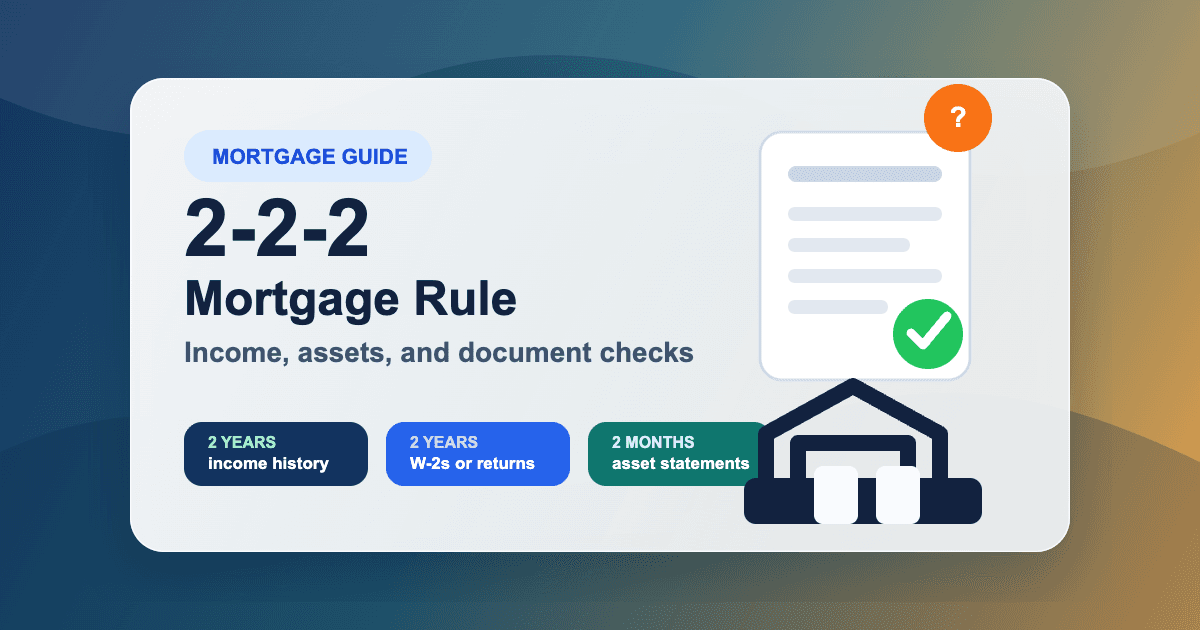
The mortgage 2-2-2 rule is informal lender shorthand. It usually means you should be ready to document two years of income or employment history, two years of W-2s or tax returns when your income type requires them, and two months of bank or asset statements. It affects you because a lender cannot approve a mortgage from a salary number alone. The lender must verify that the money used to qualify is stable, traceable, and available.
The important caveat: there is no single federal rule called the 2-2-2 rule. Fannie Mae, Freddie Mac, FHA, VA, USDA, portfolio lenders, and individual lenders each have their own documentation standards. The phrase is useful as a borrower checklist, but the exact requirement depends on your income type, loan type, credit profile, down payment, and underwriting result.
What the 2-2-2 Rule Usually Means
In practice, loan officers use 2-2-2 to help borrowers gather a clean file before pre-approval. Fannie Mae's consumer checklist lists recent pay stubs, W-2 forms for the last two years, tax returns for the last two years for some income types, and asset statements. Fannie Mae's asset documentation guidance also says purchase-transaction bank or portfolio statements generally cover the most recent full two-month period.
| Piece | What it covers | Why lenders ask |
|---|---|---|
| 2 years of history | Employment, self-employment, variable income, addresses, or income pattern. | The lender is trying to prove the income is stable, documented, and likely to continue. |
| 2 years of tax or wage records | W-2s, personal tax returns, business tax returns, 1099s, K-1s, or transcripts. | Needed most often when income is variable, self-employed, seasonal, commission-based, or not easy to verify from a salary alone. |
| 2 months of asset statements | Checking, savings, investment, retirement, or business account statements. | Used to document down payment, closing funds, reserves, large deposits, gift movement, and available cash. |
It Is Not One Universal Mortgage Law
The legal foundation is broader than the nickname. Under the CFPB ability-to-repay rule, lenders must make a reasonable, good-faith determination that the borrower can repay the loan. The CFPB rule points to verified current or reasonably expected income or assets, employment status when employment income is used, monthly debts, DTI or residual income, and third-party records.
That is why a lender can ask for documents even when the online application already shows your income. The lender is not just collecting paperwork. It is proving the numbers used in the underwriting decision. If the documents do not support the application, approval can shrink, pause, or disappear.
Underwriting Check Before You Trust 2-2-2
The 2-2-2 shortcut is useful only if it leads to a complete underwriting file. Before you assume two years and two months are enough, test the file against income stability, asset traceability, debt ratios, and any self-employed income adjustments.
| Check | Lender question | Borrower move |
|---|---|---|
| Income stability | Is the income verified, stable, and likely to continue? | Bring paystubs, W-2s, tax returns, offer letters, and explanation letters before pre-approval. |
| Asset source | Are down payment, closing costs, reserves, gifts, and large deposits traceable? | Use full bank statements and keep transfer trails instead of screenshots. |
| Debt picture | Do recurring debts still leave room under the program DTI limit? | Run the DTI calculator with the proposed mortgage, student loans, cars, cards, leases, and support. |
| Self-employed add-backs | Does qualifying income come from tax-return analysis rather than gross deposits? | Ask for a lender income worksheet before shopping at the top of the budget. |
Mortgage Document Checklist
A clean 2-2-2 packet usually starts with the items below. Your lender may request fewer documents when digital verification works, or more documents when the file has variable income, multiple accounts, large deposits, business ownership, rental property, gifts, or a recent credit event.
- Government ID and Social Security number or ITIN documentation.
- Most recent paystubs, usually showing year-to-date earnings.
- W-2 forms for the last two years when required for the income type.
- Personal tax returns for the last two years when self-employment, rental, commission, or other tax-return income is used.
- Business tax returns, K-1s, 1099s, P&L statements, or business bank statements when applicable.
- Two months of bank, investment, retirement, or other asset statements for purchase funds and reserves.
- Employer names, addresses, and work history for the past two years.
- Residential address history for the past two years.
- Gift letters, divorce decrees, bankruptcy papers, lease history, or rent-payment proof if relevant.
How It Affects Different Borrowers
The same nickname affects borrowers differently. A salaried W-2 borrower with direct deposit and clean statements may clear documentation quickly. A self-employed borrower with multiple entities can have a stronger income in real life but a slower underwriting process because the lender must analyze tax returns, business stability, and cash flow.
| Borrower type | Likely documents | Main risk |
|---|---|---|
| Salaried W-2 employee | Recent paystubs, W-2s, employer verification, and asset statements. | Job change, big bonus dependence, unpaid leave, or unexplained large deposits. |
| Hourly employee | Recent paystubs showing year-to-date earnings, W-2s, and work-history checks. | Variable hours, recent overtime spike, or inconsistent schedule. |
| Self-employed borrower | Personal and business tax returns, business analysis, P&L, and bank statements. | Gross revenue may be much higher than usable qualifying income after business expenses. |
| Commission, bonus, overtime, or tips | Paystub plus two years of W-2s or tax returns depending on income type. | Declining or new variable income may be averaged lower or excluded. |
| Seasonal or multiple-job borrower | Two-year history, recent paystubs, W-2s, and evidence the pattern is expected to continue. | Short history or gaps can make the income harder to count. |
Where It Shows Up in the Loan Timeline
The 2-2-2 rule matters before and after you find a property. It can shape pre-approval, underwriting, conditions, and closing. The fastest files are usually not the highest-income files. They are the files where the stated income, assets, debts, and source of funds are easy to verify.
| Stage | What happens | Effect on you |
|---|---|---|
| Pre-approval | Gather W-2s, tax returns, paystubs, bank statements, ID, address history, and employer history. | A cleaner file can produce a stronger pre-approval and fewer follow-up conditions. |
| Underwriting | The lender verifies income, assets, employment, debts, credit, property value, and source of funds. | Missing documents can pause the file even when your credit score and income look strong. |
| Conditional approval | The underwriter asks for explanations, updated statements, letters, or extra proof. | Common conditions include large deposits, job changes, bank transfers, and tax-return questions. |
| Before closing | The lender may refresh employment, assets, credit, and cash-to-close details. | New debt, reduced balances, or changed employment can still affect approval. |
Common Problems the Rule Exposes
Most mortgage document problems are not fatal. They become serious when they appear late, cannot be explained, or change the qualifying income, available cash, or debt ratio. The goal is to surface these issues before you make an offer.
| Problem | Why it matters | Next step |
|---|---|---|
| You changed jobs recently | A same-field job change is usually easier than a career switch, gap, or move into commission income. | Keep offer letters, first paystubs, prior W-2s, and a short explanation ready. |
| You deposited a large cash amount | Lenders must verify source of funds and may not accept money that cannot be documented. | Avoid moving money around, keep paper trails, and ask before depositing cash. |
| You are self-employed | The lender may use net qualifying income after tax-return adjustments, not gross deposits. | Ask for an income review before shopping at the top of your budget. |
| Your bonus or overtime is new | Short-history variable income may be discounted, averaged conservatively, or excluded. | Document how long you have received it and whether it is likely to continue. |
| Your bank statements show transfers | The lender may need to trace money between accounts to prove ownership and availability. | Provide all linked statements for the same period rather than screenshots. |
Self-Employed Borrowers Need Extra Planning
Self-employed borrowers should treat 2-2-2 as the minimum starting point. Fannie Mae says lenders generally obtain a two-year history of prior earnings to demonstrate that income is likely to continue. The lender may verify income with signed federal tax returns or IRS transcripts, and business returns may be required depending on the structure.
The practical issue is that tax planning and mortgage qualifying can pull in opposite directions. A business owner may reduce taxable income through legitimate expenses, but the lender often starts from filed tax returns and then applies specific add-backs or adjustments. Ask for a pre-underwriting income review before assuming your gross deposits will count.
Large Deposits and Bank Statement Tracing
Two months of statements can reveal deposits, transfers, overdrafts, new loans, business funds, cash deposits, gift movement, or borrowed money. For a purchase loan, Fannie Mae asset guidance generally looks for the most recent full two-month period of activity for bank or portfolio statements. That is why moving money right before application can create extra conditions.
If you are preparing to buy, keep funds seasoned, avoid unexplained cash deposits, and do not open new debt without asking the lender. When you transfer money between accounts, keep both statements. When gift funds are involved, ask for the lender's gift-letter process before the money moves.
Official Video Context
I looked for official or institutional videos specifically about the 2-2-2 mortgage rule. I did not find a credible official video using that exact nickname. The most relevant official video I found is Freddie Mac's affordability overview, embedded below, because it explains why lenders start with your full financial picture before you shop for a home.
Freddie Mac: How Much House Can I Afford?
This official Freddie Mac video is not a 2-2-2 documentation tutorial, but it is relevant because the document rule exists to prove the same thing: your income, assets, debts, and payment can support the home you want to buy.
How to Prepare Before You Apply
- Download full PDF bank statements, not screenshots or transaction exports.
- Keep all pages of each statement, including blank pages and disclosure pages.
- Save W-2s, 1099s, K-1s, and filed tax returns before starting pre-approval.
- Do not deposit large cash amounts unless you can document the source.
- Do not change jobs, open debt, co-sign, or move funds without checking first.
- Write short explanations for employment gaps, address changes, and unusual deposits.
- Ask whether digital verification can replace some manual documents.
- For self-employment, request an income calculation before making offers.
2-2-2 Mortgage Rule FAQ System
The safest way to use the 2-2-2 rule is as a readiness test. If you cannot quickly produce two years of income records where needed, two months of clean asset statements, and clear explanations for job or money movement, you may still qualify, but the file needs more lender review. Prepare early so underwriting does not become the bottleneck after your offer is accepted.
Trust and Update Notes
This guide was refreshed on June 24, 2026 using Fannie Mae consumer mortgage document guidance, Fannie Mae Selling Guide income and asset documentation sections, CFPB ability-to-repay guidance, and an official Freddie Mac home-affordability video. Mortgage documentation requirements can change by loan program and lender overlay, so use this as a preparation framework and verify the exact list with your lender before making an offer.
Frequently Asked Questions
Related Calculators
Mortgage Calculator
Estimate the payment that your income, assets, and documents must support.
Use Mortgage CalculatorDebt-to-Income Ratio Calculator
Check how your mortgage payment and recurring debts compare with gross monthly income.
Use Debt-to-Income Ratio CalculatorNet Pay Calculator
Compare lender-style gross income qualification with your actual take-home pay.
Use Net Pay CalculatorBudget Calculator
Stress-test the mortgage against monthly spending, savings, insurance, and reserves.
Use Budget CalculatorLoan Amortization Calculator
See how principal and interest behave after the loan is approved.
Use Loan Amortization CalculatorSources & References
- 1.Fannie Mae - Documents you need to apply for a mortgage(Accessed June 2026)
- 2.Fannie Mae Selling Guide - Standards for Employment and Income Documentation(Accessed June 2026)
- 3.Fannie Mae Selling Guide - Verification of Deposits and Assets(Accessed June 2026)
- 4.Fannie Mae Selling Guide - General Income Information(Accessed June 2026)
- 5.Fannie Mae Selling Guide - Underwriting Factors and Documentation for a Self-Employed Borrower(Accessed June 2026)
- 6.Consumer Financial Protection Bureau - Ability-to-Repay rule, Regulation Z section 1026.43(Accessed June 2026)
- 7.Consumer Financial Protection Bureau - Appendix Q, Standards for Determining Monthly Debt and Income(Accessed June 2026)
- 8.Freddie Mac - How Much House Can I Afford? video(Accessed June 2026)