
Nautical Mile Calculator
Convert nautical miles to miles, kilometers, meters, and feet, then calculate knots, travel time, current or wind correction, fuel reserve, endurance, and route range.
Last Updated: July 2026
Navigation Unit Notice
Use nautical miles for chart, marine, aviation, and knot-based planning. Use statute miles for land-road context. The two mile types are close enough to confuse, but not close enough to substitute.
Conversion, knots, trip time, and range
Calculate nautical miles with navigation context
Convert nautical miles to miles, kilometers, meters, or feet, then calculate time, distance, fuel need, reserve-adjusted range, and current or wind impact in one workflow.
Distance Inputs
Enter the route distance or conversion value.
Nautical miles are the base unit for the planning results.
Speed, Time, and Reserve Inputs
Use positive for tailwind/favorable current and negative for headwind/adverse current.
Used for fuel and planning margin checks.
Fuel and Endurance Inputs
Exact Distance Conversion
12 nmi
13.8094 statute miles, 22.224 kilometers, or 22,224 meters.
Route screen
Range looks workable
Speed Over Ground
19.2 kn
Travel Time
38 min
Distance in Planned Time
14.4 nmi
Fuel Needed With Reserve
6 gal
Reserve-Adjusted Range
57.6 nmi
Range Margin
45.6 nmi
Review Before You Navigate
- The inputs are internally consistent. Still verify charts, official weather, local rules, reserves, and equipment before navigating.
Conversion Comparison
Same route distance shown in nautical miles, statute miles, and kilometers.
Range Margin
Route distance compared with reserve-adjusted remaining range.
Unit Conversion Table
| Unit | Result | Best use |
|---|---|---|
| Nautical miles | 12 nmi | Navigation and knot-based planning unit. |
| Statute miles | 13.8094 mi | Land mile comparison for road-distance intuition. |
| Kilometers | 22.224 km | Metric distance equivalent. |
| Meters | 22224 m | Exact SI base-unit conversion using 1 nmi = 1852 m. |
| Feet | 72913.39 ft | Imperial chart or aviation cross-check. |
Time, Speed, Fuel, and Range
| Metric | Result | Meaning |
|---|---|---|
| Speed over ground | 19.2 kn | Entered speed plus current or wind correction. |
| Time for entered distance | 38 min | Distance in nautical miles divided by speed over ground. |
| Distance in planned time | 14.4 nmi | Speed over ground multiplied by planned hours. |
| Fuel needed plus reserve | 6 gal | Trip fuel with the entered reserve percentage. |
| Reserve-adjusted range | 57.6 nmi | Usable fuel endurance multiplied by speed over ground. |
Navigation and Flight Planning Notice
This calculator is for educational arithmetic and early planning. It does not replace official nautical charts, aeronautical charts, weather briefings, vessel manuals, aircraft performance data, legal fuel reserves, traffic rules, instructor guidance, or professional navigation judgment.
Checked by Jitendra Kumar
Nautical Mile Calculator is checked for formula labels, source links, and result limits.
Jitendra Kumar, Founder & Editorial Standards Lead. Updated July 2026. Scope: everyday calculators.
How to Use the Nautical Mile Calculator
Quick answer
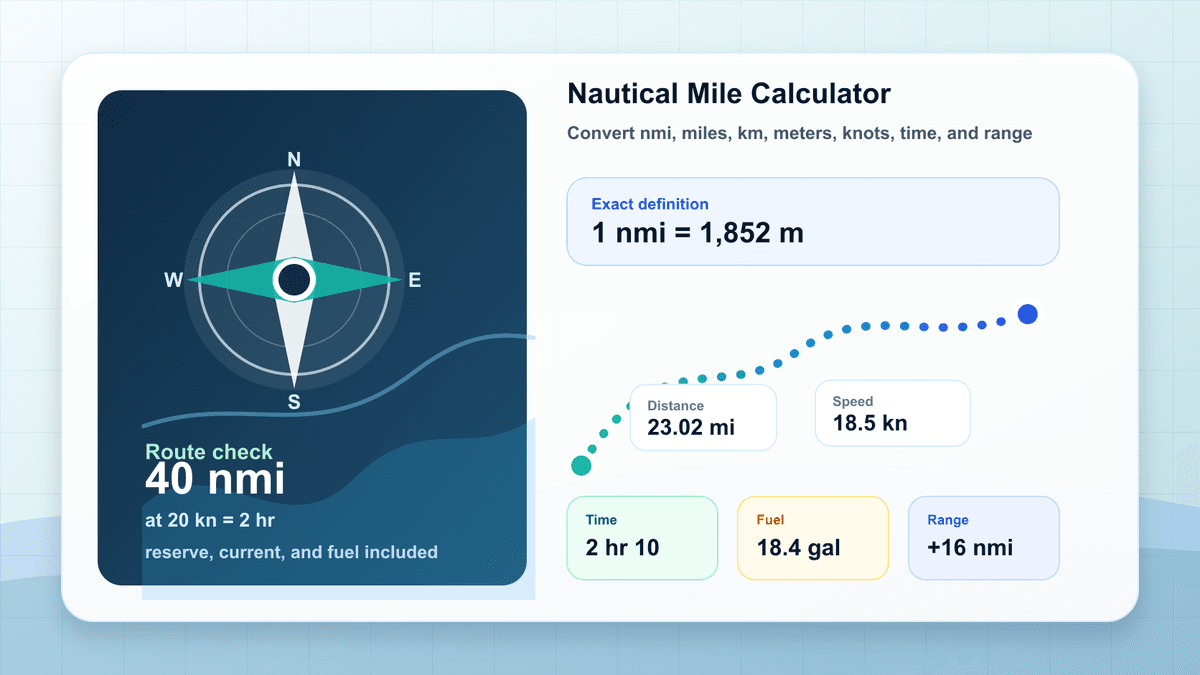
One nautical mile equals exactly 1,852 meters, 1.852 kilometers, about 1.15078 statute miles, and about 6,076.1155 feet. A knot is one nautical mile per hour, so a 40 nmi route at 20 knots takes about 2 hours before current, wind, stops, or reserve margin.
Start with the distance value and choose whether it is already in nautical miles, statute miles, kilometers, meters, or feet. The calculator converts the distance into the core navigation units and keeps the exact 1,852-meter definition visible.
Next, enter speed in knots and a current or wind correction. Use a positive correction when the current or wind helps the route and a negative correction when it opposes the route. The tool calculates speed over ground, travel time, distance covered in a planned time, fuel needed, endurance, and reserve-adjusted range.
Step 1: Enter the distance and unit
Choose nautical miles, statute miles, kilometers, meters, or feet. The calculator normalizes everything to nautical miles first.
Step 2: Add speed and current or wind correction
Enter speed in knots, then use a positive correction for favorable current or tailwind and a negative correction for adverse current or headwind.
Step 3: Check time, fuel, and range
Review speed over ground, travel time, fuel needed with reserve, reserve-adjusted range, and warning messages before using the result.
Nautical Mile Formulas
The calculator uses the international nautical mile as the anchor: 1 nmi = 1,852 meters. That exact meter value creates the kilometer conversion, while statute miles and feet are derived from standard length conversions.
| Formula | Equation | When to use it |
|---|---|---|
| Nautical miles to meters | meters = nautical miles x 1852 | The international nautical mile is exactly 1,852 meters. |
| Nautical miles to statute miles | statute miles = nautical miles x 1.150779448 | Use this only for land-mile comparison, not chart plotting. |
| Nautical miles to kilometers | kilometers = nautical miles x 1.852 | Metric equivalent used in many international references. |
| Travel time | time hours = distance nautical miles / speed over ground knots | Use speed over ground after current or headwind/tailwind correction. |
| Distance from knots and time | distance nautical miles = speed over ground knots x time hours | A knot is one nautical mile per hour. |
| Reserve-adjusted range | range nmi = usable fuel gallons / fuel burn gph x speed over ground knots | Helpful for deciding whether a leg has enough practical range margin. |
The important planning distinction is speed through water or air versus speed over ground. A boat moving at 18 knots through the water with a 2-knot adverse current is only making about 16 knots over the ground. The same idea applies to aircraft nav logs with headwind and tailwind correction.
| Example | Inputs | Result |
|---|---|---|
| Short harbor crossing | 12 nmi at 18 kn with 1.2 kn favorable current | Speed over ground is 19.2 kn, so the leg takes about 38 minutes. |
| Offshore coastal leg | 64 nmi at 22 kn with 1.5 kn adverse current | Speed over ground is 20.5 kn, so the leg takes about 3 hr 7 min before delays. |
| Land-mile comparison | 100 statute miles | 100 mi ÷ 1.150779448 = about 86.8976 nmi. |
| Chart-scale learning | 30 nmi north-south | Roughly 30 minutes of latitude, or 0.5 degrees of latitude, before local chart detail. |
What Makes a Nautical Mile Different
A nautical mile belongs to navigation, not ordinary road-distance measurement. NOAA explains the practical relationship between nautical miles and knots, and NIST lists the nautical mile as exactly 1,852 meters in its SI guide. That is why the calculator treats the meter relationship as fixed and exact.
The search intent behind a nautical-mile calculator is usually broader than a single conversion. People often need to know whether a route is 18 nmi or 18 mi, how long a 12-knot passage will take, whether an aviation leg in nmi matches a route estimate, or whether a boat has enough fuel after reserve. This page keeps those decisions in one place.
Nautical Mile vs Mile vs Kilometer
One nautical mile is longer than a statute mile. The difference is about 15%, so a 100-nmi route is about 115.08 land miles. That gap is too large to ignore when estimating arrival time, fuel need, aircraft endurance, or marine range.
| Question | Use this unit | Reason |
|---|---|---|
| Marine chart distance | Nautical miles | Charts, courses, and knots are built around nmi. |
| Aircraft route leg | Nautical miles | Aviation navigation commonly reports distance and speed as nmi and knots. |
| Road trip distance | Statute miles or kilometers | Road systems use land miles or kilometers, not nautical miles. |
| Exact SI conversion | Meters | The modern nautical mile is exactly 1,852 meters. |
Competitor Analysis and Improvement
The competing nautical-mile page covers the essential conversion and explains the knot relationship. This implementation goes further by connecting the conversion to speed over ground, reserve-adjusted range, fuel burn, latitude-minute context, and warning logic for the mistakes that make nautical-mile answers risky when copied blindly.
| Tool | What it covers | Quality gap or advantage |
|---|---|---|
| Basic nautical mile calculator | Converts nautical miles, imperial/US units, metric units, and calculates time/speed/distance. | Useful as a simple converter, but it is easy to stop at one number without checking speed over ground, fuel reserve, range margin, or statute-mile confusion. |
| This Nautical Mile Calculator | Distance conversion, knots, current or wind correction, travel time, planned-distance check, fuel burn, reserve, endurance, range margin, latitude-minute context, and warnings. | Designed for the real intent behind the search: navigation math that explains what to do with nautical miles after conversion. |
| Best practical workflow | Calculator result plus official chart, weather, route restrictions, equipment, and legal reserve requirements. | Use the calculator for arithmetic and education, then verify operational decisions with official sources and qualified instruction. |
Common Mistakes to Avoid
| Mistake | Why it matters |
|---|---|
| Treating nautical miles and statute miles as interchangeable | One nautical mile is about 15% longer than one statute mile. That difference compounds quickly over a route. |
| Using speed through water as speed over ground | Current, tide, or wind can change the distance covered over the ground in one hour. |
| Forgetting reserve fuel or reserve time | Detours, weather, harbor traffic, holding, and docking or landing delays need margin. |
| Saying knots per hour for speed | A knot already means nautical miles per hour. Knots per hour describes acceleration, not normal speed. |
| Using latitude-minute shortcuts as precise survey math | One minute of latitude is a practical navigation idea, but official charts and exact geodesic tools matter for precise positions. |
Official Video Check
I looked for a credible official or institutional video specifically explaining nautical miles, knots, and their navigation relationship. I did not find a suitable official video to embed. Instead, this page cites NOAA and NIST written references and keeps the explanation in text and calculator output.
Related workflows
For boat performance and propeller math, use the Boat Speed Calculator. For broad speed-unit conversion, use the Speed Converter. For aviation wind components, use the Crosswind Calculator.
Keep the research moving with Boat Speed Calculator, Speed Converter, Crosswind Calculator, and Drive Time Calculator.
Frequently Asked Questions
Related Calculators
Boat Speed Calculator
Estimate boat speed, prop slip, hull speed, fuel efficiency, and range in knots or mph.
Use Boat Speed CalculatorSpeed Converter
Convert knots, mph, km/h, m/s, and other speed units with exact factors.
Use Speed ConverterCrosswind Calculator
Calculate aviation headwind, tailwind, crosswind, gust component, and limit margin.
Use Crosswind CalculatorDrive Time Calculator
Plan route time, arrival time, stops, traffic delay, and schedule buffer.
Use Drive Time CalculatorSources & References
- 1.Omni Calculator - Nautical Mile Calculator(Accessed July 2, 2026)
- 2.NOAA Ocean Service - nautical mile and knot explanation(Accessed July 2, 2026)
- 3.NIST Guide to the SI - Units Outside the SI(Accessed July 2, 2026)
- 4.NOAA Ocean Service - currents tutorial, knots and nautical miles(Accessed July 2, 2026)
- 5.National Hurricane Center - forecast/advisory terminology(Accessed July 2, 2026)