
Speed Calculator
Calculate average speed, travel time, or distance from the motion triangle, then check mph, km/h, m/s, knots, pace, ETA, comparison-speed savings, and split-segment averages.
Last Updated: July 2026
Speed, Distance, and Time Solver
Solve the core motion triangle, then check unit conversions, pace, ETA with buffer, comparison-speed savings, and split-segment average speed.
Average speed, travel time, pace, and unit conversion
Calculate speed from distance and time, or solve the missing value
Pick a mode, enter the known values, and use the comparison fields to see whether a different average speed changes the trip by minutes or hours.
Core Inputs
Leave 0 when speed is the unknown.
Comparison and ETA
Use 24-hour HH:MM format.
Split Segment Check
Average speed
55.5 mph
Total distance divided by total moving time. Current average is 55.5 mph / 89.32 km/h.
Speed screen
Consistent estimate
Travel Time
3 hr 20 min 0 sec
Distance
185 mi / 297.73 km
Pace per Mile
1 min 5 sec
Pace per Kilometer
40 sec
Comparison Time
2 hr 50 min 46 sec
ETA with Buffer
12:10 PM
Practical Checks
- The distance, time, and speed assumptions are internally consistent. Use official route, weather, navigation, or event data before relying on the result.
Summary Table
| Metric | Result | Meaning |
|---|---|---|
| Solved value | 55.5 mph | Total distance divided by total moving time. |
| Distance | 185 mi / 297.73 km | Total distance used in the formula. |
| Time | 3 hr 20 min 0 sec | Total time used in the formula. |
| Departure + buffer ETA | 12:10 PM | Includes 10% schedule buffer. |
Speed and Pace Conversions
| View | Result | Use |
|---|---|---|
| Meters per second | 24.8107 m/s | SI-style speed expression. |
| Miles per hour | 55.5 mph | Common U.S. road-speed expression. |
| Kilometers per hour | 89.319 km/h | Common metric road-speed expression. |
| Knots | 48.228 kt | Nautical miles per hour. |
| Pace per mile | 1:05 min/mi | Useful for running, walking, and cycling. |
| Pace per kilometer | 0:40 min/km | Metric pace view. |
Compare Another Speed
| Scenario | Time or speed | Interpretation |
|---|---|---|
| Current estimate | 185 mi in 3 hr 20 min 0 sec | 55.5 mph average |
| Comparison speed | 65 mph | 2 hr 50 min 46 sec for the same distance |
| Time saved or lost | 29 min 14 sec faster | Negative difference means the comparison speed is faster. |
Segment Average
| Segment | Distance | Time | Average speed |
|---|---|---|---|
| Segment 1 | 75 mi | 1 hr 35 min 0 sec | 47.37 mph |
| Segment 2 | 110 mi | 1 hr 45 min 0 sec | 62.86 mph |
| Combined segments | 185 mi | 3 hr 20 min 0 sec | 55.5 mph |
Planning and Safety Notice
This calculator is for educational and planning use. It does not replace posted speed limits, official route data, air or marine navigation sources, event timing systems, weather briefings, vehicle limits, or professional judgment.
Checked by Jitendra Kumar
Speed Calculator is checked for formula labels, source links, and result limits.
Jitendra Kumar, Founder & Editorial Standards Lead. Updated July 2026. Scope: everyday calculators.
How to Use the Speed Calculator
Quick answer
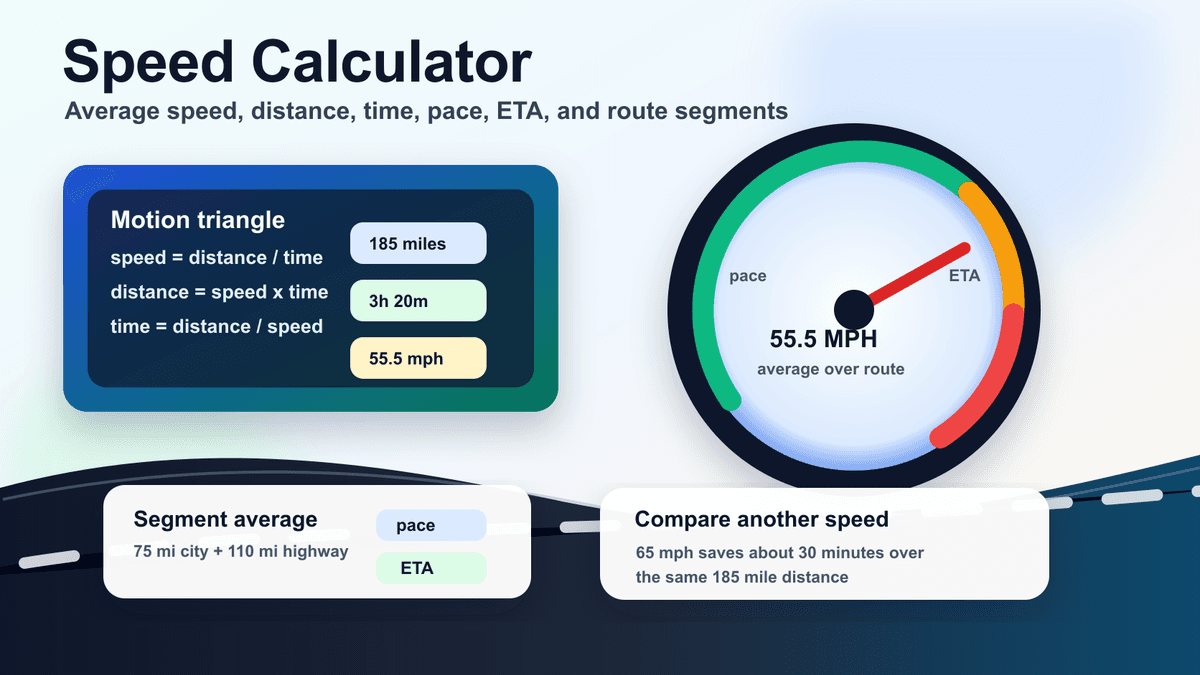
Average speed is total distance divided by total time. To find time, divide distance by speed. To find distance, multiply speed by time. This calculator solves all three versions and keeps unit conversions visible so miles, kilometers, meters, feet, nautical miles, mph, km/h, m/s, ft/s, and knots do not get mixed accidentally.
Start by choosing whether you want to find speed, distance, or time. Enter the known values in matching units, then use the comparison speed field to see how much faster or slower another average speed would be over the same distance.
Use the segment checker when one route has two parts, such as city plus highway, uphill plus downhill, or outbound plus return. Segment averaging is often more accurate than assuming one constant speed for the whole trip.
Step 1: Choose the unknown
Select Find speed, Find distance, or Find time before entering values.
Step 2: Enter matching distance, time, and speed units
Use miles, kilometers, meters, feet, nautical miles, mph, km/h, m/s, ft/s, or knots as appropriate.
Step 3: Review pace, ETA, comparison, and segment checks
Use the expanded result tables to decide whether the answer is realistic for the route or event.
Speed Formulas
Speed measures distance per unit of time. NIST lists velocity as a derived SI-style quantity in meters per second, built from the base units meter and second. Everyday planning often uses mph, km/h, knots, or pace, so the calculator converts through meters per second before displaying practical units.
| Formula | Equation | When to use it |
|---|---|---|
| Average speed | speed = total distance / total time | Use when you know how far something moved and how long the movement took. |
| Travel time | time = distance / speed | Use when you know route distance and a realistic average speed. |
| Distance covered | distance = speed x time | Use when speed and available time are known. |
| Pace per mile | minutes per mile = 60 / mph | Useful for running, walking, cycling, and event splits. |
| Pace per kilometer | minutes per kilometer = 60 / km/h | Metric pace view for training and race planning. |
| Comparison time | time difference = distance / comparison speed - current time | Shows whether another average speed meaningfully changes arrival time. |
The important audit rule is to convert units first. For example, 1 hour 20 minutes is 1.333 hours, not 1.20 hours. A nautical-mile route should use knots or converted nautical miles per hour, not statute miles per hour.
| Example | Inputs | Result |
|---|---|---|
| Road trip | 185 miles in 3 hr 20 min | 185 / 3.333 = 55.5 mph average before schedule buffer. |
| 10K run | 10 km in 52 min 30 sec | Average speed is about 11.43 km/h, or about 8:27 per mile. |
| Nautical route | 42 nmi at 18 knots | Time is 42 / 18 = 2.33 hr, or about 2 hr 20 min. |
| Walking distance | 3.2 mph for 45 minutes | Distance is 3.2 x 0.75 = 2.4 miles. |
Average Speed, Pace, and Travel Planning
The competitor covers the essential distance-time-speed relationship and lets users compare a different speed. That is the right starting point. The missing practical pieces are unit transparency, pace output, ETA buffer, segment averaging, and warnings about average speed versus top speed.
| Tool | What it covers | Quality gap or advantage |
|---|---|---|
| Basic speed calculator | Distance, time, speed, and a comparison-time option | Good for the core formula but light on pacing, ETA, knots, segment averages, warnings, and planning context. |
| This Speed Calculator | Solve for speed, distance, or time with miles, kilometers, meters, feet, nautical miles, mph, km/h, m/s, ft/s, knots, pace, ETA, and split segments | Adds unit-aware planning, comparison-speed savings, schedule buffer, segment averaging, pace output, source-backed explanations, and internal workflows. |
| Best practical workflow | Calculator result plus route map, official speed limits, event timing, navigation data, tide/current or wind context when relevant | Use for planning and learning; use official route, weather, or operational data for safety-critical decisions. |
Educational Video: Average Velocity or Speed
The Khan Academy video below explains why average speed uses distance divided by time and why velocity is different when direction or displacement matters.
Common Mistakes to Avoid
| Mistake | Why it matters |
|---|---|
| Using top speed as average speed | The calculator needs average speed over the whole distance, including slower sections if they are part of the measured time. |
| Mixing distance units | Miles, kilometers, meters, feet, and nautical miles must be converted before applying the formula. |
| Counting stopped time accidentally | Including lunch, traffic, or rest stops lowers average speed. That may be correct for door-to-door planning but not for moving-speed analysis. |
| Confusing speed and velocity | Average speed uses total distance. Average velocity uses displacement and direction. |
| Skipping route reality | Road limits, terrain, current, wind, stops, weather, and safety margins can matter more than the clean formula. |
Related workflows
Use the Drive Time Calculator when stops, traffic, fuel stops, time zones, and latest departure matter. Use the Nautical Mile Calculator for knot-based routes, and use the Speed Converter when the job is only unit conversion.
Keep the research moving with Drive Time Calculator, Nautical Mile Calculator, Speed Converter, and Time Hours Calculator.
Frequently Asked Questions
Related Calculators
Drive Time Calculator
Add stops, fuel stops, traffic delay, time-zone changes, fuel cost, and latest-departure planning.
Use Drive Time CalculatorNautical Mile Calculator
Convert nautical miles and plan knot-based travel time, current/wind correction, range, and reserve.
Use Nautical Mile CalculatorSpeed Converter
Convert mph, km/h, m/s, ft/s, knots, Mach references, scientific speed units, and more.
Use Speed ConverterTime Hours Calculator
Add and subtract hours, minutes, shifts, and durations when the speed problem becomes time-sheet math.
Use Time Hours CalculatorSources & References
- 1.Omni Calculator - Speed Calculator(Accessed July 2, 2026)
- 2.Khan Academy - Calculating average velocity or speed(Accessed July 2, 2026)
- 3.NIST - SI Units(Accessed July 2, 2026)
- 4.NIST - Meter and speed of light(Accessed July 2, 2026)
- 5.NASA JPL Education - Planetary Travel Time(Accessed July 2, 2026)