
Can I Get a Tax Refund If I Earn $100,000?
A practical guide explaining whether a $100,000 earner can still get a tax refund, with 2025 federal tax-year examples filed in 2026, withholding scenarios, child credit examples, IRS refund timing, and official IRS source links.
Guide Oversight & Review Policy
CalculatorWallah guides are written to explain calculator assumptions, source limitations, and when users should move from a rough estimate to an official rule, institution policy, or clinician conversation.
Jitendra Kumar, Founder & Editorial Standards Lead. Updated June 25, 2026. Scope: Sales tax and tax-sensitive estimate tools, Education and GPA planning calculators, Health, protein, and screening-formula pages, Platform-wide publishing standards and methodology.
Tax credentialed review: Named internal reviewer: Iliyas Khan, Chief Operating Officer. External credentialed professional review is still required before this page is treated as professional advice.
Internal tax and sales-tax methodology reviewer. Review scope: calculator assumptions, labels, source context, workflow clarity, and compliance-sensitive disclaimers.
Relevant review context: CalculatorWallah tax and sales-tax calculator workflow owner; Source-first review of IRS, state revenue, rate, and filing-sensitive references; Compliance-sensitive labels, assumptions, and user-facing disclaimer review.
Required professional credentials: CPA, Enrolled Agent, licensed tax professional. Scope: tax formulas, jurisdiction assumptions, withholding language, filing-sensitive examples, and compliance caveats.
This page is educational planning support. A named CPA, EA, or licensed tax professional should review the page before it is positioned as tax advice or used for filing decisions.
Professional Review Status
This YMYL page has internal methodology review, but no external credentialed professional review is recorded yet.
- Reliance status
- Credentialed tax review required before professional reliance
- Required credentials
- CPA, Enrolled Agent, licensed tax professional
- Review scope
- tax formulas, jurisdiction assumptions, withholding language, filing-sensitive examples, and compliance caveats
Current reviewer: Iliyas Khan, Internal tax and sales-tax methodology reviewer.
This page is educational planning support. A named CPA, EA, or licensed tax professional should review the page before it is positioned as tax advice or used for filing decisions.
On This Page
Short Answer: Yes, $100,000 Can Still Get a Refund
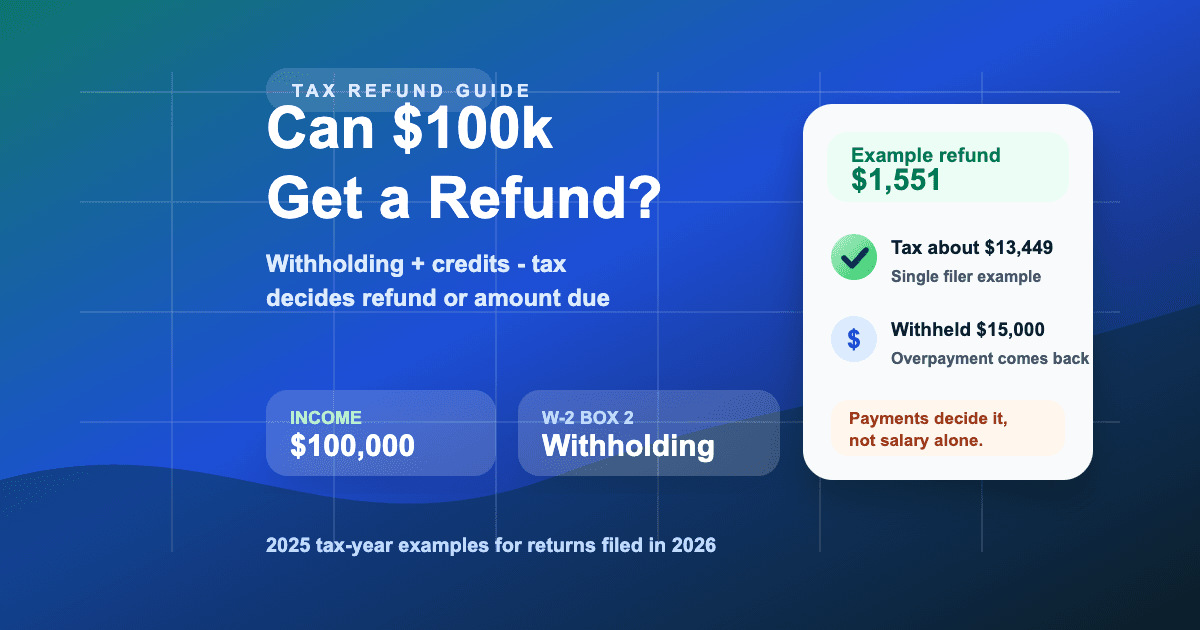
Yes. You can get a tax refund if you earn $100,000. Income by itself does not decide the refund. The refund is the difference between what you paid in and what your final federal tax return says you owe.
The basic formula is: federal withholding plus estimated payments plus refundable credits, minus total federal tax. If the result is positive, you get a refund. If it is negative, you owe. Use the Tax Refund Calculator after entering your actual W-2 box 2 withholding, credits, and any 1099 income.
Refund Calculator Workflow for $100,000 Income
The calculator formula is federal withholding + estimated payments + refundable credits - total federal tax. For a $100,000 earner, the result usually changes because of filing status, withholding, credits, side income, and pre-tax deductions, not because the income level itself blocks a refund.
| Step | Calculator input | Quality check |
|---|---|---|
| Start with taxable income | Gross W-2 wages minus standard or itemized deductions and pre-tax adjustments. | Do not use salary alone when retirement, HSA, FSA, or other pre-tax benefits changed box 1 wages. |
| Estimate regular federal tax | Filing status, taxable income, tax brackets, and nonrefundable credits. | Compare single, head of household, and married filing jointly if status is uncertain. |
| Add payments | W-2 withholding, 1099 withholding, estimated payments, and prior-year refund applied. | Use W-2 box 2 and payment confirmations instead of paycheck guesses when forms are final. |
| Add refundable credits | Eligible refundable child, education, premium tax, or earned income credits. | Check eligibility before assuming a credit amount; some credits phase out or require specific forms. |
| Compare result | Payments plus refundable credits minus total federal tax. | A positive number is refund; a negative number is balance due before penalties or interest. |
Use the Tax Refund Calculator after entering actual withholding and payment records. If the refund is too large or too small, use the W-4 Withholding Adjustment Calculator to plan the next payroll year.
$100,000 Baseline for 2025 Returns Filed in 2026
These examples use 2025 federal tax-year brackets and standard deduction assumptions for returns filed in 2026. They show regular federal income tax before credits, self-employment tax, investment tax, penalties, state tax, and other adjustments.
| Filing status | Gross income | Standard deduction | Taxable income | Estimated regular federal tax | Refund signal |
|---|---|---|---|---|---|
| Single | $100,000 W-2 wages | $15,750 | $84,250 | About $13,449 | Refund if withholding and refundable credits exceed this. |
| Married filing jointly | $100,000 W-2 wages | $31,500 | $68,500 | About $7,743 | Refund threshold is lower because the joint standard deduction is larger. |
| Head of household | $100,000 W-2 wages | $23,625 | $76,375 | About $9,978 | Refund depends on withholding, credits, and dependent eligibility. |
Examples: Same $100,000, Different Refund Result
The reason one $100,000 earner gets a refund while another owes is usually withholding, credits, or side income. These simplified examples isolate the refund formula so the moving parts are easier to see.
| Scenario | Regular tax | Payments and credits | Likely result | Why |
|---|---|---|---|---|
| Single employee, no credits | $13,449 | $15,000 federal withholding | About $1,551 refund | Withholding is higher than estimated regular federal income tax. |
| Single employee, no credits | $13,449 | $11,500 federal withholding | About $1,949 owed | Income is the same, but withholding is too low. |
| Married filing jointly, no dependents | $7,743 | $9,500 federal withholding | About $1,757 refund | The joint standard deduction lowers taxable income before withholding is compared. |
| Married filing jointly, one qualifying child | $7,743 | $9,500 withholding + $2,200 child tax credit assumption | About $3,957 refund | The credit reduces tax before withholding is refunded. Eligibility rules still matter. |
| Head of household, one qualifying child | $9,978 | $9,000 withholding + $2,200 child tax credit assumption | About $1,222 refund | Credits can move the result from balance due to refund. |
Why Refunds Happen at $100,000
Refunds happen when the IRS already received more than the final return required. For a W-2 employee, that usually means payroll withholding was higher than necessary. It can also happen when credits lower the final tax after paychecks have already withheld tax throughout the year.
A refund is not a bonus from the IRS. It is usually your own overpayment coming back to you. That is why two people with the same salary can have opposite outcomes: one person overpaid through withholding, while another had too little withholding or extra income that was not prepaid.
What Changes the Refund Result
The fastest way to estimate your answer is to separate income, tax, payments, and credits. Do not assume $100,000 is too high for a refund or low enough for a refund. The details below usually decide the result.
| Factor | Effect |
|---|---|
| Federal withholding | The biggest lever for many W-2 workers. More withholding usually means a bigger refund and less take-home pay. |
| Filing status | Single, head of household, and married filing jointly can produce very different taxable income from the same $100,000. |
| Dependents and credits | Child, education, marketplace health insurance, and refundable credits can reduce tax or increase a refund. |
| Side income | 1099, investment, unemployment, or retirement income can shrink or eliminate a refund if tax was not prepaid. |
| Pre-tax deductions | 401(k), HSA, FSA, and some benefit deductions can lower taxable wages and change the refund estimate. |
| Estimated payments | Quarterly payments and prior-year refund carryforwards count as payments toward the final return. |
Documents to Use Before You Trust the Estimate
A refund estimate gets much better when it uses actual tax documents instead of rough salary numbers. Start with W-2 withholding, then add any income and payments outside your paycheck.
| Document | Line to check | Use |
|---|---|---|
| W-2 | Box 1 wages and box 2 federal income tax withheld. | Start with actual taxable wages and withholding, not annual salary alone. |
| Final paystub | Year-to-date taxable wages, federal withholding, 401(k), HSA, and benefits. | Useful before the W-2 arrives, but reconcile it with the final W-2. |
| 1099 forms | 1099-NEC, 1099-INT, 1099-DIV, 1099-B, 1099-R, and any federal withholding. | Captures income that may not have normal payroll withholding. |
| Credit records | Dependent details, Form 1098-T, Form 1095-A, childcare, and education costs. | Confirms whether credits are available and whether any portion is refundable. |
| Estimated tax records | IRS Direct Pay, EFTPS, check records, or prior-year refund applied. | Adds payments made outside payroll. |
Use Form W-4 Planning if the Refund Is Too Big or Too Small
If your refund is much larger than expected, your W-4 may be withholding more federal income tax than you need. If you owe, your W-4 may be too light, especially if you have a spouse, multiple jobs, bonus income, 1099 work, investment income, or taxable retirement income.
The IRS Tax Withholding Estimator is the official in-year planning tool. Use it after pay changes, marriage, divorce, a new child, a second job, freelance work, or a major credit change. For multiple jobs, also read How to Calculate Taxes When You Have Two Jobs.
Official IRS Video Context
I looked for official refund videos and found this IRSvideos Short about checking refund status. It does not estimate the refund amount, but it is directly relevant after filing: once your return is accepted, the IRS refund tracker uses the filed return details.
IRSvideos: Check Your Tax Refund Status
This official IRS video is relevant after filing because refund amount and refund tracking are separate steps. Estimate the amount first, then use IRS tools to track the return after it has been accepted.
$100,000 Tax Refund Checklist
- Confirm whether $100,000 is W-2 box 1 wages, gross salary, or total household income.
- Choose the right filing status before estimating tax.
- Use the actual standard deduction or itemized deductions for the tax year.
- Enter all federal withholding from W-2s, 1099s, pensions, and retirement forms.
- Add estimated payments and any prior-year refund applied to the current year.
- Enter dependents and credits only when the eligibility rules are met.
- Include 1099 work, investment income, unemployment, and retirement income.
- Separate federal refund from state refund.
- After filing, use IRS refund tools to track timing rather than recalculating the return.
FAQ: The Clean Way to Think About a $100,000 Refund
The clean question is not, “Is $100,000 too much income for a refund?” The clean question is, “Did I pay in more than my final tax after deductions and credits?” A single filer with $100,000 and low withholding may owe. A married filer with the same income, higher withholding, and eligible credits may receive a refund.
Trust and Update Notes
This guide was updated on June 25, 2026 using IRS federal bracket resources, IRS refund guidance, IRS direct deposit guidance, IRS withholding tools, IRS credits and deductions guidance, IRS refundable credit guidance, and an official IRSvideos refund-status video. The examples use 2025 tax-year math for returns filed in 2026. Verify final results with your actual W-2s, 1099s, credits, state rules, and filed tax return.
Frequently Asked Questions
Related Calculators
Tax Refund Calculator
Estimate whether your withholding, payments, and refundable credits create a refund or balance due.
Use Tax Refund CalculatorFederal Income Tax Calculator
Estimate regular federal income tax before comparing it with withholding and credits.
Use Federal Income Tax CalculatorPaycheck Calculator
Check how paycheck withholding changes take-home pay and refund size.
Use Paycheck CalculatorFICA Tax Calculator
Separate Social Security and Medicare withholding from federal income tax withholding.
Use FICA Tax CalculatorSelf-Employment Tax Calculator
Estimate the extra tax that freelance or contractor profit can add to a W-2 return.
Use Self-Employment Tax CalculatorW-4 Withholding Adjustment Calculator
Adjust paycheck withholding when the refund is much larger or smaller than planned.
Use W-4 Withholding Adjustment CalculatorSources & References
- 1.IRS - Federal income tax rates and brackets(Accessed May 2026)
- 2.IRS - Tax Withholding Estimator(Accessed May 2026)
- 3.IRS - Refunds(Accessed May 2026)
- 4.IRS - Get your refund faster with direct deposit(Accessed May 2026)
- 5.IRS - Refundable tax credits(Accessed May 2026)
- 6.IRS - Credits and deductions for individuals(Accessed May 2026)
- 7.IRSvideos - Check Your Tax Refund Status(Accessed May 2026)