
Form 1040 Deadline 2026: April 15 Filing Date, Extension Rules, and Late-Filing Checklist
A detailed 2026 Form 1040 deadline guide for 2025 federal returns, including the April 15 filing and payment deadline, October 15 extension date, late-filing steps, taxpayer scenarios, calculators, official IRS video, and source-backed checklist.

Guide Oversight & Review Policy
CalculatorWallah guides are written to explain calculator assumptions, source limitations, and when users should move from a rough estimate to an official rule, institution policy, or clinician conversation.
Reviewed by Jitendra Kumar, Founder & Editorial Standards Lead. Page updated May 8, 2026. Trust-critical pages are reviewed when official rates or rules change. Evergreen calculator guides are checked on a recurring quarterly or annual cycle depending on topic volatility. Topic ownership: Sales tax and tax-sensitive estimate tools, Education and GPA planning calculators, Health, protein, and screening-formula pages, Platform-wide publishing standards and methodology.
On This Page
Form 1040 Deadline 2026
The main Form 1040 deadline in 2026 was April 15, 2026 for most calendar-year individual taxpayers filing a 2025 federal income tax return. That was both the filing deadline and the payment deadline for tax due with Form 1040 or Form 1040-SR.
This guide is updated as of May 8, 2026, so the original April 15 deadline has already passed. If you filed a valid extension, the next major federal date is usually October 15, 2026, when the completed 2025 return must be filed. If you did not file or extend, the priority is to file as soon as possible and pay what you can.
Countdown Timer
The tracked 2026 IRS deadline sequence is complete.
Original Due Date
April 15, 2026
Most 2025 Form 1040 and Form 1040-SR returns were due on this date, and any unpaid 2025 federal tax balance was also due.
Extension Date
October 15, 2026
A valid extension can move the filing date for many individual returns, but it does not move the payment deadline.
Current Status
April deadline has passed
As of May 8, 2026, taxpayers who missed April 15 should focus on filing, paying, and reducing penalty exposure.
Quick Form 1040 Actions
Use calculators for estimates, then confirm filing, payment, and extension rules with the official IRS pages before acting.
Key Form 1040 Dates for 2026
Form 1040 timing is more than one day. The original annual return deadline, the extension deadline, estimated tax dates, and special nonresident or abroad rules can all touch the same taxpayer.
2026 Form 1040 Deadline Calendar
| Date | Deadline | Applies To | Action |
|---|---|---|---|
| January 15, 2026 | 2025 Q4 estimated tax payment | Taxpayers who paid 2025 federal estimated tax | Pay the final 2025 installment if required, or reconcile it on the 2025 Form 1040. |
| April 15, 2026 | Original Form 1040 deadline | Most Form 1040 and Form 1040-SR filers for the 2025 tax year | File the return, pay tax due, or request a valid extension by this date. |
| April 15, 2026 | Form 4868 and payment estimate | Taxpayers who needed more time to file | Request the extension and pay the best available estimate. The payment deadline did not move. |
| June 15, 2026 | Certain abroad and nonresident filing dates | Some taxpayers outside the United States and some Form 1040-NR filers | Confirm whether a special rule applies before relying on June 15. |
| June 15, 2026 | 2026 Q2 estimated tax payment | Taxpayers making 2026 Form 1040-ES payments | Pay the second 2026 estimated installment if required. |
| September 15, 2026 | 2026 Q3 estimated tax payment | Taxpayers making 2026 Form 1040-ES payments | Pay the third 2026 estimated installment if required. |
| October 15, 2026 | Extended Form 1040 filing deadline | Many individual taxpayers with a valid federal extension | File the completed 2025 return. Do not treat this as a payment extension. |
| January 15, 2027 | 2026 Q4 estimated tax payment | Taxpayers making 2026 Form 1040-ES payments | Pay the final 2026 estimated installment, unless an exception applies. |
The dates above are federal dates. State income tax, city tax, disaster postponements, fiscal-year issues, and military or overseas rules can change the operational calendar.
What Form 1040 Covers
Form 1040 is the core federal individual income tax return. A taxpayer may attach schedules and forms for wages, interest, dividends, capital gains, retirement income, Social Security, business income, credits, deductions, self-employment tax, estimated tax payments, and refund or balance-due instructions.
For deadline planning, the important point is that the Form 1040 due date usually covers the entire individual return package. A sole proprietor may be thinking about Schedule C, an investor may be waiting on a brokerage 1099, and a parent may be checking education credits, but the return still routes through the individual Form 1040 deadline.
Annual Return
Form 1040 or 1040-SR
Used by many individuals to report 2025 income, deductions, credits, payments, refund, and tax due.
Extension Form
Form 4868
Used by many U.S. citizens and residents to request an automatic extension of time to file an individual return.
Estimated Payments
Form 1040-ES
Used to calculate and pay quarterly estimated tax for income not fully covered by withholding.
Nonresident Return
Form 1040-NR
Used by nonresident aliens with U.S. income, with deadlines that can differ by wage and withholding facts.
Form 1040 Extension Rules
The standard individual extension workflow is simple in concept: request the extension by the original due date and pay the estimated balance due by the original due date. The trap is assuming the extension gives six more months to pay. It usually does not.
If a valid extension was filed by April 15, 2026, many taxpayers have until October 15, 2026 to file the completed 2025 Form 1040. Interest and failure-to-pay exposure can still apply if the April payment estimate was short.
Extension Helps
Filing time
More time to gather corrected forms, finish bookkeeping, review credits, and file a complete return.
Extension Does Not Help
Payment time
More time to wait on the original 2025 tax balance. Any balance due should generally have been paid by April 15.
Keep Proof
Save the confirmation
Keep Form 4868 records, tax software acceptance, Free File confirmation, or payment confirmation marked as an extension.
File Early
October 15 is a ceiling
If the return is ready in May, June, or July, there is usually no benefit to waiting until October.
What to Do If You Missed the April 15 Deadline
Because this guide is dated May 8, 2026, a taxpayer who has not filed or extended is already in cleanup mode. The safest general sequence is to file the return, pay what is possible, and then deal with any remaining balance or IRS notice.
Step 1
File the return
Filing late because you cannot pay can make penalties worse. File electronically if possible and save the acceptance confirmation.
Step 2
Pay what you can
Even a partial payment can reduce future penalty and interest growth. Use official IRS payment channels and keep proof.
Step 3
Review payment options
If full payment is not possible, review IRS payment plan options after filing or while filing the completed return.
If you are due a refund, filing late may not create the same balance-due pressure, but it still delays the refund. For an older unfiled year, refund-claim timing becomes more important, so do not let unfiled returns sit.
Form 1040 Filing Checklist
Good deadline management is mostly document control. The return cannot be clean if income forms, payment records, identity details, or state records are missing.
Income Documents
- W-2 wage statements and corrected W-2c forms if issued.
- 1099-INT, 1099-DIV, 1099-B, 1099-R, 1099-NEC, 1099-MISC, and 1099-K forms.
- Schedule K-1 forms from partnerships, S corporations, estates, or trusts.
- Unemployment, Social Security, pension, IRA, and brokerage tax forms.
Deduction and Credit Records
- Mortgage interest, property tax, charitable giving, and medical expense records.
- Education forms such as Form 1098-T and student loan interest forms.
- Child care provider details, adoption records, clean energy records, and eligible credit support.
- Marketplace Form 1095-A if a premium tax credit was involved.
Payment Records
- Federal withholding shown on W-2s and 1099s.
- 2025 estimated tax payments and any prior-year overpayment applied to 2025.
- IRS Direct Pay, EFTPS, card payment, or tax software payment confirmations.
- Extension payment confirmation if Form 4868 or an online extension payment was used.
Final Filing Checks
- Names, Social Security numbers, address, bank details, and filing status.
- Dependents, custody agreements, identity protection PINs, and prior-year AGI or e-file PIN.
- State return status, local tax requirements, and disaster-relief eligibility if applicable.
- E-file acceptance confirmation, PDF copy, and proof of payment saved in one folder.
How the Deadline Changes by Taxpayer Type
The federal date may be the same, but the reason a return is late or extended differs by taxpayer. Use the scenario cards to find the pressure point before filing.
Scenario
W-2 Employees
Most employees filed Form 1040 or Form 1040-SR by April 15, 2026. If a balance was due, compare the result with 2026 withholding so the same issue does not repeat.
Scenario
Self-Employed Filers
Sole proprietors usually attach Schedule C and Schedule SE to Form 1040. They should track the annual return deadline separately from quarterly Form 1040-ES payments.
Scenario
Investors
Brokerage forms, capital gains, dividends, interest, and crypto records can delay a return. Confirm corrected 1099-B or composite statements before filing.
Scenario
Retirees
Retirees may use Form 1040 or Form 1040-SR and should reconcile Social Security, pensions, IRA distributions, withholding, estimated payments, and required minimum distributions.
Scenario
Students and Parents
Education credits, dependency, scholarship taxability, Form 1098-T, and Marketplace coverage can change the return. Verify who claims the student before filing.
Scenario
Taxpayers Abroad
Some U.S. taxpayers abroad receive an automatic two-month filing extension, but payment and interest rules can still matter. Foreign account reporting may have separate dates.
Payment, Refund, and Withholding Planning
The Form 1040 deadline is also a cash-flow checkpoint. A surprise balance due often means the taxpayer should review wage withholding, estimated tax payments, retirement withholding, investment income, side-business income, or major credit changes for 2026.
If you owed for 2025, use the Federal Income Tax Calculator and Tax Refund Calculator as planning aids, then update real withholding or estimated payments through official channels. Calculator estimates do not replace a filed return or IRS account transcript.
Balance Due
Do not wait to pay
If the return shows a balance, paying sooner generally reduces future penalty and interest exposure.
Refund Due
File to unlock the refund
The IRS cannot issue a refund until the return is filed and processed. Direct deposit and e-file are usually faster than paper filing.
State, Nonresident, Abroad, and Disaster Rules
Do not assume every Form 1040-related deadline is identical. A federal extension may not automatically satisfy a state extension rule, and a federal payment made through IRS Direct Pay does not pay state income tax.
Some nonresident Form 1040-NR taxpayers, some U.S. taxpayers living abroad, military taxpayers, and federally declared disaster-area taxpayers can have different filing timing. These rules are fact specific, so use the IRS instructions and official state pages instead of relying on a generic deadline summary.
Official IRS Videos for Form 1040 Deadline Planning
A suitable official IRS video exists and is embedded below. It is relevant because the biggest deadline mistake for Form 1040 filers is confusing an extension to file with an extension to pay.
IRS: Extension of Time to File
Official IRS video explaining extension-to-file basics, useful when deciding whether October 15 applies to a 2025 Form 1040.
IRS: Owe Taxes but Can't Pay?
Official IRS video for taxpayers who owe a balance and need to understand why filing still matters after a deadline.
Frequently Asked Questions
Related Calculators
Federal Income Tax Calculator
Estimate federal income tax before finalizing Form 1040 or an extended return.
Use Federal Income Tax CalculatorTax Refund Calculator
Compare withholding, credits, and payments against a likely refund or balance due.
Use Tax Refund CalculatorSelf-Employment Tax Calculator
Estimate Schedule SE pressure before filing a Schedule C return with Form 1040.
Use Self-Employment Tax CalculatorPaycheck Calculator
Review wage withholding if a 2025 balance due points to a 2026 withholding gap.
Use Paycheck CalculatorFICA Tax Calculator
Separate payroll tax from federal income-tax planning when reviewing pay records.
Use FICA Tax CalculatorRelated Guides
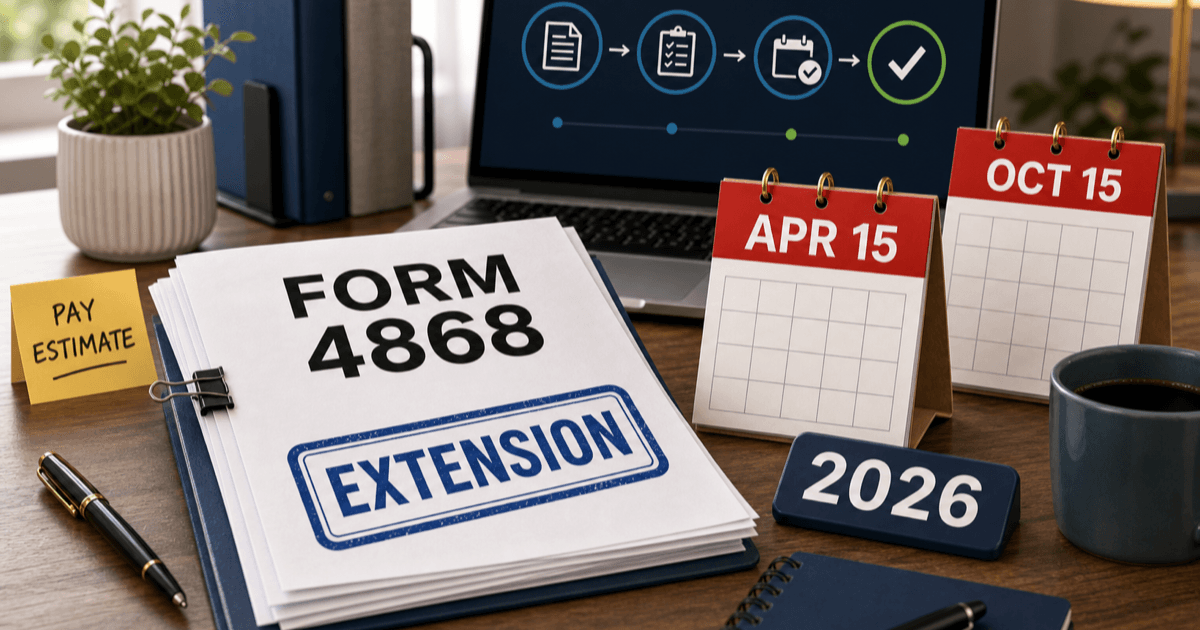
Form 4868 Deadline 2026
Use this for the individual extension form behind the October 15 filing date, including payment estimates and extension proof.
Read guide
IRS Tax Deadlines 2026
Use this broader calendar for individual, entity, extension, estimated-payment, state, and refund timing around the Form 1040 deadline.
Read guideSources & References
- 1.IRS - Publication 509, Tax Calendars(Accessed May 2026)
- 2.IRS - About Form 1040, U.S. Individual Income Tax Return(Accessed May 2026)
- 3.IRS - Get an Extension To File Your Tax Return(Accessed May 2026)
- 4.IRS - About Form 4868(Accessed May 2026)
- 5.IRS - Direct Pay With Bank Account(Accessed May 2026)
- 6.IRS - Failure to File Penalty(Accessed May 2026)
- 7.IRS - Failure to Pay Penalty(Accessed May 2026)
- 8.IRS - Refunds(Accessed May 2026)
- 9.IRS - Instructions for Form 1040-NR(Accessed May 2026)
- 10.IRS - Videos(Accessed May 2026)