Form 4868 Deadline 2026: Tax Extension Due Date, October 15 Filing Deadline, and Payment Rules
A detailed 2026 Form 4868 deadline guide for individual federal tax extensions. Covers the April 15, 2026 extension request deadline, October 15 extended filing date, payment rules, online extension methods, overseas taxpayer dates, Form 1040-NR issues, missed-extension cleanup, official IRS video, and filing checklist.
Guide Oversight & Review Policy
CalculatorWallah guides are written to explain calculator assumptions, source limitations, and when users should move from a rough estimate to an official rule, institution policy, or clinician conversation.
Reviewed by Jitendra Kumar, Founder & Editorial Standards Lead. Page updated May 8, 2026. Trust-critical pages are reviewed when official rates or rules change. Evergreen calculator guides are checked on a recurring quarterly or annual cycle depending on topic volatility. Topic ownership: Sales tax and tax-sensitive estimate tools, Education and GPA planning calculators, Health, protein, and screening-formula pages, Platform-wide publishing standards and methodology.
On This Page
Form 4868 Deadline 2026
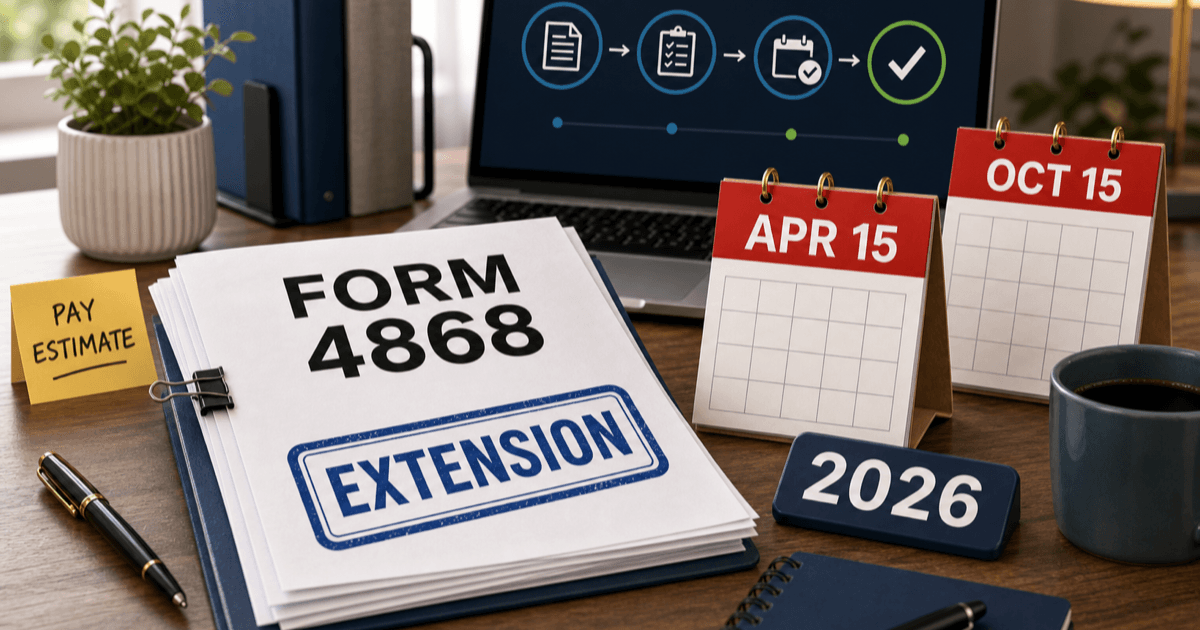
The main Form 4868 deadline in 2026 was April 15, 2026 for most calendar-year individual taxpayers filing a 2025 federal income tax return. Form 4868 is the application for an automatic extension of time to file many individual returns, but it is not an automatic extension of time to pay.
This article is updated as of May 8, 2026. That means the original Form 4868 request deadline has already passed for most taxpayers. If you filed a valid extension, the next major federal filing date is generally October 15, 2026. If you did not file or extend by April 15, the practical move is to file the completed return as soon as possible and pay what can be paid.
Countdown Timer
The tracked 2026 IRS deadline sequence is complete.
Original Due Date
April 15, 2026
Most Form 4868 requests for 2025 individual returns were due by April 15, 2026, the same date the estimated tax balance was due.
Extended Filing Date
October 15, 2026
A valid extension generally gives many individual taxpayers until October 15, 2026 to file the completed 2025 return.
Payment Rule
File, not pay
The extension moves the return filing deadline. It does not move the original due date for paying 2025 federal tax.
Quick Answer
File Form 4868 or request an IRS electronic extension by the original individual return due date, pay the best estimate of tax due by that same date, save proof, and then file the completed return by October 15, 2026 if the extension was valid.
2026 Form 4868 Deadline Table
Form 4868 is only one date on an individual tax calendar. The extension request, payment deadline, overseas rules, estimated-tax dates, and final extended filing deadline can all matter at the same time.
2026 Form 4868 Deadline Table
| Date | Deadline | Applies To | Action |
|---|---|---|---|
| April 15, 2026 | Form 4868 extension request due | Most calendar-year Form 1040 and Form 1040-SR taxpayers needing more time to file | Request the extension by this date and pay the best estimate of 2025 federal tax due. |
| April 15, 2026 | 2025 individual tax payment due | Taxpayers with a 2025 federal balance due | Pay by the original due date even if the return is extended. Form 4868 does not extend payment. |
| June 15, 2026 | Certain abroad and nonresident timing | Some taxpayers outside the United States and some Form 1040-NR filers, depending on facts | Confirm the special rule before relying on June 15, and use Form 4868 if additional time is needed. |
| September 15, 2026 | 2026 Q3 estimated tax payment | Taxpayers making 2026 federal estimated tax payments | This payment is separate from the 2025 extension and may still be due before the extended return is filed. |
| October 15, 2026 | Extended individual return filing deadline | Many taxpayers who requested a valid Form 4868 extension for the 2025 return | File the completed return by this date. Pay any remaining balance as soon as possible. |
| January 15, 2027 | 2026 Q4 estimated tax payment | Taxpayers making 2026 federal estimated tax payments | Do not let the 2025 extension distract from the final 2026 estimated-tax installment. |
What Form 4868 Actually Does
Form 4868 requests an automatic extension of time to file an individual federal income tax return. For many taxpayers, that means more time to finish Form 1040, Form 1040-SR, or certain related individual returns. The extension can be useful when corrected 1099s, Schedule K-1s, brokerage statements, crypto records, business books, or deduction records are not ready by April.
The extension does not make the tax disappear, and it does not usually delay interest or failure-to-pay exposure. Form 4868 asks for an estimate of total tax liability, total payments, balance due, and the amount being paid with the extension. Those lines are the payment control, not a rough formality.
It Helps With
More filing time
More time to collect documents, review credits, finish bookkeeping, and file a complete return.
It Does Not Help With
More payment time
More time to pay the original 2025 balance. Payment was generally still due April 15, 2026.
Automatic
No detailed explanation
Most taxpayers do not need to explain why they need more time if the extension request is timely and valid.
Not Universal
Wrong form for many entities
Businesses, partnerships, corporations, estates, trusts, exempt organizations, payroll returns, and FBARs use other systems.
How to File Form 4868 or Request the Extension
IRS extension guidance gives taxpayers several ways to request more time. A taxpayer can file Form 4868 through tax software, use IRS Free File extension tools when available, submit a paper Form 4868, or get an extension by making an electronic payment and marking it as an extension payment through eligible IRS payment channels.
The method matters because proof matters. A tax software acceptance record is different from a payment confirmation, and a paper filing needs reliable mailing proof. If the IRS later says no extension is on record, the saved confirmation may be the difference between a clean correction and a penalty fight.
Tax Software
E-file extension
Use software or a provider that can transmit Form 4868 and produce an acceptance confirmation.
IRS Free File
Free extension workflow
IRS Free File extension options may be available during the filing season for taxpayers requesting more time.
Electronic Payment
Pay and mark extension
IRS guidance allows an extension through certain electronic payments when the payment is marked for extension.
Paper Form
Mail with proof
If filing on paper, use the current address and preserve timely mailing or private delivery proof.
Payment Rules: Estimate and Pay by April 15
The core Form 4868 mistake is confusing extension-to-file with extension-to-pay. The taxpayer should estimate total 2025 federal tax, subtract payments and credits already made, and pay the expected balance by April 15, 2026. If the final return later shows a higher balance, paying the difference sooner usually reduces future interest and penalty growth.
Good estimates use real records: W-2 withholding, 1099 withholding, estimated tax payments, prior-year overpayment applied to 2025, refundable credits, self-employment tax, additional Medicare tax, net investment income tax, premium tax credit repayment, and other items that may affect the final return.
Line 4
Estimate total tax
Include all income, credits, additional taxes, and self-employment tax you can estimate from available records.
Line 5
Subtract payments
Include withholding, estimated tax payments, prior-year overpayment, and refundable credits already known.
Line 7
Pay what you can
Paying the estimated balance by April 15 helps reduce failure-to-pay penalty and interest exposure.
Who Uses Form 4868
Form 4868 is most often used by individuals who need more time to file Form 1040 or Form 1040-SR. It can also be relevant to certain nonresident and special individual return situations, but the exact return and taxpayer facts matter.
A sole proprietor still generally uses the individual extension because Schedule C and Schedule SE attach to Form 1040. That is different from a partnership Form 1065, S corporation Form 1120-S, or C corporation Form 1120. Those entity returns usually use Form 7004 rather than Form 4868.
If the taxpayer has business income, rental income, Schedule K-1s, foreign reporting, crypto transactions, Marketplace coverage, or itemized deductions, Form 4868 can be a sensible way to file a complete return instead of rushing a weak return by April.
Taxpayers Abroad and Form 1040-NR Timing
Form 4868 timing can change for taxpayers outside the United States and for some nonresident filers. Some U.S. citizens and resident aliens living outside the United States and Puerto Rico on the regular due date may receive an automatic two-month filing extension. Some Form 1040-NR taxpayers also have different filing dates depending on wage and withholding facts.
Do not rely on a simple April-or-October answer if the taxpayer is abroad, in the military, a nonresident alien, or tied to a disaster postponement. The payment deadline, interest, foreign account reporting, foreign earned income exclusion timing, Form 8938, state residency, and treaty positions can all require separate review.
Proof, Records, and Extension Audit Trail
The extension record should be saved with the tax return file. A good file includes the Form 4868 copy, tax estimate worksheet, payment confirmation, e-file acceptance, mailing proof if applicable, and notes about why the payment estimate was reasonable based on the information available by April 15.
This matters because the final return may be prepared months later by a different person. Without a clean record, it is easy to miss the extension payment on the return, double count a payment, fail to prove timely extension, or forget that a state extension still needs separate handling.
What If the Form 4868 Deadline Was Missed
Because this guide is dated May 8, 2026, a taxpayer who did not file a return or request a valid extension by April 15 is already in cleanup mode for most federal individual returns. In that situation, filing the completed return usually matters more than trying to create a late extension.
Step 1
File as soon as possible
A late return can keep failure-to-file exposure from growing and starts refund or balance-due processing.
Step 2
Pay what you can
Partial payment can still reduce future penalty and interest growth even if the full balance cannot be paid today.
Step 3
Use official payment options
IRS payment plans may help when the return is filed but the balance cannot be paid in full.
How to Use the October 15, 2026 Deadline
October 15, 2026 is the outside filing deadline for many taxpayers with a valid federal extension. It is not a recommended filing date. If the return is ready in May, June, July, August, or September, filing earlier can speed refunds, reveal payment gaps, and reduce the risk of a last-minute e-file rejection.
Before filing the extended return, reconcile every payment: withholding, estimated tax, extension payment, refundable credits, and any payment made after April. Also check the state return. A federal extension payment does not pay the state, and a federal extension may not satisfy every state filing requirement.
Common Form 4868 Mistakes
Form 4868 is short, but its surrounding payment and proof rules are where most problems appear. These mistakes are the ones most likely to produce penalties, notices, or missed refunds.
Watch
Treating October 15 as a payment extension
Form 4868 extends filing time. Interest and failure-to-pay exposure can still run from April 15 when the tax was not paid.
Watch
Submitting Form 4868 after the deadline
For most taxpayers, an extension request must be made by the original due date. Filing after April 15 usually means cleanup, not extension planning.
Watch
Guessing the payment estimate too casually
The form asks for total tax liability, payments, balance due, and amount paid. A weak estimate can create avoidable payment penalties.
Watch
Missing state extension rules
Federal Form 4868 does not automatically solve every state return or state payment deadline.
Watch
Confusing Form 4868 with Form 7004
Form 4868 is generally for individual returns. Many business and entity returns use Form 7004 or other extension systems.
Watch
Waiting until October when the return is ready
Filing earlier can release refunds, reveal payment issues, and reduce the risk of missing the extended deadline.
Form 4868 Filing Checklist
Use this checklist before filing Form 4868, before relying on an extension, and before finishing the extended return.
Before April 15
- Estimate 2025 total tax from wages, self-employment income, investments, retirement income, and credits.
- Add withholding, estimated payments, prior-year overpayment, and refundable credits already known.
- Pay the best estimate of the remaining balance by April 15, 2026.
- Choose online payment extension, IRS Free File extension, tax software, or paper Form 4868.
Proof to Save
- IRS online payment confirmation marked as an extension payment.
- Tax software or Free File extension acceptance confirmation.
- Certified mail, private delivery service, or postal proof if filing on paper.
- A copy of the completed Form 4868 and the worksheet used to estimate tax.
Before October 15
- Collect W-2s, 1099s, Schedule K-1s, brokerage statements, crypto records, and corrected forms.
- Reconcile the extension payment, withholding, and estimated tax payments on the final return.
- File the federal return before October 15, 2026 rather than treating the date as a target.
- Confirm state return, state extension, and state payment status separately.
If April 15 Was Missed
- File the completed return as soon as possible instead of trying to backdate an extension.
- Pay as much as possible through official IRS payment channels.
- Review payment-plan options if the balance cannot be paid in full.
- Save notices, payment proof, and reasonable-cause facts for penalty review if needed.
Official IRS Videos for Form 4868 Planning
Suitable official IRS videos exist and are embedded below. The first explains the extension-to-file concept behind Form 4868. The second is relevant when the extension payment was short or the taxpayer cannot pay the final balance in full.
IRS: Extension of Time to File
Official IRS video explaining extension-to-file basics, useful for understanding what Form 4868 does and does not extend.
IRS: Owe Taxes but Can't Pay?
Official IRS video for taxpayers who owe a balance and need to understand payment options after filing.
Form 4868 Deadline FAQ
The FAQ section covers the April 15, 2026 Form 4868 deadline, October 15 extended filing date, extension-to-file versus extension-to-pay rule, online payment extension method, missed-extension cleanup, state deadlines, and abroad or nonresident timing issues.
Trust and Update Notes
This article was built from IRS Form 4868, IRS extension guidance, IRS Publication 509, IRS Form 1040 resources, IRS Form 1040-NR instructions, IRS payment pages, IRS penalty pages, and official IRS videos reviewed in May 2026. It is written for deadline planning and filing workflow decisions. It is not a substitute for the current IRS instructions, state revenue agency rules, disaster relief notices, or a tax adviser reviewing taxpayer-specific facts.
Before filing or relying on an extension, confirm the return type, tax year, residency status, disaster relief, overseas rules, state extension requirements, payment amount, submission method, and proof of timely extension.
Frequently Asked Questions
Related Calculators
Federal Income Tax Calculator
Estimate the 2025 federal balance that should have been paid with Form 4868 by April 15, 2026.
Use Federal Income Tax CalculatorTax Refund Calculator
Compare withholding, credits, estimated payments, and extension payments before finishing the extended return.
Use Tax Refund CalculatorSelf-Employment Tax Calculator
Estimate Schedule SE pressure when a Schedule C return is extended because business books are not ready.
Use Self-Employment Tax CalculatorDate Duration Calculator
Count time remaining to October 15, notice response dates, state deadlines, and document collection targets.
Use Date Duration CalculatorPaycheck Calculator
Review 2026 wage withholding if the 2025 Form 4868 estimate or final return shows a balance due.
Use Paycheck CalculatorRelated Guides

Form 1040 Deadline 2026
Use this for the underlying individual return deadline, April 15 payment rule, October 15 filing date, and Form 1040 checklist.
Read guide
IRS Extension Deadline 2026
Use this broader extension guide when Form 4868 sits beside other individual, business, payment, and late-filing extension issues.
Read guideSources & References
- 1.IRS - About Form 4868(Accessed May 2026)
- 2.IRS - Form 4868(Accessed May 2026)
- 3.IRS - Get an Extension To File Your Tax Return(Accessed May 2026)
- 4.IRS - Publication 509, Tax Calendars(Accessed May 2026)
- 5.IRS - About Form 1040(Accessed May 2026)
- 6.IRS - Instructions for Form 1040-NR(Accessed May 2026)
- 7.IRS - Direct Pay With Bank Account(Accessed May 2026)
- 8.IRS - Payment Plans and Installment Agreements(Accessed May 2026)
- 9.IRS - Failure to File Penalty(Accessed May 2026)
- 10.IRS - Failure to Pay Penalty(Accessed May 2026)
- 11.IRS - Videos(Accessed May 2026)