
Freelancer Tax Deadline 2026: 1099, Schedule C, Schedule SE, Extension, and Quarterly Dates
A practical 2026 freelancer tax deadline guide covering the April 15 Form 1040, Schedule C, Schedule SE, Form 4868 extension, October 15 extended filing date, 2026 quarterly estimated-tax payments, 1099-NEC, 1099-K, gig income, state rules, and official IRS video guidance.
Guide Oversight & Review Policy
CalculatorWallah guides are written to explain calculator assumptions, source limitations, and when users should move from a rough estimate to an official rule, institution policy, or clinician conversation.
Jitendra Kumar, Founder & Editorial Standards Lead. Updated June 25, 2026. Scope: Sales tax and tax-sensitive estimate tools, Education and GPA planning calculators, Health, protein, and screening-formula pages, Platform-wide publishing standards and methodology.
Tax credentialed review: Named internal reviewer: Iliyas Khan, Chief Operating Officer. External credentialed professional review is still required before this page is treated as professional advice.
Internal tax and sales-tax methodology reviewer. Review scope: calculator assumptions, labels, source context, workflow clarity, and compliance-sensitive disclaimers.
Relevant review context: CalculatorWallah tax and sales-tax calculator workflow owner; Source-first review of IRS, state revenue, rate, and filing-sensitive references; Compliance-sensitive labels, assumptions, and user-facing disclaimer review.
Required professional credentials: CPA, Enrolled Agent, licensed tax professional. Scope: tax formulas, jurisdiction assumptions, withholding language, filing-sensitive examples, and compliance caveats.
This page is educational planning support. A named CPA, EA, or licensed tax professional should review the page before it is positioned as tax advice or used for filing decisions.
Professional Review Status
This YMYL page has internal methodology review, but no external credentialed professional review is recorded yet.
- Reliance status
- Credentialed tax review required before professional reliance
- Required credentials
- CPA, Enrolled Agent, licensed tax professional
- Review scope
- tax formulas, jurisdiction assumptions, withholding language, filing-sensitive examples, and compliance caveats
Current reviewer: Iliyas Khan, Internal tax and sales-tax methodology reviewer.
This page is educational planning support. A named CPA, EA, or licensed tax professional should review the page before it is positioned as tax advice or used for filing decisions.
On This Page
Freelancer Tax Deadline 2026
For most calendar-year freelancers, the 2026 federal filing and payment deadline for the 2025 tax year was April 15, 2026. Freelance income is commonly reported on Schedule C attached to Form 1040, with Schedule SE used when self-employment tax is required.
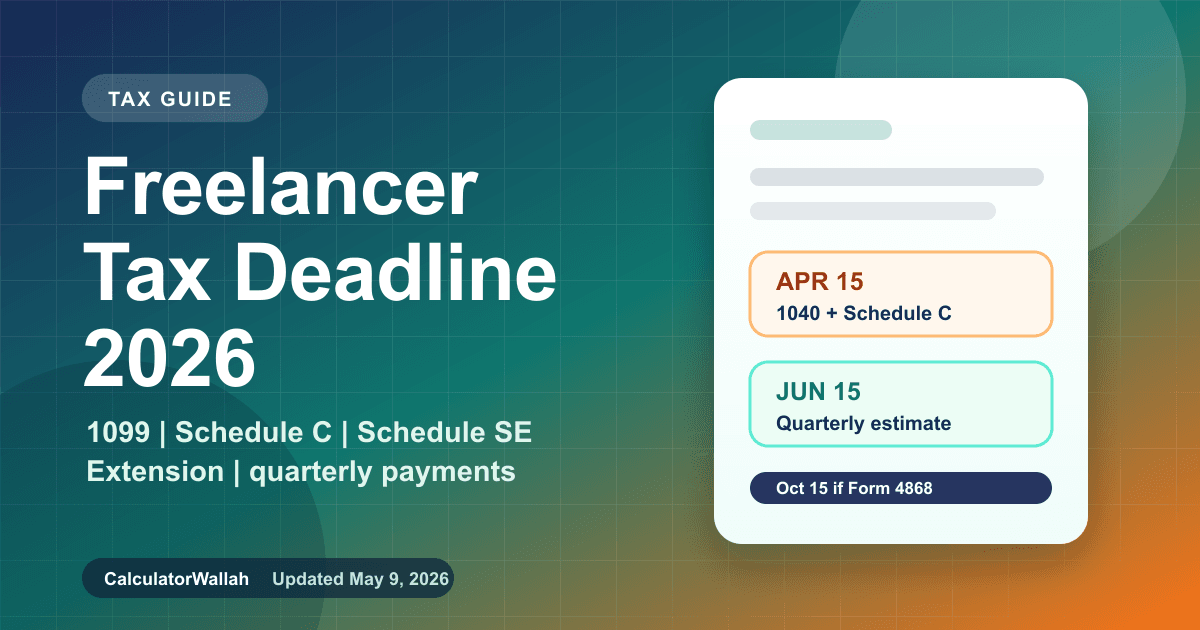
This article is updated as of June 25, 2026. The original April 15 deadline and June 15 estimated-tax date have passed. If a valid Form 4868 was filed, the next major filing date is generally October 15, 2026, but any 2025 income tax and self-employment tax should already have been paid by April 15. The next common 2026 estimated-tax date is September 15, 2026.
Countdown Timer
The tracked 2026 IRS deadline sequence is complete.
Original Deadline
April 15, 2026
Form 1040, Schedule C, Schedule SE, Form 4868, 2025 balance payments, and the first 2026 estimated-tax installment all centered on April 15 for many freelancers.
Extension Alert
October 15 is filing time only
Form 4868 generally extends the return filing deadline. It does not extend income tax, self-employment tax, state tax, or estimated-tax payment dates.
Quarterly Alert
September 15 is the next common date
Freelancers with 2026 profit should review estimated-tax payments before September 15 and January 15, 2027.
Quick Freelancer Actions
Use this page to map filing, payment, and record deadlines. Use IRS systems, tax software, state portals, and professional review before filing, extending, correcting, or paying.
Important 2026 Freelancer Tax Dates
A freelancer deadline is not just one annual return date. Track Form 1040, Schedule C, Schedule SE, Form 4868, quarterly estimated-tax payments, 1099 forms, platform reports, subcontractor filings, and state or city business rules together.
2026 Freelancer Deadline Table
| Date | Category | Deadline | Applies To | Action |
|---|---|---|---|---|
| January 15, 2026 | Estimated Tax | Fourth 2025 federal estimated-tax installment | Freelancers who needed a final 2025 Form 1040-ES payment | This date has passed. Review it when checking whether the 2025 return has an estimated-tax underpayment issue. |
| February 2, 2026 | 1099 and Payroll | W-2, W-3, and many 1099-NEC filings | Freelancers who hired employees, subcontractors, assistants, or reportable vendors | This date has passed. Fix missed worker or vendor reporting before finalizing business records. |
| April 15, 2026 | Annual Return | Form 1040, Schedule C, Schedule SE, and payment due | Most calendar-year freelancers reporting 2025 business activity | File the return or Form 4868 by this date and pay expected income tax and self-employment tax. |
| April 15, 2026 | Estimated Tax | First 2026 estimated-tax installment | Freelancers expecting 2026 tax not fully covered by withholding | Pay Q1 2026 estimated tax separately from any 2025 balance due or extension payment. |
| June 15, 2026 | Estimated Tax | Second 2026 estimated-tax installment | Freelancers with ongoing 2026 client, creator, platform, or contractor income | Update projections for invoices, platform payouts, expenses, spouse wages, withholding, and state tax. |
| September 15, 2026 | Estimated Tax | Third 2026 estimated-tax installment | Freelancers making federal quarterly payments | Recalculate after seasonal swings, corrected 1099 data, equipment purchases, and client payment changes. |
| October 15, 2026 | Extended Filing | Extended 2025 Form 1040 filing deadline | Freelancers who timely filed a valid Form 4868 | File the completed Form 1040 with Schedule C and Schedule SE. This is not a payment extension. |
| January 15, 2027 | Estimated Tax | Fourth 2026 estimated-tax installment | Freelancers with remaining 2026 estimated-tax obligations | Use full-year income, withholding, deductions, retirement contributions, and safe-harbor review before paying. |
Who Counts as a Freelancer for Tax Deadlines
Freelancers are often self-employed sole proprietors for federal income tax. That can include independent contractors, consultants, designers, developers, writers, creators, editors, photographers, drivers, tutors, marketers, virtual assistants, and platform or app-based workers.
Freelancer
Usually Schedule C
A freelancer who sells services directly to clients or through platforms usually reports net business income on Schedule C unless another entity structure applies.
Gig Worker
Platform income still counts
App-based and marketplace income can be taxable even when forms arrive late, are corrected, or do not arrive.
LLC Owner
State law is not the whole answer
A disregarded single-member LLC often follows Schedule C federal timing, but state LLC fees and entity elections can change the calendar.
Not W-2 Wages
Freelance income has no employer withholding
Clients usually do not withhold payroll tax from contractor payments, so estimated-tax planning matters.
Schedule C and Schedule SE for Freelancers
Schedule C reports freelance income and deductible business expenses. Schedule SE figures self-employment tax when required. Both are part of the Form 1040 filing package, so the normal calendar-year 2025 deadline was April 15, 2026.
Schedule C
Freelance profit or loss
Reconcile client payments, marketplace payouts, refunds, fees, subscriptions, supplies, software, home office, mileage, and equipment before filing.
Schedule SE
Self-employment tax
IRS guidance generally requires Schedule SE when net earnings from self-employment are $400 or more, subject to exceptions and special rules.
Multiple Freelance Lines
Separate business records
A designer who also teaches courses or earns platform income should keep records clear enough to support income and expense categories.
Entity Change
Corporation elections change deadlines
An S corporation, C corporation, or partnership return follows a different filing calendar than a normal Schedule C freelancer.
Freelancer Extension Rules
Freelancers usually request an individual filing extension with Form 4868 because Schedule C is attached to Form 1040. For a 2025 calendar-year return, Form 4868 was generally due April 15, 2026. A valid extension generally moves the filing deadline to October 15, 2026.
The extension does not extend the time to pay. If a freelancer underpaid income tax or self-employment tax by April 15, penalties and interest can continue even if the return is filed by the October deadline.
Quarterly Estimated Tax for Freelancers
Freelance income usually does not have employer withholding. IRS estimated-tax guidance says taxpayers may need quarterly estimated payments when income is not subject to enough withholding, including self-employment income, gig income, interest, dividends, prizes, and rental income.
For many calendar-year individual taxpayers, the 2026 federal estimated-tax installments are due April 15, June 15, September 15, 2026, and January 15, 2027. These dates are not four equal calendar quarters, so freelancers with irregular client payments should update projections before each date.
1099-NEC, 1099-MISC, and Missing Forms
Freelancers often receive Form 1099-NEC from clients, but the tax return should be based on actual business records rather than only on tax forms. Income can still be taxable when a client forgets to issue a form, sends a corrected form later, or pays below a reporting threshold.
1099-NEC
Nonemployee compensation
Compare every 1099-NEC with invoices, deposits, client ledgers, refunds, and credits before filing.
Missing Form
Report taxable income anyway
Do not omit taxable freelance income only because a form was missing or late.
1099-K and Platform Income
Platform, marketplace, payment-app, and card-processor reporting can create Form 1099-K issues. A 1099-K may report gross payments, so freelancers should reconcile it to business records, refunds, fees, personal transfers, duplicate 1099-NEC reporting, and other adjustments before filing.
The IRS gig economy guidance is useful here: income from app-based, sharing-economy, or platform work can be taxable even when the work is part time, temporary, paid in cash, or not reported on a form.
Freelancer Income Reconciliation Before Quarterly Tax
Freelance income is often paid through several channels, so the useful calculator input is reconciled net profit, not a pile of form totals. The working formula is Schedule C profit = reconciled business receipts - documented business deductions. Then calculate self-employment tax, income tax, state tax, and payments already made.
Freelancer Income Reconciliation Workflow
| Source | Reconcile Against | Calculator Input | Risk Avoided |
|---|---|---|---|
| Client invoices and retainers | Bank deposits, accounts receivable, refunds, credits, write-offs, and year-end unpaid invoices. | Recognized freelance gross receipts before platform or processor adjustments. | Missing income because a client skipped Form 1099-NEC or paid after year-end. |
| Form 1099-NEC and 1099-MISC | Client ledgers, duplicate 1099-K reporting, reimbursed expenses, corrected forms, and legal-name mismatches. | Taxable nonemployee compensation after duplicate reporting is identified. | Double counting the same project payment or omitting a corrected form. |
| Form 1099-K and platform reports | Gross card payments, marketplace fees, refunds, chargebacks, tips, personal transfers, and app statements. | Gross business receipts and separately documented selling or processor fees. | Treating gross 1099-K as net profit or mixing personal transfers with business income. |
| Business expenses and reserve transfers | Software, supplies, contractors, education, home office, mileage, insurance, and tax savings account transfers. | Net Schedule C profit and remaining tax reserve by due date. | Using a flat percentage that ignores actual deductions, withholding, and prior estimated payments. |
Use the Schedule C Profit Tax Reserve Calculator after reconciling forms, the Quarterly Tax Payment Calculator for Freelancers before each installment, and the Taxable Income Calculator when W-2 wages, deductions, or credits change the annual picture.
Deductions and Records Freelancers Should Close
Freelancer tax deadlines are easier when the books are closed before the tax form work starts. Reconcile subscriptions, software, contractor help, advertising, phone, internet, equipment, supplies, home office, travel, mileage, professional fees, education, and payment-processing fees with receipts and statements.
State and Local Freelancer Deadlines
Federal Schedule C timing is only part of the calendar. State income tax, state estimated tax, sales tax, gross receipts tax, local business tax, business licenses, DBA renewals, payroll accounts, and city or county filings can all use separate dates. Single-member LLCs can also have annual reports, franchise taxes, or LLC fees that do not appear on Schedule C.
What To Do If the Freelancer Deadline Was Missed
If the April 15, 2026 deadline was missed, file the return or finish extension cleanup as soon as practical and pay as much as possible. Waiting until October 15 only helps if Form 4868 was timely and valid, and it still does not solve an April payment miss.
Step 1
Finish the cleanest return possible
Reconcile invoices, platform records, 1099s, deposits, expenses, mileage, home office, and equipment records before filing.
Step 2
Pay what can be paid
Use IRS payment channels and keep confirmation numbers. State payment systems are separate.
Step 3
Address quarterly payments
If April 15 was missed, review June 15 and later 2026 estimated-tax payments before underpayment risk grows.
Step 4
Watch for notices
Save IRS and state notices, e-file rejection records, mailing receipts, and reasonable cause facts.
Freelancer Filing Checklist
Use this checklist before filing, extending, paying, or correcting a freelancer tax position. The goal is to tie every date to the right income year, payment, form, platform, and state filing.
Reconcile Freelance Income
- Match invoices, retainers, marketplace payouts, payment app deposits, cash receipts, refunds, and chargebacks.
- Compare Form 1099-NEC, 1099-MISC, 1099-K, platform reports, and bank deposits before filing.
- Report taxable income even when a client or payment platform does not issue a form.
Prepare Schedule C and SE
- Separate personal spending from deductible business expenses before preparing Schedule C.
- Review software, equipment, subscriptions, advertising, contractor help, supplies, phone, internet, home office, and mileage support.
- Use Schedule SE when net earnings from self-employment require self-employment tax reporting.
Manage Payments
- Pay any 2025 balance by April 15, 2026 even if Form 4868 extended the filing deadline.
- Track 2026 estimated-tax dates: April 15, June 15, September 15, and January 15, 2027.
- Review W-2 withholding, spouse withholding, credits, and irregular freelance income before each estimated payment.
Check Side Calendars
- Confirm subcontractor 1099-NEC, employee payroll, backup withholding, and state worker reporting if you hired help.
- Review state income tax, state estimated tax, sales tax, gross receipts tax, business licenses, and local taxes.
- If an LLC is involved, check state LLC annual fees, annual reports, franchise taxes, and registered-agent requirements.
Calculator Tools for Freelancers
CalculatorWallah tools do not prepare Schedule C, file Form 4868, classify workers, or reconcile 1099-K forms. They can help estimate the owner-level pressure before you decide whether to increase withholding, make an estimated payment, or set aside cash for tax.
SE Tax
Self-employment tax estimate
Use after freelance net profit is credible enough to estimate Social Security and Medicare tax on net earnings.
Income Tax
Federal income tax estimate
Combine freelance profit with filing status, deductions, credits, W-2 wages, and other income.
Withholding
Paycheck review
Useful when a W-2 job or spouse wages can cover part of the freelance tax bill.
Refund
Payment coverage check
Compare withholding and estimated payments against likely annual tax before filing or the next quarterly date.
Official IRS Videos
I looked for official IRS video material relevant to freelancer deadline planning. The estimated-tax video is directly relevant because freelancer profit often has no withholding. The IRS gig economy page also references an official sharing-economy video, but the current IRS page exposes the transcript rather than a verifiable embed ID, so the second embedded video below uses the official IRS Small Business Self-Employed Tax Center video.
IRS: Estimated Tax Payments
Official IRS video on quarterly estimated tax payments for income not subject to withholding, including self-employment and gig income.
IRS: Small Business Self-Employed Tax Center
Official IRS video on self-employed and small-business resources. Use current written IRS gig economy, Schedule C, Schedule SE, estimated-tax, and Form 4868 guidance for exact 2026 filing rules.
Freelancer Tax Deadline FAQ System
The short answer is April 15, 2026 for most 2025 calendar-year freelancer returns, with October 15 available only for filing when Form 4868 was valid. The safer answer is to confirm Schedule C records, Schedule SE exposure, estimated-tax status, 1099-NEC and 1099-K reconciliation, platform income, state obligations, and whether the work belongs under a different entity structure.
Schema, Trust, and Update Notes
This page is structured for Article, FAQ, source citation, reviewer, related calculator, and VideoObject markup. It uses IRS written sources for gig economy income, self-employed individuals, Schedule C, Schedule SE, Form 1040 filing deadlines, estimated tax, Publication 505, Publication 509, Form 4868, Form 1099-K, and official IRS video context.
CalculatorWallah tools do not prepare Schedule C, file Form 4868, reconcile every 1099-K, classify workers, decide hobby-loss treatment, determine sales tax, handle payroll deposits, or replace a CPA, enrolled agent, tax attorney, payroll provider, state agency, or official IRS source. Refresh this article when IRS instructions, disaster relief, payment rules, Form 1099 thresholds, or state tax calendars change.
Frequently Asked Questions
Related Calculators
Self-Employment Tax Calculator
Estimate self-employment tax and deductible half of SE tax after freelance net profit is known.
Use Self-Employment Tax CalculatorFederal Income Tax Calculator
Model Form 1040 federal income tax after freelance income, expenses, deductions, credits, and filing status.
Use Federal Income Tax CalculatorTax Refund Calculator
Compare withholding, estimated payments, credits, 1099 income, and freelance profit before filing or extending.
Use Tax Refund CalculatorPaycheck Calculator
Use when W-2 wages or a spouse's withholding can reduce freelance quarterly payment pressure.
Use Paycheck CalculatorFICA Tax Calculator
Compare payroll Social Security and Medicare taxes with self-employment tax on freelance profit.
Use FICA Tax CalculatorSchedule C Profit Tax Reserve Calculator
Reconcile freelance gross receipts, fees, refunds, and deductions before estimating tax reserves.
Use Schedule C Profit Tax Reserve CalculatorQuarterly Tax Payment Calculator for Freelancers
Translate freelancer profit swings into April, June, September, and January estimated-tax targets.
Use Quarterly Tax Payment Calculator for FreelancersTaxable Income Calculator
Check how freelance profit interacts with deductions, W-2 wages, credits, and other taxable income.
Use Taxable Income CalculatorSources & References
- 1.IRS - Gig Economy Tax Center(Accessed June 2026)
- 2.IRS - Self-Employed Individuals Tax Center(Accessed June 2026)
- 3.IRS - When to File(Accessed June 2026)
- 4.IRS - Publication 509, Tax Calendars(Accessed June 2026)
- 5.IRS - Publication 505, Tax Withholding and Estimated Tax(Accessed June 2026)
- 6.IRS - About Schedule C(Accessed June 2026)
- 7.IRS - About Schedule SE(Accessed June 2026)
- 8.IRS - Estimated Taxes(Accessed June 2026)
- 9.IRS - About Form 4868(Accessed June 2026)
- 10.IRS - Form 1099-K(Accessed June 2026)
- 11.IRS - Estimated Tax Payments YouTube Video Script(Accessed June 2026)
- 12.IRS - Your Taxes in the Sharing Economy YouTube Video Script(Accessed June 2026)