Self-Employed Tax Deadlines 2026: Schedule C, SE Tax, Extension, and Quarterly Dates
A practical 2026 self-employed tax deadline guide covering the April 15 Schedule C and Schedule SE deadline, Form 4868 extension, October 15 extended filing date, 2026 quarterly estimated tax payments, 1099 income, state obligations, LLC distinctions, and official IRS estimated-tax video guidance.

Guide Oversight & Review Policy
CalculatorWallah guides are written to explain calculator assumptions, source limitations, and when users should move from a rough estimate to an official rule, institution policy, or clinician conversation.
Jitendra Kumar, Founder & Editorial Standards Lead. Updated June 25, 2026. Scope: Sales tax and tax-sensitive estimate tools, Education and GPA planning calculators, Health, protein, and screening-formula pages, Platform-wide publishing standards and methodology.
Tax credentialed review: Named internal reviewer: Iliyas Khan, Chief Operating Officer. External credentialed professional review is still required before this page is treated as professional advice.
Internal tax and sales-tax methodology reviewer. Review scope: calculator assumptions, labels, source context, workflow clarity, and compliance-sensitive disclaimers.
Relevant review context: CalculatorWallah tax and sales-tax calculator workflow owner; Source-first review of IRS, state revenue, rate, and filing-sensitive references; Compliance-sensitive labels, assumptions, and user-facing disclaimer review.
Required professional credentials: CPA, Enrolled Agent, licensed tax professional. Scope: tax formulas, jurisdiction assumptions, withholding language, filing-sensitive examples, and compliance caveats.
This page is educational planning support. A named CPA, EA, or licensed tax professional should review the page before it is positioned as tax advice or used for filing decisions.
Professional Review Status
This YMYL page has internal methodology review, but no external credentialed professional review is recorded yet.
- Reliance status
- Credentialed tax review required before professional reliance
- Required credentials
- CPA, Enrolled Agent, licensed tax professional
- Review scope
- tax formulas, jurisdiction assumptions, withholding language, filing-sensitive examples, and compliance caveats
Current reviewer: Iliyas Khan, Internal tax and sales-tax methodology reviewer.
This page is educational planning support. A named CPA, EA, or licensed tax professional should review the page before it is positioned as tax advice or used for filing decisions.
On This Page
Self-Employed Tax Deadlines 2026
The main self-employed tax deadline in 2026 was April 15, 2026 for most calendar-year taxpayers filing a 2025 Form 1040 with Schedule C and Schedule SE. That same date was also the original payment deadline for federal income tax and self-employment tax, the Form 4868 extension request deadline, and the first 2026 estimated-tax payment date.
This page is updated as of June 25, 2026. That means the original April 15 deadline has already passed. If you filed a valid Form 4868 extension, the next big individual filing date is October 15, 2026. If you owed tax, the payment deadline did not move.
Countdown Timer
The tracked 2026 IRS deadline sequence is complete.
Deadline Summary
April 15 was the original deadline
Schedule C, Schedule SE, Form 1040 payment, Form 4868, and the first 2026 estimated-tax installment all pointed to April 15 for many self-employed taxpayers.
Filing Status Alert
October 15 needs a valid extension
The October date is a filing deadline only for taxpayers who requested a timely and valid extension by the original April deadline.
Payment Alert
Extension is not payment relief
Form 4868 extends time to file. It does not extend time to pay federal income tax, self-employment tax, interest, penalties, or state amounts.
Self-Employed Deadline Action Buttons
Use calculators for planning. Use IRS systems, state revenue sites, tax software, and professional review for filing, extension, penalty, state, and payment decisions.
Important 2026 Self-Employed Tax Dates
Self-employed tax timing is a calendar, not one deadline. The federal dates include annual filing, payment, extension, and quarterly estimated-tax installments. State and local calendars can add income tax, sales tax, payroll, LLC, annual report, or business license requirements.
Self-Employed Tax Deadline Table for 2026
| Date | Type | Deadline | Applies To | Action |
|---|---|---|---|---|
| January 15, 2026 | Quarterly Payments | Fourth 2025 federal estimated-tax installment | Self-employed taxpayers who needed a final 2025 Form 1040-ES payment | This date has passed as of this June 25, 2026 update. Reconcile the payment against the 2025 return before filing or extending. |
| February 2, 2026 | 1099 and Payroll | Common 1099-NEC and W-2 operating date | Businesses that paid contractors or employees; self-employed recipients waiting on payer forms | This date has passed. Correct missed or inaccurate information returns and do not wait for late 1099s to organize income records. |
| April 15, 2026 | Federal Dates | Form 1040, Schedule C, and Schedule SE original deadline | Calendar-year sole proprietors, freelancers, gig workers, and many 1099 workers | File the 2025 individual return, include Schedule C and Schedule SE when required, and pay income tax plus self-employment tax due. |
| April 15, 2026 | Extension Dates | Form 4868 individual extension request deadline | Self-employed taxpayers who needed more time to file the 2025 return | A valid extension can move the filing date to October 15, 2026. It does not extend the payment deadline. |
| April 15, 2026 | Quarterly Payments | First 2026 federal estimated-tax installment | Self-employed taxpayers expecting 2026 income not covered by withholding | Use current-year income, deductions, credits, withholding, and safe-harbor planning before setting the first installment. |
| Varies by state | State Dates | State income tax, estimated tax, sales tax, and local business dates | Self-employed taxpayers with state income tax, local licenses, sales tax, payroll, or entity registrations | Check the state revenue department and local licensing calendar. Federal extension proof may not satisfy state payment or filing rules. |
| June 15, 2026 | Quarterly Payments | Second 2026 federal estimated-tax installment | Self-employed taxpayers making 2026 Form 1040-ES payments | Reforecast year-to-date profit, deductible business expenses, W-2 withholding, spouse income, credits, and state tax. |
| September 15, 2026 | Quarterly Payments | Third 2026 federal estimated-tax installment | Self-employed taxpayers making 2026 quarterly payments | Update projections after summer income changes, large expenses, new contracts, or late 1099 corrections. |
| October 15, 2026 | Extension Dates | Extended 2025 Form 1040 filing deadline | Self-employed taxpayers with a valid Form 4868 extension | File the completed Form 1040 with Schedule C and Schedule SE by this date. Payment was still due April 15. |
| January 15, 2027 | Quarterly Payments | Fourth 2026 federal estimated-tax installment | Self-employed taxpayers with remaining 2026 quarterly payment obligations | Use final 2026 profit estimates and withholding to reduce underpayment risk before the 2026 return is filed. |
Weekend adjustments, state holidays, disaster relief, fiscal-year entities, nonresident filings, and entity tax elections can change the calendar. Treat the table as a federal planning baseline, then verify your exact state and entity facts before filing or paying.
Schedule C and Schedule SE Deadlines
A self-employed individual commonly reports business profit or loss on Schedule C and calculates self-employment tax on Schedule SE. Those schedules attach to Form 1040, so the ordinary individual filing calendar controls unless a different entity return applies.
Schedule C
Business income and expenses
Schedule C is where many sole proprietors report gross receipts, returns, cost of goods, ordinary business expenses, and net profit or loss.
Schedule SE
Self-employment tax
Schedule SE calculates Social Security and Medicare tax for self-employment income when self-employment tax applies.
Form 1040
The schedules follow the individual return
Schedule C and Schedule SE do not create a separate federal filing date for a calendar-year sole proprietor.
Entity Check
Classification changes the workflow
Partnerships, S corporations, C corporations, and some LLC elections use different federal forms and deadline rules.
Self-Employed Extension Rules
Form 4868 is the individual extension form. If it was filed timely and validly, it can move the 2025 Form 1040 filing deadline from April 15 to October 15, 2026. That helps when records, corrected 1099s, business books, or state documents are not ready.
It does not create extra time to pay. Self-employed taxpayers who owed federal income tax or self-employment tax should have paid the expected balance by April 15, 2026, even if the return itself is finished later.
Extension Form
Form 4868
Use Form 4868 for an automatic individual filing extension. Keep e-file acceptance, mailed proof, and payment confirmations with the return file.
Payment Caveat
Pay the expected balance
An extension does not stop interest or penalties on tax that was unpaid after the original payment due date.
State Extensions
State rules can diverge
Some states accept the federal extension. Others require separate forms, payments, or state-specific extension handling.
No Extension Filed
File quickly if April was missed
If no valid extension was filed, complete and file the return as soon as practical and pay as much as possible.
Quarterly Estimated Tax Deadlines for 2026
Self-employed taxpayers often pay tax as income is earned because there may be little or no withholding. Federal estimated-tax planning usually looks at income tax, self-employment tax, credits, W-2 withholding, spouse withholding, prior-year tax, current-year profit, and safe-harbor rules.
Q1
April 15, 2026
First 2026 estimated-tax installment. This was also the original 2025 Form 1040 filing and payment deadline for many taxpayers.
Q2
June 15, 2026
Recalculate after spring income, new client contracts, software subscriptions, mileage, equipment, and year-to-date withholding.
Q3
September 15, 2026
Reforecast after midyear profit changes, corrected 1099s, business travel, insurance, retirement contributions, and state tax changes.
Q4
January 15, 2027
Final 2026 installment for many self-employed taxpayers before the 2026 return is filed in 2027.
Payment Rules for Self-Employed Taxpayers
Self-employed taxpayers can owe two federal layers at once: income tax on taxable income and self-employment tax for Social Security and Medicare. A filing extension only changes filing time. It does not change the pay-as-you-go structure of the tax system.
Annual Balance
April payment deadline
The expected 2025 federal balance should have been paid by April 15, 2026, even if the return was extended.
Quarterly Payments
Use Form 1040-ES planning
Estimate payments are planning payments, not a separate return. Keep confirmation records and reconcile them on the annual Form 1040.
Withholding Option
W-2 withholding can help
A taxpayer with wages or a working spouse may reduce estimated-payment pressure by changing withholding, but timing and sufficiency still matter.
Payment Records
Keep proof with the tax file
Save IRS Direct Pay, EFTPS, card processor, tax software, and state payment confirmations by tax year and quarter.
1099 Forms, Records, and Business Books
A common self-employed mistake is filing from forms instead of books. Forms 1099 are reporting documents from payers. They are useful, but they may be incomplete, late, corrected, duplicated, or different from your gross receipts after refunds and fees.
1099-NEC
Nonemployee compensation
Contractor income may arrive on Form 1099-NEC, but your own invoices and deposits still matter if a payer form is missing or wrong.
1099-K
Platform and payment card activity
Platform and payment processor reporting may not match taxable gross receipts after fees, refunds, chargebacks, reimbursements, or personal transfers.
No Form
Income can still be taxable
Business income generally does not become non-taxable just because a payer did not send a form.
Your Own Payers
You may have 1099 obligations too
If your business paid contractors or vendors, you may have payer-side information return duties in addition to your personal tax return.
State and Local Self-Employed Deadlines
Federal Schedule C timing is only one layer. Self-employed taxpayers can also face state income tax, local business licenses, sales tax permits, gross receipts taxes, franchise or LLC fees, payroll registrations, unemployment tax, and annual report deadlines.
State Income Tax
Filing and estimates can differ
State individual returns may follow the federal date, but estimated-tax and extension rules can differ.
Sales Tax
Product and service taxability
Selling taxable products or services can create monthly, quarterly, or annual sales tax filing dates unrelated to Form 1040.
Local Licenses
City and county obligations
Business license renewals, local gross receipts taxes, and occupational taxes can follow separate calendars.
LLC Fees
Legal entity dates
State LLC annual reports, franchise taxes, registered-agent updates, and minimum fees can apply even when the federal business is reported on Schedule C.
Regional and Entity Sections
Searchers use "self-employed" for many different work arrangements. The right deadline depends on where the income is earned, how the business is classified, whether workers are hired, and whether the owner also receives wages, K-1s, or foreign income.
Self-Employed Workflow
Individuals With Side Income
W-2 wages do not erase side-business reporting. Schedule C profit, SE tax, withholding, and estimated payments should be reviewed together.
Self-Employed Workflow
Freelancers and Contractors
Freelancers should track invoices, 1099-NEC forms, platform payouts, expenses, and quarterly estimated-tax payments as one workflow.
Self-Employed Workflow
Gig Workers
Ride-share, delivery, marketplace, creator, and app-based work can create Schedule C, 1099-K, 1099-NEC, sales tax, and local-license questions.
Self-Employed Workflow
Single-Member LLCs
A disregarded single-member LLC often reports federal business income on Schedule C, but state LLC fees, reports, and taxes can follow separate calendars.
Self-Employed Workflow
Multi-Member LLCs and Partnerships
A multi-member LLC usually needs partnership deadline analysis, Form 1065, Schedule K-1, and partner estimated-tax planning rather than a pure Schedule C workflow.
Self-Employed Workflow
S Corporation Owners
An S corporation owner may have payroll wages, Form 1120-S, Schedule K-1, shareholder estimates, and a March entity deadline before the personal return.
Self-Employed Workflow
C Corporation Owners
A C corporation files Form 1120 separately. Shareholder wages, dividends, and stock sales then flow into the individual tax picture.
Self-Employed Workflow
Nonresident and Multistate Workers
Nonresident, part-year, remote, and multistate self-employed workers should check state sourcing, local tax, treaty, and nonresident filing rules.
Self-Employed Operating Calendar and Tax Reserve
A self-employed deadline calendar should run from business records, not from panic at tax time. The useful calculator workflow connects monthly profit, tax reserve, estimated payments, 1099 reconciliation, and extension status.
Tax reserve target = Schedule C profit x planning tax rate - withholding - refundable credits - estimated payments already made
| Operating Control | Monthly or Quarterly Action | Tool | Deadline Result |
|---|---|---|---|
| Profit reserve | Update revenue, expenses, mileage, inventory, and home-office records before estimating the tax reserve. | Schedule C Profit Tax Reserve Calculator | Prevents a profitable quarter from becoming an unfunded September estimate. |
| Quarterly payment | Rebuild the remaining 2026 installments after the April and June dates have passed. | Quarterly Payment Calculator | Turns actual year-to-date profit into a September 15 payment plan. |
| 1099 reconciliation | Match platform statements, invoices, bank deposits, fees, refunds, and 1099 forms before filing. | 1099-K Threshold Checker | Reduces the risk of underreporting or double-counting platform income. |
| Filing readiness | Confirm return or extension status, payment proof, state obligations, and missing deduction records. | Tax Document Checklist Builder | Makes October 15 an extended filing deadline, not a record cleanup deadline. |
Self-Employed Tax Deadline Action Checklist
Use this checklist to separate missing data from real filing blockers. The goal is to file a complete return, pay the right amount as early as possible, preserve proof, and avoid mixing federal, state, payroll, and entity deadlines.
Documents Needed
- 1099-NEC, 1099-K, 1099-MISC, platform reports, invoices, payment processor statements, bank deposits, and cash receipts.
- Business expense records, mileage logs, home-office support, equipment purchases, software subscriptions, insurance, professional fees, and supplies.
- Prior-year Form 1040, Schedule C, Schedule SE, Form 1040-ES vouchers, payment confirmations, refund or balance-due notices, and state records.
- W-2 forms, spouse income records, health insurance records, retirement contributions, HSA records, credits, and dependent information.
- State income tax records, sales tax permits, local business licenses, payroll records, contractor W-9s, and any LLC annual report or fee notices.
Filing Steps
- Confirm whether the activity belongs on Schedule C, Schedule E, a partnership return, an S corporation return, a C corporation return, or another workflow.
- Reconcile gross receipts to 1099s, platform dashboards, invoices, cash deposits, refunds, chargebacks, and year-end bank records.
- Categorize ordinary and necessary business expenses before estimating net profit and self-employment tax.
- Prepare Form 1040 with Schedule C and Schedule SE, or file Form 4868 by the original deadline if more filing time is needed.
- Reconcile April, June, September, and January estimated payments after the return or extension is filed.
Mistakes to Avoid
- Treating a filing extension as extra time to pay income tax or self-employment tax.
- Reporting only 1099 income and ignoring cash, platform, card, or invoice income not shown on a form.
- Confusing payroll FICA withholding with self-employment tax on Schedule SE.
- Assuming a single-member LLC automatically changes the federal deadline or removes Schedule C reporting.
- Ignoring state estimated tax, sales tax, local license, or payroll deadlines because the federal return is extended.
Business Checklist
- Separate business and personal transactions before filing, especially if the business uses personal cards or shared bank accounts.
- Review whether contractors paid by your business need Form 1099-NEC, W-9 cleanup, or late correction action.
- Check whether hiring workers created payroll, W-2, unemployment, workers compensation, or state employer registrations.
- Keep IRS payment confirmations, e-file acknowledgments, extension proof, and state submission receipts in the same tax folder.
- Set recurring reminders for June 15, September 15, January 15, and state estimated-tax dates before the next payment window.
Calculator Tools for Self-Employed Planning
CalculatorWallah tools are planning aids. They help estimate tax exposure before a payment or filing decision, but they do not file a return, request an extension, prove a deduction, determine state law, or replace advice from a CPA, enrolled agent, tax attorney, payroll provider, or official tax authority.
SE Tax
Estimate self-employment tax
Use the Self-Employment Tax Calculator for Social Security, Medicare, deductible half of SE tax, and quarterly planning context.
Income Tax
Model the Form 1040 impact
Use the Federal Income Tax Calculator after estimating Schedule C profit, deductions, credits, W-2 withholding, and filing status.
Refund or Balance Due
Reconcile payments
Use the Tax Refund Calculator to compare withholding, estimated payments, credits, and likely balance-due or refund direction.
W-2 Withholding
Compare wage and business income
Use the Paycheck Calculator when a job or spouse withholding strategy may offset self-employed income.
Official IRS Videos
I did not find a current official IRS video dedicated only to 2026 self-employed tax deadlines during this update. The embedded IRS videos below are still relevant because estimated payments and payment channels are central to self-employed deadline planning.
IRS: Estimated Tax Payments
Official IRS video explaining who may need estimated tax payments. It is directly relevant for freelancers, gig workers, sole proprietors, and 1099 workers who do not have enough withholding.
IRS: Options for Paying Your Federal Taxes
Official IRS video overview of federal tax payment options, relevant after calculating an estimated payment, extension payment, or balance due.
Self-Employed Tax Deadline FAQ System
The FAQ structured data for this page focuses on deadline questions, penalty questions, extension questions, refund questions, 1099 questions, state deadline questions, and entity-classification questions. The visible FAQ block below the article uses the same answers emitted in structured data.
Schema, Trust, and Updates
This guide is structured for Article, FAQ, source citation, reviewer, and VideoObject markup. It uses written IRS sources for self-employed filing context, Schedule C, Schedule SE, Form 1040-ES, Form 4868, estimated-tax rules, payment options, and gig economy context. It should be refreshed when IRS filing calendars, Form 1040 instructions, Schedule C instructions, Schedule SE instructions, estimated-tax guidance, disaster relief, or state rules change.
This page is educational deadline support. It is not individualized tax advice, a filed return, an extension request, penalty abatement advice, state tax guidance, or a substitute for a CPA, enrolled agent, tax attorney, payroll provider, state revenue department, or official IRS guidance.
Frequently Asked Questions
Related Calculators
Schedule C Profit Tax Reserve Calculator
Turn Schedule C profit into a tax-reserve target for income tax, self-employment tax, and estimated payments.
Use Schedule C Profit Tax Reserve CalculatorQuarterly Tax Payment Calculator for Freelancers
Convert business profit, withholding, credits, and prior payments into remaining 2026 installments.
Use Quarterly Tax Payment Calculator for FreelancersEstimated Tax Underpayment Penalty Calculator
Estimate penalty exposure when April or June 2026 self-employed installments were late or incomplete.
Use Estimated Tax Underpayment Penalty CalculatorTax Deadline Calendar 2026-2027
Track Schedule C, Form 4868, quarterly estimated tax, 1099, state, and local self-employed dates.
Use Tax Deadline Calendar 2026-2027Tax Document Checklist Builder
Build a self-employed document checklist for income, expenses, mileage, home office, 1099s, and payments.
Use Tax Document Checklist BuilderSelf-Employment Tax Calculator
Estimate SE tax, deductible half of SE tax, and a planning target for quarterly payments.
Use Self-Employment Tax CalculatorFederal Income Tax Calculator
Model Form 1040 federal income tax after Schedule C profit, deductions, credits, and filing status.
Use Federal Income Tax CalculatorTax Refund Calculator
Compare withholding, estimated payments, credits, and 1099 income before filing or extending.
Use Tax Refund CalculatorPaycheck Calculator
Use when W-2 wages or a spouse's withholding can reduce self-employed balance-due pressure.
Use Paycheck CalculatorFICA Tax Calculator
Separate payroll Social Security and Medicare from self-employment tax before comparing work types.
Use FICA Tax CalculatorRelated Guides
IRS Tax Deadlines 2026
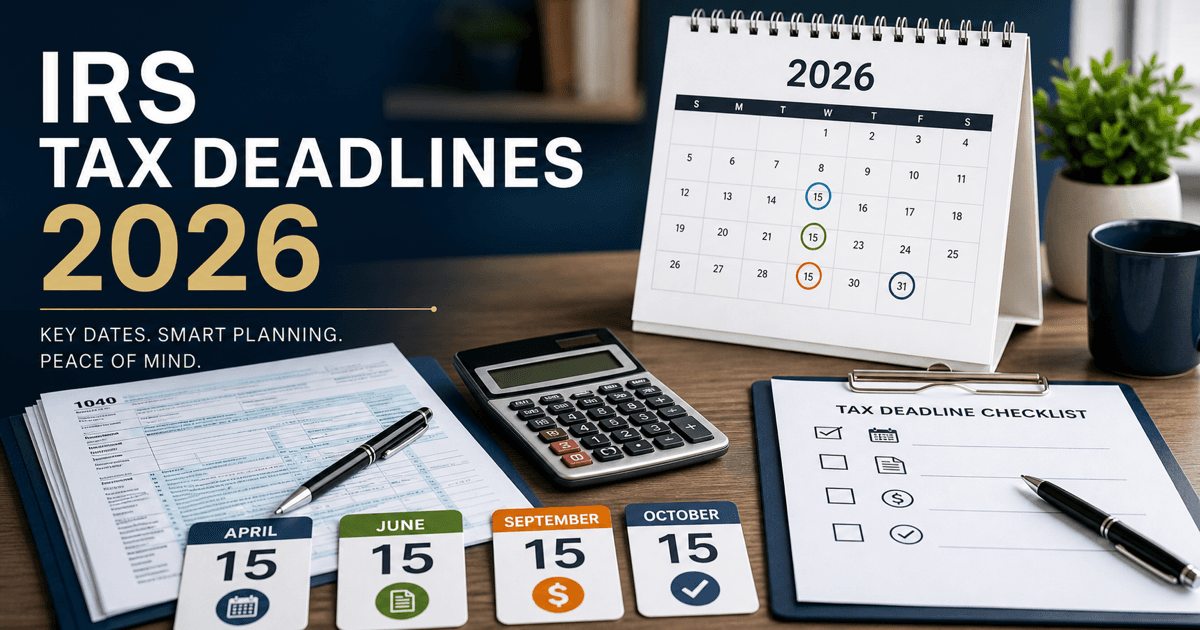
Use this broader calendar for individual, entity, extension, estimated-payment, refund, and state deadline context.
Read guide
IRS Estimated Tax Payment Deadlines 2026
Use this for Form 1040-ES quarterly dates, safe-harbor planning, missed payments, and IRS payment options.
Read guide
Quarterly Tax Payment Dates 2026
Use this as the date-first companion for April 15, June 15, September 15, and January 15 estimated-tax dates.
Read guide
IRS Extension Deadline 2026
Pairs with self-employed filing when Form 4868 moved the filing date but not the payment deadline.
Read guideSources & References
- 1.IRS - Self-Employed Individuals Tax Center(Accessed June 2026)
- 2.IRS - When to File(Accessed June 2026)
- 3.IRS - Estimated Taxes(Accessed June 2026)
- 4.IRS - About Form 1040-ES(Accessed June 2026)
- 5.IRS - About Schedule C(Accessed June 2026)
- 6.IRS - Self-Employment Tax(Accessed June 2026)
- 7.IRS - About Schedule SE(Accessed June 2026)
- 8.IRS - About Form 4868(Accessed June 2026)
- 9.IRS - If You Need More Time to File, Do Not Wait(Accessed June 2026)
- 10.IRS - Gig Economy Tax Center(Accessed June 2026)
- 11.IRS - Estimated Tax Payments YouTube Video Script(Accessed June 2026)
- 12.IRS - Direct Pay(Accessed June 2026)