Small Business Tax Deadlines 2026: 1099, Payroll, Schedule C, 1065, 1120-S, 1120, Extensions, and Estimated Taxes
A practical 2026 small business tax deadline guide covering Schedule C, Form 1065, Form 1120-S, Form 1120, Form 7004, Form 4868, payroll Form 941, W-2, 1099-NEC, estimated taxes, extensions, state dates, and official IRS video guidance.
Guide Oversight & Review Policy
CalculatorWallah guides are written to explain calculator assumptions, source limitations, and when users should move from a rough estimate to an official rule, institution policy, or clinician conversation.
Jitendra Kumar, Founder & Editorial Standards Lead. Updated June 25, 2026. Scope: Sales tax and tax-sensitive estimate tools, Education and GPA planning calculators, Health, protein, and screening-formula pages, Platform-wide publishing standards and methodology.
Tax credentialed review: Named internal reviewer: Iliyas Khan, Chief Operating Officer. External credentialed professional review is still required before this page is treated as professional advice.
Internal tax and sales-tax methodology reviewer. Review scope: calculator assumptions, labels, source context, workflow clarity, and compliance-sensitive disclaimers.
Relevant review context: CalculatorWallah tax and sales-tax calculator workflow owner; Source-first review of IRS, state revenue, rate, and filing-sensitive references; Compliance-sensitive labels, assumptions, and user-facing disclaimer review.
Required professional credentials: CPA, Enrolled Agent, licensed tax professional. Scope: tax formulas, jurisdiction assumptions, withholding language, filing-sensitive examples, and compliance caveats.
This page is educational planning support. A named CPA, EA, or licensed tax professional should review the page before it is positioned as tax advice or used for filing decisions.
Professional Review Status
This YMYL page has internal methodology review, but no external credentialed professional review is recorded yet.
- Reliance status
- Credentialed tax review required before professional reliance
- Required credentials
- CPA, Enrolled Agent, licensed tax professional
- Review scope
- tax formulas, jurisdiction assumptions, withholding language, filing-sensitive examples, and compliance caveats
Current reviewer: Iliyas Khan, Internal tax and sales-tax methodology reviewer.
This page is educational planning support. A named CPA, EA, or licensed tax professional should review the page before it is positioned as tax advice or used for filing decisions.
On This Page
Small Business Tax Deadlines 2026
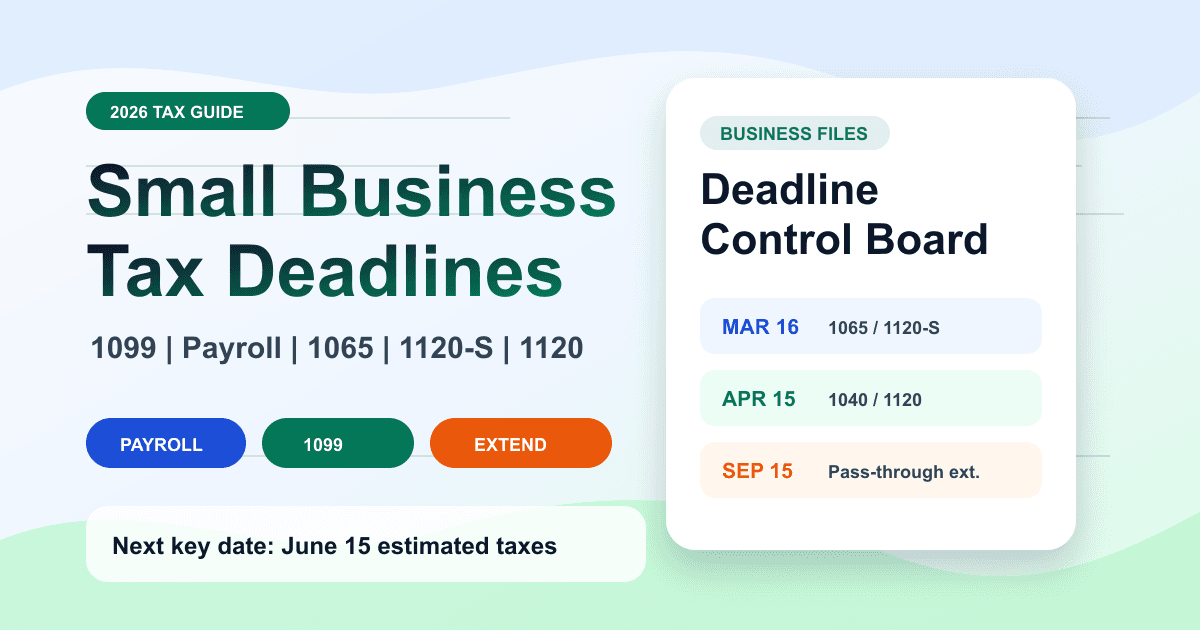
Small business tax deadlines in 2026 depend on the business structure. For calendar-year 2025 returns, partnerships and S corporations generally had a March 16, 2026 deadline, sole proprietors and calendar-year C corporations generally had an April 15, 2026 deadline, and many extended pass-through returns point to September 15, 2026.
This article is updated as of June 25, 2026. The March and April original return dates and June 15 estimated-tax date have passed. The next common federal dates for many small businesses are the July 31, 2026 Q2 Form 941 payroll deadline, the September 15, 2026 pass-through extension and estimated-tax date, and the October 15, 2026 individual and C corporation extended filing date.
Countdown Timer
The tracked 2026 IRS deadline sequence is complete.
Pass-Throughs
March 16 and September 15
Calendar-year partnerships, multi-member LLCs taxed as partnerships, and S corporations generally use March 16, 2026 for original returns and September 15 for valid extensions.
Owners and C Corps
April 15 and October 15
Schedule C owners and calendar-year C corporations generally use April 15, 2026 for original filings and October 15 for valid extended filings.
Operating Calendar
Payroll, 1099s, and estimates
A small business calendar also needs W-2, 1099-NEC, Form 941, estimated-tax, state, sales tax, and payroll deposit controls.
Quick Small Business Actions
First identify the tax form, then the year end, then the extension form, then the payment calendar. Payroll, vendor reporting, and state obligations should be reviewed separately from the annual income tax return.
Important 2026 Small Business Tax Dates
A small business deadline calendar should combine annual returns, owner-level taxes, estimated payments, payroll returns, information returns, extensions, and state filings. The table below focuses on common federal calendar-year dates.
2026 Small Business Deadline Table
| Date | Category | Deadline | Applies To | Action |
|---|---|---|---|---|
| January 15, 2026 | Estimated Tax | Fourth 2025 individual estimated-tax installment | Schedule C owners, partners, S corporation shareholders, and other owners who needed a final 2025 estimate | This date has passed. Review it when checking 2025 underpayment exposure or owner-level payment coverage. |
| February 2, 2026 | Payroll and 1099 | Many 2025 W-2, W-3, 1099-NEC, Form 940, and Q4 Form 941 actions | Employers and businesses that paid employees, contractors, or reportable vendors | This date has passed. Reconcile payroll, vendor files, e-file confirmations, and corrected forms. |
| March 16, 2026 | Pass-Through Returns | Calendar-year Form 1065 and Form 1120-S due | Partnerships, multi-member LLCs taxed as partnerships, and S corporations | File the return, provide Schedule K-1 where required, or file Form 7004 by the original due date. |
| April 15, 2026 | Annual Returns | Schedule C individual returns and calendar-year Form 1120 due | Sole proprietors, single-member LLCs, and calendar-year C corporations | File Form 1040 with Schedule C or Form 1120, request the right extension, and pay expected tax. |
| April 15, 2026 | Estimated Tax | First 2026 federal estimated-tax installment | Many business owners and calendar-year corporations with estimated-tax obligations | Pay the 2026 estimate separately from any 2025 balance due or extension payment. |
| April 30, 2026 | Payroll | First quarter 2026 Form 941 due | Many employers that file quarterly federal payroll tax returns | Reconcile wages, tips, withholding, Social Security, Medicare, deposits, and payroll provider records. |
| June 15, 2026 | Estimated Tax | Second 2026 federal estimated-tax installment | Many owners and corporations making 2026 estimated payments | Update projections for revenue, payroll, inventory, deductions, owner draws, distributions, and withholding. |
| July 31, 2026 | Payroll | Second quarter 2026 Form 941 due | Many quarterly payroll return filers | Confirm Q2 payroll tax deposits, benefit adjustments, tips, fringe benefits, and state payroll filings. |
| September 15, 2026 | Extended Returns | Extended Form 1065 and Form 1120-S due | Calendar-year partnerships and S corporations with valid Form 7004 extensions | File the completed return and provide Schedule K-1 information needed by owners. |
| September 15, 2026 | Estimated Tax | Third 2026 federal estimated-tax installment | Many business owners and corporations making estimates | Recalculate after summer revenue, payroll, depreciation, inventory, and owner compensation changes. |
| October 15, 2026 | Extended Returns | Extended Form 1040 and calendar-year Form 1120 due | Schedule C owners with Form 4868 and C corporations with valid Form 7004 extensions | File the completed return. The extension did not move the original payment deadline. |
| November 2, 2026 | Payroll | Third quarter 2026 Form 941 due | Many quarterly payroll return filers | October 31, 2026 is a Saturday, so the practical next-business-day date is Monday, November 2, 2026. |
| January 15, 2027 | Estimated Tax | Fourth 2026 individual estimated-tax installment | Many pass-through owners, sole proprietors, and other individual business owners | Use full-year business profit, wages, deductions, credits, and safe-harbor review before paying. |
Build a Small Business Deadline Control System
A useful small business tax tool should connect five calendars at once: entity returns, owner payments, payroll deposits and returns, vendor information returns, and state or local obligations. The practical formula is total deadline risk = filings due + payments due + people waiting on forms + proof not saved. A clean calendar reduces all four.
Small Business Deadline Control System
| Control | Records Needed | Calculator Use | Owner Action |
|---|---|---|---|
| Entity return calendar | Tax classification, year end, prior return, extension status, K-1 package, state entity file. | Use the tax deadline calendar to route Schedule C, Form 1065, Form 1120-S, Form 1120, and Form 7004 correctly. | Assign one owner for the federal return and one owner for state annual reports or franchise tax. |
| Owner payment coverage | Profit forecast, draws, distributions, guaranteed payments, wages, withholding, credits, prior estimates. | Use federal income, self-employment, refund, and quarterly payment calculators after books are updated. | Document whether the next cash move is a withholding change, an estimated payment, or a state payment. |
| Payroll and deposits | Payroll register, deposit history, Form 941 quarters, benefits, tips, fringe benefits, state withholding. | Use payroll deposit and FICA calculators to audit cash timing before Form 941 is finalized. | Keep payroll provider confirmations separate from income tax extension proof. |
| Vendor and information returns | W-9 files, 1099-NEC vendors, rent/legal payments, backup withholding, W-2/W-3 confirmations. | Use the deadline calendar to separate annual information-return dates from income-tax return dates. | Correct missing W-9 or 1099 issues before finalizing deductions on the annual return. |
| State and local obligations | State income, sales tax, gross receipts, payroll unemployment, annual report, license, franchise tax. | Use federal calculators for cash planning, then build a separate state checklist because dates may not match IRS dates. | Save state portal proof in the same close package as federal e-file and payment confirmations. |
Use the Tax Deadline Calendar to map dates, the Payroll Tax Deposit Schedule Calculator for employer cash timing, and the Schedule C Profit Tax Reserve Calculator for owner-level cash reserves.
Small Business Deadlines by Entity Type
The same business activity can land on different federal calendars depending on tax classification. A single-member LLC may be Schedule C, a multi-member LLC may be a partnership, and an LLC with an election may be taxed as an S corporation or C corporation.
Sole Proprietor
Form 1040 with Schedule C
Original calendar-year 2025 filing and payment date was April 15, 2026. A valid Form 4868 generally moves filing to October 15, not payment.
Partnership
Form 1065 and K-1s
Calendar-year 2025 Form 1065 and many partner Schedule K-1 obligations were due March 16, 2026, with a common extended date of September 15.
S Corporation
Form 1120-S and K-1s
Calendar-year 2025 Form 1120-S generally followed the same March 16 original and September 15 extended filing dates.
C Corporation
Form 1120
Calendar-year 2025 Form 1120 was generally due April 15, 2026, with a common extended filing deadline of October 15 when Form 7004 was valid.
Payroll, W-2, and 1099 Deadlines
A small business with employees or contractors has deadlines before the income tax return is finished. Many 2025 W-2, W-3, and Form 1099-NEC obligations landed on February 2, 2026 because January 31 was a Saturday. Quarterly Form 941 deadlines continue through the year.
Employees
W-2, W-3, Form 941, deposits
Reconcile payroll registers, tax deposits, state withholding, unemployment, benefits, tips, fringe benefits, and third-party payroll reports before filing.
Contractors
W-9 and 1099 controls
Collect W-9s early, review payment thresholds, reconcile vendors, and correct duplicate 1099-NEC or 1099-K reporting before annual returns.
Estimated Tax Dates for Small Businesses
Estimated-tax obligations can exist at the owner level, the corporation level, or both, depending on the structure. Sole proprietors, partners, and S corporation shareholders often make individual estimated payments. C corporations may have corporate estimated-tax payments.
For many calendar-year individual taxpayers, 2026 federal estimated-tax installments are due April 15, June 15, September 15, 2026, and January 15, 2027. Corporations generally use the 15th day of the fourth, sixth, ninth, and twelfth months of the tax year.
Small Business Extension Rules
Small businesses use different extension forms. Form 7004 is used for many business returns, including Form 1065, Form 1120-S, and Form 1120. Form 4868 is used by many individuals, including sole proprietors filing Schedule C with Form 1040.
Extensions generally extend filing time, not payment time. A partnership or S corporation extension also does not remove the practical need to give owners Schedule K-1 information in time for their personal returns.
Fiscal-Year Small Business Rules
Fiscal-year businesses must shift deadlines based on tax year end. Publication 509 gives general rules: Form 1065 and Form 1120-S are generally due on the 15th day of the third month after year-end, Form 1120 is generally due on the 15th day of the fourth month after year-end, and individual Form 1040 timing follows the 15th day of the fourth month after the tax year.
Do not apply a calendar-year deadline to a fiscal-year entity without checking the return instructions, extension form, weekend or holiday adjustment, and any special fiscal-year corporate rule.
State and Local Small Business Deadlines
Federal dates are only part of the compliance calendar. State income tax, franchise tax, gross receipts tax, sales tax, local business tax, state payroll withholding, unemployment, annual reports, registered-agent renewals, business licenses, professional licenses, and city taxes can all use separate deadlines.
What To Do If a Small Business Deadline Was Missed
If a 2026 deadline was missed, identify the exact filing, tax year, entity type, and payment. Then file the missing return or extension cleanup as soon as practical, pay what can be paid, and keep filing, mailing, e-file, and payment confirmations.
Step 1
Find the actual missing item
Separate annual income tax returns, payroll returns, 1099s, estimated payments, and state filings before fixing the wrong problem.
Step 2
File and pay promptly
Use the right IRS or state system, preserve confirmations, and review whether penalties or interest continue to accrue.
Step 3
Protect owners and employees
Late K-1s, W-2s, 1099s, and payroll returns can affect other people, not just the business entity.
Step 4
Rebuild the calendar
Add recurring controls for extensions, estimates, payroll deposits, 941s, state taxes, sales tax, and annual reports.
Small Business Filing Checklist
Use this checklist before filing, extending, paying, or correcting a small business tax position. The goal is to connect each deadline to the right return, owner, payroll obligation, vendor form, extension, and state filing.
Confirm Entity Type
- Identify whether the business files Schedule C, Form 1065, Form 1120-S, Form 1120, or another return.
- Check LLC tax classification instead of relying only on state LLC status.
- Confirm calendar year versus fiscal year before using any date table.
Close Books and Owner Records
- Reconcile sales, refunds, bank deposits, payment processors, 1099-K, 1099-NEC, inventory, loans, and owner contributions.
- Review deductions, depreciation, mileage, home office, meals, payroll, benefits, retirement plans, and accountable plans.
- Prepare owner K-1, wage, draw, distribution, basis, and self-employment tax records before filing.
Handle Payroll and Vendors
- Confirm W-2, W-3, 1099-NEC, 1099-MISC, and 1099-K reconciliation before annual returns are finalized.
- Review Form 941 quarters, payroll deposits, unemployment filings, state withholding, and payroll provider reports.
- Collect Form W-9 information before paying contractors, not after the deadline arrives.
Manage Extensions and Payments
- Use Form 7004 for many business return extensions and Form 4868 for individual Schedule C extensions.
- Do not confuse filing extensions with payment extensions.
- Track estimated-tax dates separately from return due dates and payroll deposit dates.
Calculator Tools for Small Business Owners
CalculatorWallah tools do not prepare Form 1065, Form 1120-S, Form 1120, Schedule C, Form 7004, Form 4868, Form 941, W-2, or 1099 filings. They can support planning around owner income tax, self-employment tax, payroll tax, employee withholding, and cash set aside before a filing or payment deadline.
Owner Tax
Income and self-employment tax
Use owner-level calculators after business profit, wages, distributions, deductions, and credits are credible enough to model.
Payroll
FICA and withholding
Use payroll calculators as planning aids, while actual deposits and filings remain tied to payroll records and IRS/state systems.
Official IRS Videos
I looked for official IRS video material relevant to small business deadline planning. The IRS Tax Calendar video is relevant for recurring due-date controls, and the Small Business Self-Employed Tax Center video is relevant because IRS small business guidance is organized around entity structure, payroll, records, forms, and filing responsibilities.
IRS: Tax Calendar
Official IRS video about using IRS calendar tools. Use current written Publication 509 and form instructions for exact 2026 dates.
IRS: Small Business Self-Employed Tax Center
Official IRS video introducing small business and self-employed tax resources, including business structure, records, forms, payroll, and tax centers.
Small Business Tax Deadline FAQ System
The short answer is that no single 2026 small business tax deadline applies to every business. The safer answer is to confirm entity tax classification, year end, return form, payroll status, vendor reporting, estimated-tax obligations, extension form, owner-level tax, and state or local deadlines.
Schema, Trust, and Update Notes
This page is structured for Article, FAQ, source citation, reviewer, related calculator, and VideoObject markup. It uses IRS written sources for Publication 509, small business and self-employed guidance, estimated taxes, Form 1065, Form 1120-S, Form 1120, Form 7004, Form 4868, Form 941, information returns, and official IRS video context.
CalculatorWallah tools do not prepare business tax returns, file extensions, calculate every payroll deposit, classify every worker, decide LLC tax status, handle state taxes, or replace a CPA, enrolled agent, tax attorney, payroll provider, state agency, or official IRS source. Refresh this article when IRS instructions, disaster relief, weekend adjustments, payment rules, state calendars, or business tax law changes affect 2026 deadlines.
Frequently Asked Questions
Related Calculators
Self-Employment Tax Calculator
Estimate self-employment tax for sole proprietors, single-member LLC owners, and other Schedule C businesses.
Use Self-Employment Tax CalculatorFederal Income Tax Calculator
Model owner-level income tax after business profit, wages, deductions, credits, and filing status.
Use Federal Income Tax CalculatorFICA Tax Calculator
Estimate Social Security and Medicare taxes for payroll planning and compare them with self-employment tax.
Use FICA Tax CalculatorPaycheck Calculator
Review employee withholding and net pay when a small business has payroll or owner wages.
Use Paycheck CalculatorTax Refund Calculator
Compare withholding, estimated payments, credits, and business income before filing or extending.
Use Tax Refund CalculatorTax Deadline Calendar 2026-2027
Map entity, owner, payroll, 1099, extension, and estimated-tax dates into one operating calendar.
Use Tax Deadline Calendar 2026-2027Payroll Tax Deposit Schedule Calculator
Estimate payroll deposit timing when Form 941 deadlines are not the only employer obligation.
Use Payroll Tax Deposit Schedule CalculatorSchedule C Profit Tax Reserve Calculator
Convert sole proprietor profit into owner-level income tax and self-employment tax reserves.
Use Schedule C Profit Tax Reserve CalculatorSources & References
- 1.IRS - Publication 509, Tax Calendars(Accessed June 2026)
- 2.IRS - Small Businesses and Self-Employed(Accessed June 2026)
- 3.IRS - Self-Employed Individuals Tax Center(Accessed June 2026)
- 4.IRS - Estimated Taxes(Accessed June 2026)
- 5.IRS - About Form 1065(Accessed June 2026)
- 6.IRS - About Form 1120-S(Accessed June 2026)
- 7.IRS - About Form 1120(Accessed June 2026)
- 8.IRS - About Form 7004(Accessed June 2026)
- 9.IRS - About Form 4868(Accessed June 2026)
- 10.IRS - About Form 941(Accessed June 2026)
- 11.IRS - General Instructions for Certain Information Returns(Accessed June 2026)
- 12.IRS - IRS Small Business Self-Employed Tax Center YouTube Video Script(Accessed June 2026)