
Form 7004 Extension Deadline 2026: Business Tax Extension Due Dates, Payment Rules, and Filing Checklist
A detailed 2026 Form 7004 extension deadline guide for partnerships, S corporations, C corporations, estates, trusts, and other business returns. Covers March 16 and April 15 extension request deadlines, September 15, September 30, and October 15 extended due dates, e-file rules, payment warnings, fiscal-year exceptions, Form 1041 5.5-month extensions, June 30 C corporation rules, missed extensions, official IRS payment video context, and a practical checklist.
Guide Oversight & Review Policy
CalculatorWallah guides are written to explain calculator assumptions, source limitations, and when users should move from a rough estimate to an official rule, institution policy, or clinician conversation.
Reviewed by Jitendra Kumar, Founder & Editorial Standards Lead. Page updated May 8, 2026. Trust-critical pages are reviewed when official rates or rules change. Evergreen calculator guides are checked on a recurring quarterly or annual cycle depending on topic volatility. Topic ownership: Sales tax and tax-sensitive estimate tools, Education and GPA planning calculators, Health, protein, and screening-formula pages, Platform-wide publishing standards and methodology.
On This Page
Form 7004 Extension Deadline 2026
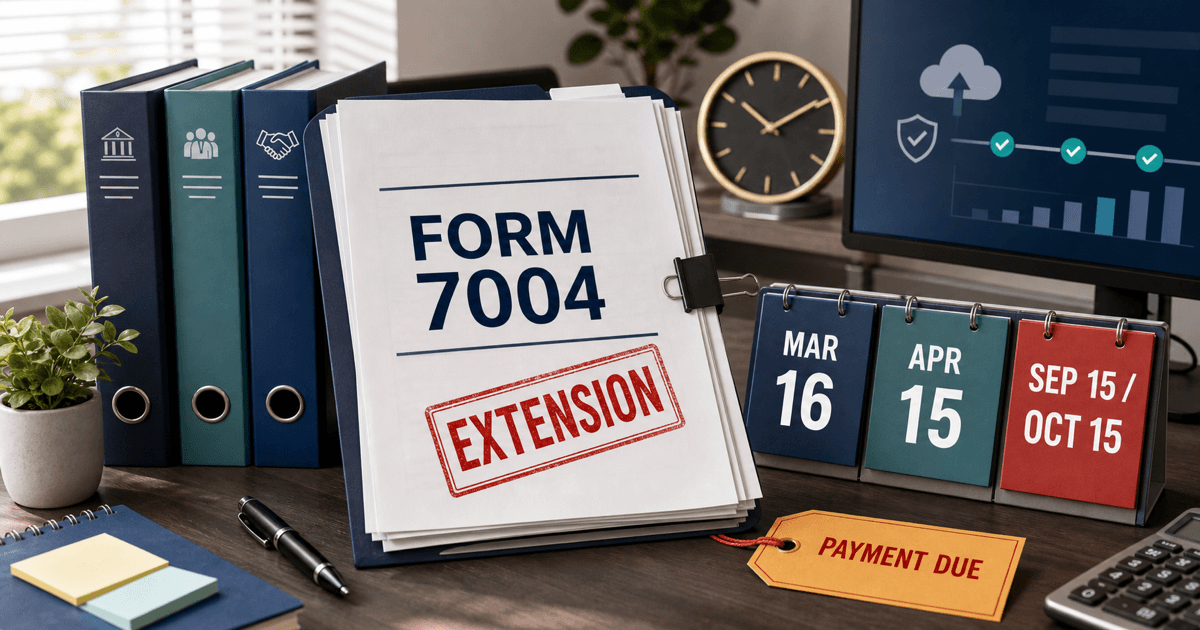
The Form 7004 extension deadline in 2026 is not one universal date. Form 7004 is generally due by the original deadline of the return being extended. For many calendar-year partnerships and S corporations filing 2025 returns, the Form 7004 deadline was March 16, 2026. For many calendar-year C corporations, estates, and trusts, the Form 7004 deadline was April 15, 2026.
This article is updated as of May 8, 2026. That means the main March 16 and April 15 extension request deadlines have passed for most calendar-year business filers. If Form 7004 was timely and valid, the next major federal extended filing dates are generally September 15, 2026 for partnerships and S corporations, September 30, 2026 for many Form 1041 estates and trusts, and October 15, 2026 for many C corporations.
Countdown Timer
The tracked 2026 IRS deadline sequence is complete.
Extension Request
Due by the return due date
Form 7004 generally must be filed on or before the original due date of the return being extended.
Payment Warning
No extension to pay
IRS instructions state that Form 7004 does not extend the time to pay any tax due.
Approval Proof
Keep acceptance records
The IRS normally sends a notice only if the extension request is disallowed, so proof of timely filing matters.
Quick Answer
File Form 7004 by the original due date, pay the expected balance by the original due date, save acceptance or mailing proof, and calendar the correct extended due date for that specific return. Do not assume every entity gets October 15.
2026 Form 7004 Extension Deadline Table
The table below summarizes common 2026 federal deadlines for calendar-year entities and a key June 30 C corporation exception. It is not a complete list of every return listed on Form 7004. Always check the current instructions for the specific return, entity year, state filing, disaster relief, and special international rules before filing.
2026 Form 7004 Extension Deadline Table
| Original Return Due Date | Return Type | Form 7004 Due | Extended Filing Date | Payment Note |
|---|---|---|---|---|
| March 16, 2026 | Calendar-year partnership Form 1065 | March 16, 2026 | September 15, 2026 | Partner individual, trust, or corporate payment deadlines are separate from the partnership extension. |
| March 16, 2026 | Calendar-year S corporation Form 1120-S | March 16, 2026 | September 15, 2026 | Any entity-level tax, state tax, payroll tax, or shareholder payment issue is not delayed by Form 7004. |
| April 15, 2026 | Calendar-year C corporation Form 1120 | April 15, 2026 | October 15, 2026 | Expected corporate income tax is generally due by April 15 even when the return is extended. |
| April 15, 2026 | Calendar-year estate or trust Form 1041 | April 15, 2026 | September 30, 2026 | Form 1041 has an automatic 5.5-month extension, but payment and interest rules still track the original due date. |
| April 15, 2026 | Calendar-year homeowners association Form 1120-H | April 15, 2026 | October 15, 2026 | Check the association return instructions and Form 7004 code before filing the extension. |
| September 15, 2026 | C corporation fiscal year ending June 30, 2026 | September 15, 2026 | April 15, 2027 | Special 7-month extension rules can apply to June 30 C corporation years that began before January 1, 2026. |
What Form 7004 Actually Does
Form 7004 is the IRS application for an automatic extension of time to file certain business income tax, information, and other returns. The extension is generally automatic when Form 7004 is completed properly, filed by the due date of the return, and any tax due is paid.
Properly filing Form 7004 generally gives the maximum extension period allowed from the due date of the return. The IRS instructions also say the IRS will no longer send a notice that the extension has been approved. The IRS normally contacts the filer only if the extension request is disallowed.
Maximum Extension
Usually 6 months
Most Form 7004 returns receive a 6-month filing extension, but Form 1041 and certain June 30 C corporation years have special periods.
Return Specific
No blanket request
A separate Form 7004 is generally required for each return. One extension does not cover related returns by default.
No Signature
Signature not required
IRS Form 7004 instructions state that no signature is required on the extension form.
Still Due
Tax payment remains due
Estimated tax, balance due, withholding, deposits, state payments, and owner-level payments need separate review.
Who Uses Form 7004
Form 7004 is commonly used by partnerships filing Form 1065, S corporations filing Form 1120-S, C corporations filing Form 1120, estates and trusts filing Form 1041, homeowners associations filing Form 1120-H, and many other business or information returns listed in the Form 7004 instructions.
It is not the extension form for every tax obligation. Individual Form 1040 taxpayers generally use Form 4868. Many exempt organization returns use Form 8868. The trustee of a trust required to file Form 1041-A uses Form 8868 instead of Form 7004. FBAR extensions are separate and do not use Form 7004.
Payment Rules: Extension to File, Not Pay
The most expensive Form 7004 mistake is thinking that the extension moves the payment deadline. IRS instructions state that Form 7004 does not extend the time to pay any tax due. Any balance due shown on Form 7004 line 8 is generally required by the original due date of the return.
Payment analysis depends on the return. A C corporation filing Form 1120 may need to pay corporate income tax by April 15, 2026 even if the Form 1120 paperwork is extended to October 15. An estate or trust may owe Form 1041 tax by April 15 even though the extended filing date is September 30. A partnership or S corporation may not owe regular federal income tax at the entity level, but withholding, composite tax, pass-through entity tax, state tax, audit-related payments, payroll tax, or partner/shareholder payments may still be due separately.
E-File and Paper Filing Rules
IRS e-file guidance says Form 7004 can be e-filed through Modernized e-File for most eligible returns. However, some returns and situations cannot be e-filed. IRS guidance lists exceptions, including certain forms and cases involving items such as name change applications, reasonable-cause statements for late filing or late payment, refund requests, certain accounting-period changes, and other special facts.
If a paper Form 7004 is required or chosen, use the current IRS where-to-file table for the return being extended. A paper extension and electronic return can also create timing problems if the return is processed before the extension record is recognized, so keep mailing proof, private delivery service proof, and any IRS response.
Calendar-Year Partnership, S Corp, and C Corp Dates
For many calendar-year 2025 partnerships and S corporations, March 16, 2026 was the key original filing and Form 7004 date because March 15, 2026 fell on a Sunday. A timely and valid Form 7004 generally moves those Form 1065 and Form 1120-S filing deadlines to September 15, 2026.
For many calendar-year 2025 C corporations, April 15, 2026 was the Form 1120 deadline, payment deadline, and Form 7004 deadline. A timely and valid Form 7004 generally moves the Form 1120 paperwork deadline to October 15, 2026. It does not move the April 15 corporate tax payment obligation.
Estates and Trusts: Form 1041 Extension Date
Form 1041 has a different extension period. IRS Form 7004 instructions state that an estate other than a bankruptcy estate, and a trust filing Form 1041, are eligible for an automatic 5.5-month extension. IRS Form 1041 instructions say calendar-year estates and trusts must file 2025 Form 1041 by April 15, 2026.
Put those together and a timely Form 7004 for a calendar-year Form 1041 generally moves the filing deadline to September 30, 2026. Interest and payment consequences can still run from April 15, so trustees and fiduciaries should treat the payment estimate as a separate workstream.
Fiscal-Year and Short-Year Rules
Fiscal-year entities do not blindly use March 16, April 15, September 15, or October 15. The Form 7004 deadline generally follows the due date of the applicable return for that entity's tax year. A fiscal-year partnership or S corporation usually uses the 15th day of the third month after year-end. A fiscal-year C corporation usually uses the 15th day of the fourth month after year-end, with special rules for June 30 years.
IRS Publication 509 and Form 7004 instructions highlight the June 30 C corporation rule. C corporations with tax years ending June 30 and beginning before January 1, 2026 can be eligible for a 7-month automatic extension. For tax years beginning in 2026, the automatic extension period is generally 6 months. A short tax year ending anytime in June is treated as if the short year ended on June 30.
Common Form 7004 Mistakes
Form 7004 is short, but the surrounding deadline logic is easy to get wrong. These are the mistakes most likely to create late filing, late payment, or notice problems.
Watch
Treating the extended date as automatic without filing Form 7004
September 15, September 30, and October 15 generally matter only if the extension was timely and valid.
Watch
Forgetting that Form 7004 does not extend payment
Line 8 and the underlying return instructions matter because balance-due exposure runs from the original due date.
Watch
Using one Form 7004 for multiple returns
The IRS requires a separate Form 7004 for each return being extended, with the correct form code.
Watch
Mixing up Form 7004 with Form 4868, Form 8868, or FBAR extensions
Individuals, many exempt organizations, and FBAR filers use different extension systems.
Watch
Using the wrong name, EIN, tax year, or short-year box
A mismatch can prevent a valid extension or create notices later when the return is filed.
Watch
Assuming federal extension rules control every state filing
States may require a separate form, payment, estimate, annual report, or franchise tax action.
What If the Form 7004 Deadline Was Missed
If the original due date passed and Form 7004 was not timely filed, do not wait until the extended deadline. The extended deadline generally depends on a valid extension. The practical move is to complete the underlying return as soon as possible, pay what can be paid, provide K-1 or shareholder information if relevant, and preserve proof of filing and payment.
If a penalty notice arrives, review the notice, the return type, the filing proof, payment proof, entity history, reasonable-cause facts, and whether the IRS record shows a timely Form 7004. Federal penalty relief, state penalty relief, and partner or shareholder communication should be handled separately.
Form 7004 Filing Checklist
Use this checklist before filing Form 7004, before relying on an extended date, or when cleaning up a missed extension.
Before the Original Due Date
- Identify the exact return being extended and the correct Form 7004 code.
- Confirm the entity tax year, fiscal year, short year, and calendar-year status.
- Estimate tax due as accurately as possible and confirm whether payment is required with the extension.
- Choose e-file or paper filing based on the return type and IRS e-file restrictions.
When Filing Form 7004
- Use the name and EIN that match IRS records.
- File a separate Form 7004 for each return being extended.
- Save e-file acceptance, certified mail proof, private delivery service proof, and payment records.
- Do not rely on an approval notice because IRS instructions say approval notices are not normally sent.
After the Extension
- Set the actual extended deadline for the specific return, not a generic October date.
- Close books, reconcile payroll and 1099 records, collect K-1 or shareholder schedules, and prepare state extensions.
- Track notices and payment confirmations separately from the federal extension record.
- File before the extended deadline if the return is ready; the extension date is the outside limit, not a target.
If the Deadline Was Missed
- Do not wait until the extended date if Form 7004 was not timely filed.
- Finish and file the most accurate return as soon as possible.
- Pay what can be paid and preserve proof of payment.
- Prepare reasonable-cause support if a late-filing or late-payment notice arrives.
Official IRS Video Context
A dedicated official IRS video solely about Form 7004 extension deadlines was not found during this update. The official IRS video below is included because Form 7004 does not extend the time to pay tax, and payment method choice is part of a valid extension workflow when a balance is due.
IRS: Options for Paying Your Federal Taxes
Official IRS video about federal payment methods. Use it for payment context only; use the written IRS Form 7004 instructions and the applicable return instructions for deadline rules.
Form 7004 Extension Deadline FAQ
The short answer is that Form 7004 is due by the original due date of the return being extended and does not move the payment deadline. The FAQ section covers March 16, April 15, September 15, September 30, October 15, e-file rules, approval notices, separate extension requests, wrong-form mistakes, and June 30 C corporation exceptions.
Trust and Update Notes
This article was built from IRS Form 7004 instructions, IRS e-file guidance, IRS Publication 509, IRS Form 1041 instructions, IRS where-to-file guidance, and IRS payment resources reviewed in May 2026. It is written for deadline planning and filing workflow decisions. It is not a substitute for the current IRS instructions, state revenue agency guidance, e-file provider rules, or a tax adviser reviewing entity-specific facts.
Before filing or relying on an extension, confirm the return type, tax year, short-year status, international exceptions, disaster relief, state extension rules, e-file eligibility, payment amount, and acceptance proof.
Frequently Asked Questions
Related Calculators
Date Duration Calculator
Count days from the original return due date to the extended deadline, notice response date, or filing cleanup target.
Use Date Duration CalculatorFederal Income Tax Calculator
Estimate owner-level federal tax when a business extension delays K-1 or shareholder information.
Use Federal Income Tax CalculatorSelf-Employment Tax Calculator
Review partner, LLC member, or sole-owner self-employment tax exposure that Form 7004 does not extend.
Use Self-Employment Tax CalculatorPaycheck Calculator
Review officer and employee wage records before finalizing business returns that also affect W-2 and payroll files.
Use Paycheck CalculatorFICA Tax Calculator
Separate payroll tax from business income-tax extension planning when wages and entity returns need reconciliation.
Use FICA Tax CalculatorRelated Guides

IRS Extension Deadline 2026
Use this broader extension guide when Form 7004 sits beside individual Form 4868 extensions, payment deadlines, and late-filing cleanup.
Read guide
Form 2553 Deadline 2026
Use this when the extension question is really an S corporation election deadline question, because Form 7004 does not extend Form 2553.
Read guideSources & References
- 1.IRS - Instructions for Form 7004(Accessed May 2026)
- 2.IRS - About Form 7004(Accessed May 2026)
- 3.IRS - E-filing Form 7004(Accessed May 2026)
- 4.IRS - Where to File Form 7004(Accessed May 2026)
- 5.IRS - Publication 509, Tax Calendars(Accessed May 2026)
- 6.IRS - Instructions for Form 1041(Accessed May 2026)
- 7.IRS - Payments(Accessed May 2026)
- 8.IRS - Options for Paying Your Federal Taxes Video Text Script(Accessed May 2026)