
What Is FICA Tax and How Do I Calculate It?
A practical 2026 FICA tax guide explaining Social Security tax, Medicare tax, Additional Medicare Tax, employee and employer shares, wage base limits, W-2 boxes, self-employment tax, and worked examples.
Guide Oversight & Review Policy
CalculatorWallah guides are written to explain calculator assumptions, source limitations, and when users should move from a rough estimate to an official rule, institution policy, or clinician conversation.
Jitendra Kumar, Founder & Editorial Standards Lead. Updated June 25, 2026. Scope: Sales tax and tax-sensitive estimate tools, Education and GPA planning calculators, Health, protein, and screening-formula pages, Platform-wide publishing standards and methodology.
Tax credentialed review: Named internal reviewer: Iliyas Khan, Chief Operating Officer. External credentialed professional review is still required before this page is treated as professional advice.
Internal tax and sales-tax methodology reviewer. Review scope: calculator assumptions, labels, source context, workflow clarity, and compliance-sensitive disclaimers.
Relevant review context: CalculatorWallah tax and sales-tax calculator workflow owner; Source-first review of IRS, state revenue, rate, and filing-sensitive references; Compliance-sensitive labels, assumptions, and user-facing disclaimer review.
Required professional credentials: CPA, Enrolled Agent, licensed tax professional. Scope: tax formulas, jurisdiction assumptions, withholding language, filing-sensitive examples, and compliance caveats.
This page is educational planning support. A named CPA, EA, or licensed tax professional should review the page before it is positioned as tax advice or used for filing decisions.
Professional Review Status
This YMYL page has internal methodology review, but no external credentialed professional review is recorded yet.
- Reliance status
- Credentialed tax review required before professional reliance
- Required credentials
- CPA, Enrolled Agent, licensed tax professional
- Review scope
- tax formulas, jurisdiction assumptions, withholding language, filing-sensitive examples, and compliance caveats
Current reviewer: Iliyas Khan, Internal tax and sales-tax methodology reviewer.
This page is educational planning support. A named CPA, EA, or licensed tax professional should review the page before it is positioned as tax advice or used for filing decisions.
On This Page
Short Answer: FICA Is Social Security Plus Medicare
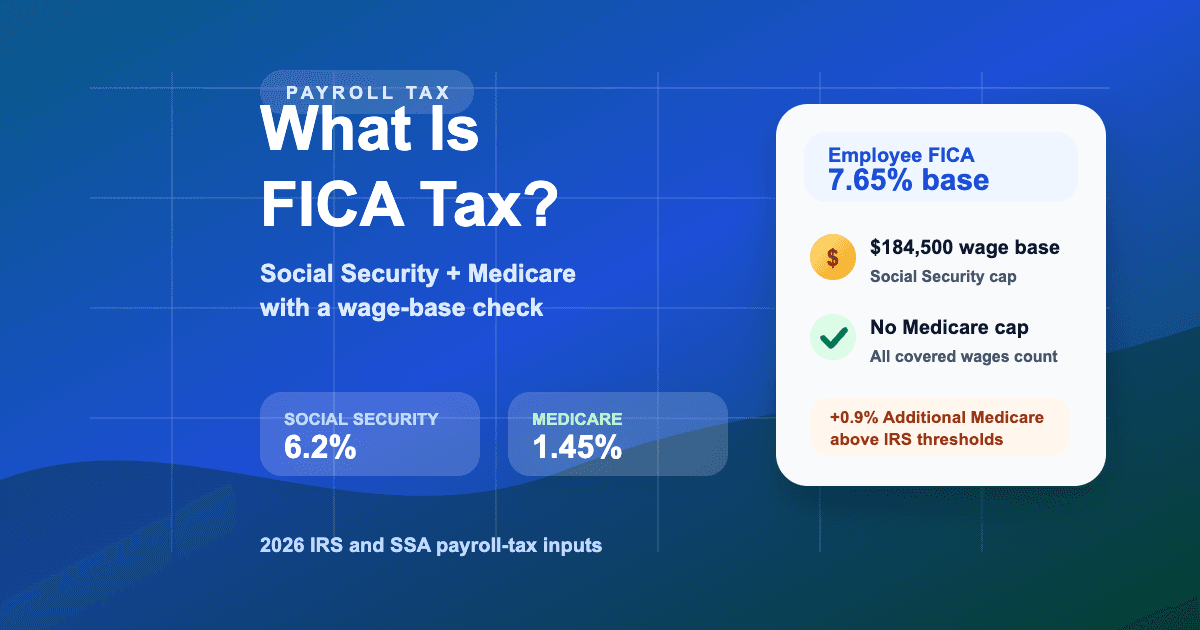
FICA tax is the payroll tax for Social Security and Medicare. For most employees, the basic employee rate is 7.65%: 6.2% for Social Security plus 1.45% for Medicare. Employers generally match that same 7.65%, so the combined employer-plus-employee rate is 15.3% before Additional Medicare Tax.
The calculation is not the same as federal income tax. FICA uses payroll-tax wages, a Social Security wage base, a Medicare rate with no wage cap, and a separate Additional Medicare Tax rule for higher earners. Use the FICA Tax Calculator when you want this payroll-tax layer separated from income tax withholding.
2026 FICA Tax Rates
The IRS and SSA list the 2026 Social Security wage base as $184,500. Social Security tax stops after covered wages reach that amount for the year. Medicare tax does not stop at a wage limit, and high earners may also have Additional Medicare Tax.
| Component | Employee rate | Employer rate | Combined rate | Wage limit |
|---|---|---|---|---|
| Social Security tax | 6.2% | 6.2% | 12.4% | $184,500 for 2026 |
| Medicare tax | 1.45% | 1.45% | 2.9% | No wage base limit |
| Additional Medicare Tax | 0.9% above threshold | No employer match | Employee only | Applies above filing-status threshold; employer withholding starts after $200,000 of wages |
How to Calculate FICA Tax
For a W-2 employee, calculate each part separately. The Social Security calculation uses Social Security wages and the annual wage base. The Medicare calculation uses Medicare wages and has no annual wage base limit.
| Step | Detail | Math |
|---|---|---|
| 1. Find Social Security wages | Use W-2 box 3 or taxable wages subject to Social Security. | Multiply wages up to $184,500 by 6.2% for the employee share. |
| 2. Find Medicare wages | Use W-2 box 5 or wages subject to Medicare. | Multiply all Medicare wages by 1.45%. There is no Medicare wage cap. |
| 3. Check Additional Medicare Tax | Compare Medicare wages, RRTA compensation, and self-employment income with the filing-status threshold. | Apply 0.9% to the excess amount when the threshold is exceeded. |
| 4. Add the pieces | Employee FICA is Social Security tax plus Medicare tax plus any Additional Medicare Tax. | Do not add federal income tax withholding to FICA; it is a separate line item. |
Source Map Before You Use a FICA Calculator
The clean calculator formula is Social Security wages x 6.2% + Medicare wages x 1.45% + Additional Medicare Tax. The hard part is choosing the right source document, especially when wages, self-employment income, and Additional Medicare Tax overlap.
| Source | Calculator input | Use |
|---|---|---|
| Paystub or payroll register | Current-year Social Security wages, Medicare wages, and FICA withheld. | Best for in-year paycheck planning before W-2 forms are final. |
| Form W-2 | Box 3 Social Security wages, box 4 Social Security tax withheld, box 5 Medicare wages, box 6 Medicare tax withheld. | Best for checking whether final payroll records match the annual FICA calculation. |
| Schedule C and Schedule SE | Net profit, 92.35% net earnings adjustment, and remaining Social Security wage base. | Best for freelancers, contractors, and mixed W-2 plus self-employment income. |
| Form 8959 | Additional Medicare Tax threshold, wages, RRTA compensation, and self-employment income. | Best when income approaches $200,000 single, $250,000 joint, or $125,000 married filing separately. |
| Paycheck and refund calculators | FICA separated from income tax withholding, benefits, credits, and estimated payments. | Best when users confuse payroll tax with refund or take-home-pay estimates. |
Start with the FICA Tax Calculator for the payroll-tax layer. Then use the Payroll Deductions Calculator when you need to combine FICA with federal withholding, state tax, benefits, and other deductions.
Worked Examples for Employees
These examples show the employee side only. Employers generally pay their own matching Social Security and Medicare share, but the employer share is not deducted from the employee paycheck.
| Annual wages | Social Security | Medicare | Additional Medicare | Employee FICA |
|---|---|---|---|---|
| $60,000 | $3,720.00 | $870.00 | $0.00 | $4,590.00 |
| $184,500 | $11,439.00 | $2,675.25 | $0.00 | $14,114.25 |
| $250,000 single filer | $11,439.00 | $3,625.00 | $450.00 | $15,514.00 |
| $250,000 married filing jointly, one earner | $11,439.00 | $3,625.00 | $0 final liability if total Medicare wages are exactly $250,000 | $15,064.00 before any employer-withheld Additional Medicare Tax credit |
Additional Medicare Tax Is the High-Earner Layer
Additional Medicare Tax is 0.9% on Medicare wages, RRTA compensation, and self-employment income above the filing-status threshold. Employers must start withholding it when wages paid to an employee exceed $200,000 in a calendar year, even though the final tax return threshold can be different for married filing jointly or married filing separately.
| Filing status | Threshold | Note |
|---|---|---|
| Single | $200,000 | Employer withholding also starts once one employer pays more than $200,000 in Medicare wages. |
| Head of household | $200,000 | Same taxpayer-level threshold as single filers. |
| Married filing jointly | $250,000 | Two jobs can create tax due even if neither employer withholds Additional Medicare Tax. |
| Married filing separately | $125,000 | This lower threshold can create tax due even when employer withholding has not started. |
Where FICA Shows Up on Form W-2
On Form W-2, Social Security wages are usually in box 3 and Social Security tax withheld is in box 4. Medicare wages and tips are usually in box 5 and Medicare tax withheld is in box 6. Box 6 can include regular Medicare tax and Additional Medicare Tax withholding.
Box 1 federal taxable wages can differ from Social Security and Medicare wages because pre-tax deductions, retirement contributions, cafeteria plan benefits, and other payroll items do not always affect each tax the same way.
Self-Employment Tax Uses a Different Workflow
Freelancers, independent contractors, sole proprietors, and many partners do not have an employer withholding employee FICA from a paycheck. Instead, Schedule SE calculates self-employment tax. That system generally covers both the employee and employer shares of Social Security and Medicare tax.
| Situation | Net earnings | Social Security | Medicare | Simplified result |
|---|---|---|---|---|
| $100,000 Schedule C net profit | $92,350 after the 92.35% Schedule SE adjustment | $11,451.40 | $2,678.15 | About $14,129.55 before income tax and the deductible half of SE tax |
| $250,000 Schedule C net profit, single filer | $230,875 after the 92.35% Schedule SE adjustment | $22,878.00 | $6,695.38 | About $29,851.26 after adding about $277.88 of Additional Medicare Tax |
| W-2 wages plus freelance profit | Combine wage Social Security coverage with Schedule SE limits | W-2 Social Security wages reduce remaining Social Security wage base | Medicare still applies broadly, with no wage cap | Use Schedule SE and Form 8959 when thresholds may apply |
Self-employment tax is separate from federal income tax. If you are estimating a full tax return, use both the Self-Employment Tax Calculator and the Federal Income Tax Calculator.
FICA Is Not Federal Income Tax Withholding
FICA is a payroll-tax system. Federal income tax withholding is a prepayment toward your income tax return. Both can appear on the same paycheck, but they answer different questions and use different formulas.
This distinction matters for refunds. Social Security and Medicare withholding usually do not create your ordinary income tax refund. A refund is mostly about federal income tax withholding, estimated payments, refundable credits, and final income tax. FICA errors are usually handled through payroll correction, W-2 correction, or specific IRS procedures.
Official Video Search Note
I looked for a credible official or institutional video specifically explaining FICA tax calculation. I found IRS employment-tax resources and the IRS video library, but I did not find a suitable official FICA-specific video to embed. Because the available non-official videos were creator content rather than government or institutional guidance, this article uses IRS and SSA written sources instead of embedding an unrelated or lower-trust video.
Common FICA Calculation Mistakes
Most FICA mistakes happen because people use the wrong wage number, apply the wrong cap, or mix payroll tax with income tax. Check the tax layer before choosing a calculator.
| Mistake | Fix |
|---|---|
| Treating FICA as federal income tax | FICA is Social Security and Medicare payroll tax. Federal income tax uses a separate withholding and return calculation. |
| Applying Social Security tax above the wage base | For 2026, the Social Security wage base is $184,500. Medicare has no wage cap. |
| Ignoring the employer share | Employees see only their withheld share on the paycheck, but employers generally owe a matching Social Security and Medicare share. |
| Missing Additional Medicare Tax | The 0.9% tax can apply above $200,000 for single and head of household filers, $250,000 for joint filers, and $125,000 for married filing separately. |
| Using gross business revenue for self-employment tax | Self-employment tax generally starts from net earnings, not gross receipts. Schedule SE applies its own adjustment. |
FAQ: The Clean FICA Calculation
The clean FICA calculation is: Social Security wages up to the annual wage base times 6.2%, plus all Medicare wages times 1.45%, plus 0.9% Additional Medicare Tax when the threshold applies. For employers, add the matching Social Security and Medicare shares. For self-employed workers, use Schedule SE logic instead of employee paycheck logic.
Trust and Update Notes
This guide was updated on June 25, 2026 using IRS Topic 751, IRS Publication 15 for 2026, IRS employment-tax guidance, SSA contribution and benefit base data, IRS Form 8959 guidance, IRS Schedule SE instructions, and IRS Understanding Taxes educational material. FICA rates, wage bases, filing thresholds, payroll forms, and self-employment instructions can change. Verify final payroll, tax return, and employer filing decisions against the current IRS and SSA sources.
Frequently Asked Questions
Related Calculators
FICA Tax Calculator
Calculate employee Social Security, Medicare, Additional Medicare, and employer payroll tax shares.
Use FICA Tax CalculatorPaycheck Calculator
See how FICA, federal income tax withholding, and deductions affect take-home pay.
Use Paycheck CalculatorSelf-Employment Tax Calculator
Estimate Social Security and Medicare tax when you are a freelancer or contractor.
Use Self-Employment Tax CalculatorFederal Income Tax Calculator
Estimate federal income tax separately from payroll taxes.
Use Federal Income Tax CalculatorTax Refund Calculator
Compare withholding, credits, and payments against total tax to estimate refund or amount due.
Use Tax Refund CalculatorPayroll Deductions Calculator
Separate Social Security, Medicare, federal withholding, benefits, and other deductions.
Use Payroll Deductions CalculatorSources & References
- 1.IRS Topic No. 751 - Social Security and Medicare Withholding Rates(Accessed May 2026)
- 2.IRS Publication 15 (2026), Employer's Tax Guide(Accessed May 2026)
- 3.IRS - Understanding employment taxes(Accessed May 2026)
- 4.SSA - Contribution and Benefit Base(Accessed May 2026)
- 5.IRS - About Form 8959, Additional Medicare Tax(Accessed May 2026)
- 6.IRS - Instructions for Form 8959(Accessed May 2026)
- 7.IRS - Instructions for Schedule SE (Form 1040)(Accessed May 2026)
- 8.IRS Understanding Taxes - Payroll Taxes and Federal Income Tax Withholding(Accessed May 2026)