
IRS Extension Deadline 2026: October 15 Filing Date, Payment Rules, and Late-Filing Checklist
A practical 2026 IRS extension deadline guide covering the October 15 extended filing date, April payment rules, Form 4868, missed-extension actions, entity deadlines, calculators, official IRS videos, and penalty warnings.

Guide Oversight & Review Policy
CalculatorWallah guides are written to explain calculator assumptions, source limitations, and when users should move from a rough estimate to an official rule, institution policy, or clinician conversation.
Jitendra Kumar, Founder & Editorial Standards Lead. Updated June 25, 2026. Scope: Sales tax and tax-sensitive estimate tools, Education and GPA planning calculators, Health, protein, and screening-formula pages, Platform-wide publishing standards and methodology.
Tax credentialed review: Named internal reviewer: Iliyas Khan, Chief Operating Officer. External credentialed professional review is still required before this page is treated as professional advice.
Internal tax and sales-tax methodology reviewer. Review scope: calculator assumptions, labels, source context, workflow clarity, and compliance-sensitive disclaimers.
Relevant review context: CalculatorWallah tax and sales-tax calculator workflow owner; Source-first review of IRS, state revenue, rate, and filing-sensitive references; Compliance-sensitive labels, assumptions, and user-facing disclaimer review.
Required professional credentials: CPA, Enrolled Agent, licensed tax professional. Scope: tax formulas, jurisdiction assumptions, withholding language, filing-sensitive examples, and compliance caveats.
This page is educational planning support. A named CPA, EA, or licensed tax professional should review the page before it is positioned as tax advice or used for filing decisions.
Professional Review Status
This YMYL page has internal methodology review, but no external credentialed professional review is recorded yet.
- Reliance status
- Credentialed tax review required before professional reliance
- Required credentials
- CPA, Enrolled Agent, licensed tax professional
- Review scope
- tax formulas, jurisdiction assumptions, withholding language, filing-sensitive examples, and compliance caveats
Current reviewer: Iliyas Khan, Internal tax and sales-tax methodology reviewer.
This page is educational planning support. A named CPA, EA, or licensed tax professional should review the page before it is positioned as tax advice or used for filing decisions.
On This Page
IRS Extension Deadline 2026
The main IRS extension deadline in 2026 is October 15, 2026 for many individual taxpayers who requested a valid extension for their 2025 federal income tax return. That date is the extended filing deadline, not a new payment deadline.
This article is updated as of June 25, 2026. That means the original April 15, 2026 deadline to file, pay, or request an extension has already passed for most calendar-year individuals. If you filed a valid extension, use the time before October 15 to complete the return, reconcile payments, and avoid last-minute document issues. If you did not file or extend, the safer operational move is usually to file as soon as possible.
Countdown Timer
The tracked 2026 IRS deadline sequence is complete.
Deadline Summary
October 15 is the filing date
A valid federal extension generally gives many individuals until October 15, 2026 to file the return without the failure-to-file penalty.
Payment Alert
April 15 was still the payment date
The IRS extension is for filing. Any 2025 tax due should generally have been estimated and paid by April 15, 2026.
Status Check
No proof, no comfort
Keep proof of Form 4868, Free File, tax software acceptance, or an IRS extension payment confirmation. Do not assume an extension was accepted.
Extension Action Buttons
Start by estimating the balance and checking the official IRS extension guidance before you file or pay.
Important 2026 Extension Dates
The extension calendar depends on taxpayer type. Individuals often focus on October 15, but partnerships, S corporations, nonresidents, taxpayers abroad, and corporations can follow different workflows.
2026 IRS Extension Dates
| Date | Deadline | Applies To | Action |
|---|---|---|---|
| April 15, 2026 | Extension request and payment estimate due | Most calendar-year individual Form 1040 taxpayers | This date has passed as of the June 25, 2026 update. A valid extension generally had to be requested by this date, and tax due should have been paid. |
| June 15, 2026 | Certain abroad and nonresident filing dates | Some U.S. taxpayers abroad and some Form 1040-NR situations | Confirm whether the automatic two-month rule or nonresident filing rule applies before relying on this date. |
| September 15, 2026 | Extended partnership and S corporation returns | Many calendar-year Forms 1065 and 1120-S with valid extensions | File the completed entity return and provide owner or shareholder schedules as required. |
| October 15, 2026 | Extended individual federal income tax returns | Many Form 1040 and Form 1040-SR taxpayers with valid extensions | File the completed return. This is the main 2026 IRS extension deadline for many individuals. |
| October 15, 2026 | Many extended calendar-year C corporation returns | Many Form 1120 filers with valid extensions | Verify corporate extension and payment rules, especially for fiscal-year, short-year, and June-year-end cases. |
State and local deadlines can differ from federal dates. Some states accept the federal extension automatically, some require a state form, and many still require payment by the original state due date.
Extension to File vs Extension to Pay
The most expensive misunderstanding is treating an extension as extra time to pay. The IRS extension protects filing time when properly requested. It does not erase failure-to-pay penalties, interest, or the need to estimate the April balance.
Extension Covers
More filing time
More time to gather forms, finish books, resolve K-1s, review deductions, and file a complete return by the extended deadline.
Extension Does Not Cover
More payment time
More time to pay the original tax balance. If tax was due for 2025, it should generally have been paid by April 15, 2026.
Penalty Risk
Failure to file
If no valid extension exists and the return is late, failure-to-file penalties can be more severe than payment-only issues.
Payment Risk
Failure to pay
Even with a valid extension, unpaid tax can trigger failure-to-pay penalties and interest until the balance is paid.
Extension Payment Proof Worksheet
The useful extension workflow is a proof file: one place showing extension acceptance, payment records, missing documents, and the expected balance. Use this formula before filing an extended return or deciding whether to send an additional payment now.
Remaining extension balance = estimated 2025 tax - withholding - estimated payments - refundable credits - prior-year overpayment - extension payments
| Control | Evidence to Keep | Calculator or Link | Why It Matters |
|---|---|---|---|
| Extension proof | Form 4868 acceptance, Free File confirmation, tax software receipt, or extension payment record. | Extension Deadline Calculator | Prevents assuming an extension exists when no proof is available. |
| Payment bridge | Withholding, estimated payments, April payment, and IRS account payment history. | Federal Income Tax Calculator | Shows whether an extra payment should be made before October 15. |
| Penalty exposure | Original due date, payment dates, balance due, and any IRS notice amounts. | IRS Penalty & Interest Calculator | Separates late filing risk from late payment risk. |
| Document readiness | W-2s, 1099s, K-1s, deductions, credits, basis records, and state documents. | Tax Document Checklist Builder | Turns October 15 into a filing deadline instead of a last-minute search. |
Who Qualifies for an IRS Extension
For individuals, Form 4868 is the standard extension mechanism. The IRS also recognizes certain electronic extension workflows, including IRS Free File extension filing and online payment options where the taxpayer identifies the payment as part of an extension.
Special rules can apply to taxpayers outside the United States, disaster-area taxpayers, military taxpayers, certain nonresidents, corporations, exempt organizations, estates, and information return filers. Do not reuse a Form 1040 extension rule for every entity.
What If You Missed the April 15 Extension Request
As of June 25, 2026, the April 15 deadline has passed. If you did not file a return, request an extension, or make an extension-designated payment by that date, assume the issue needs immediate cleanup. The usual priority is to file the return as soon as possible and pay what you can.
Step 1
File the return
Filing late because you cannot pay can make the penalty stack worse. File electronically if possible and save the acceptance record.
Step 2
Pay what you can
A partial payment can reduce future penalties and interest. Use an official IRS payment channel and keep the confirmation.
Step 3
Request a plan if needed
If the balance cannot be paid in full, review IRS payment plan options after making the best practical payment.
Extension Action Checklist
The extension period should be used to finish the return cleanly, not to postpone the problem until October. Work through the checklist before the final week.
Documents Needed
- W-2s, 1099s, K-1s, brokerage forms, bank interest forms, and retirement-income forms.
- Extension confirmation, Form 4868 record, IRS payment confirmation, and tax software receipts.
- Estimated tax payments, withholding records, and prior-year overpayment credits.
- Business income, expenses, mileage, assets, inventory, and home-office records if applicable.
- IRS notices, identity protection PIN, state extension records, and amended information forms.
Filing Steps
- Confirm whether a valid federal extension was actually filed or paid online as an extension.
- Estimate final federal tax and compare it with April payments, withholding, and credits.
- Resolve missing forms, mismatched names, address changes, and dependent information early.
- File electronically when possible and save the acceptance confirmation.
- Pay any remaining balance as soon as practical, even if a payment plan is needed.
Mistakes to Avoid
- Treating October 15 as a payment deadline instead of a filing deadline.
- Waiting until October 15 when the return is ready earlier.
- Forgetting state extensions, city taxes, or entity returns.
- Assuming an extension exists without proof of Form 4868, Free File, tax software, or payment confirmation.
- Ignoring a balance due because the return is on extension.
Business Checklist
- Confirm whether the business is a sole proprietorship, partnership, S corporation, C corporation, or disregarded entity.
- Track September 15 entity extensions separately from October 15 individual extensions.
- Reconcile books before finalizing K-1s, owner draws, payroll, and estimated tax records.
- Check payroll tax, sales tax, franchise tax, and state annual-report deadlines separately.
- Keep owner tax planning separate from entity return filing obligations.
Regional and Entity Sections
A useful extension guide should separate taxpayers by filing workflow. The wrong entity assumption can put a taxpayer on the wrong deadline.
Individuals
For many individuals, October 15, 2026 is the extended federal filing deadline only if a valid extension was requested by April 15, 2026. It is not a second chance to delay the original tax payment.
Freelancers
Freelancers often need to finish Schedule C, self-employment tax, business deductions, estimated payments, and state returns before the extended filing date. Missing books or 1099s should be resolved well before October.
LLCs
An LLC deadline depends on tax classification. A single-member LLC may follow the owner Form 1040 deadline, while a multi-member LLC taxed as a partnership often follows the September 15 extended entity deadline.
Corporations
Calendar-year S corporations commonly point to September 15, 2026 when extended. Calendar-year C corporations commonly point to October 15, 2026 when extended, but fiscal-year and short-year rules can differ.
Nonresidents
Nonresident deadlines can depend on wages, withholding, U.S.-source income, treaty claims, and state obligations. Form 1040-NR situations deserve careful review before assuming the same deadline as a domestic Form 1040 filer.
Refund Filers
If you are due a refund, the extension may protect the filing deadline, but waiting can delay the refund. Filing earlier is usually cleaner once the return is complete.
Calculator Tools
Calculator tools help estimate the amount at stake before filing or paying. They do not replace IRS instructions, tax software, or professional review, but they make the filing workflow more concrete.
Federal Balance Estimate
Use the Federal Income Tax Calculator to compare projected tax with withholding, estimated payments, and credits before filing the extended return.
Refund or Balance-Due Direction
Use the Tax Refund Calculator when the key question is whether the extension return is likely to produce a refund or a remaining balance.
Freelance Income
Use the Self-Employment Tax Calculator if Schedule C profit, 1099 income, or quarterly estimated tax payments are driving the extension.
Withholding Review
Use the Paycheck Calculator and FICA Tax Calculator when employee withholding and payroll taxes need to be separated from the annual federal tax estimate.
Official IRS Videos
These embedded videos are from the official IRS YouTube channel. I did not find a current official IRS video dedicated only to the October 15, 2026 extension deadline, so this page embeds the most relevant official payment videos for the extension problem: what to do when you owe and how to pay.
IRS: Owe Taxes but Can't Pay?
Official IRS guidance for taxpayers who owe a balance but cannot pay in full, relevant because a filing extension does not extend the payment deadline.
IRS: Options for Paying Your Federal Taxes
Official IRS overview of federal tax payment options for taxpayers who need to pay a balance connected to an extension or late return.
Extension FAQ System
The FAQ structured data for this article focuses on deadline questions, payment questions, missed-extension questions, penalty questions, refund questions, state questions, and entity-deadline questions. The visible FAQ block below the article uses the same answers that are emitted in structured data.
Schema, Trust, and Updates
This page is educational planning support, not individualized tax advice. It uses article metadata, FAQ structured data, breadcrumb structured data, source citations, and VideoObject structured data for the official IRS videos embedded above.
Trust caveat: extension deadlines can shift because of weekends, holidays, disaster relief, state law, taxpayer residence, foreign-address rules, military service, nonresident status, fiscal years, and entity classification. Verify the date with the IRS, the state revenue agency, tax software, or a qualified tax professional before filing or paying.
Update policy: this article should be refreshed whenever the IRS updates Form 4868, Publication 509, penalty pages, payment plan procedures, disaster relief, or filing-season extension guidance.
Frequently Asked Questions
Related Calculators
IRS Tax Extension Deadline Calculator
Check the extended filing date and the original payment date for an individual or business return.
Use IRS Tax Extension Deadline CalculatorFederal Income Tax Calculator
Estimate the federal tax balance that should have been paid by the April deadline.
Use Federal Income Tax CalculatorTax Refund Calculator
Check whether withholding and payments point toward a refund or balance due.
Use Tax Refund CalculatorIRS Penalty & Interest Calculator
Estimate late-payment and late-filing pressure when the April payment or extension workflow was missed.
Use IRS Penalty & Interest CalculatorTax Deadline Calendar 2026-2027
Track April, September, October, estimated-tax, and business extension dates in one place.
Use Tax Deadline Calendar 2026-2027Tax Document Checklist Builder
Build the missing-document list before filing an extended return.
Use Tax Document Checklist BuilderSelf-Employment Tax Calculator
Estimate self-employment tax before filing an extended Schedule C return.
Use Self-Employment Tax CalculatorPaycheck Calculator
Review wage withholding before year-end if 2026 payments are already falling short.
Use Paycheck CalculatorFICA Tax Calculator
Separate Social Security and Medicare tax from federal income-tax planning.
Use FICA Tax CalculatorRelated Guides
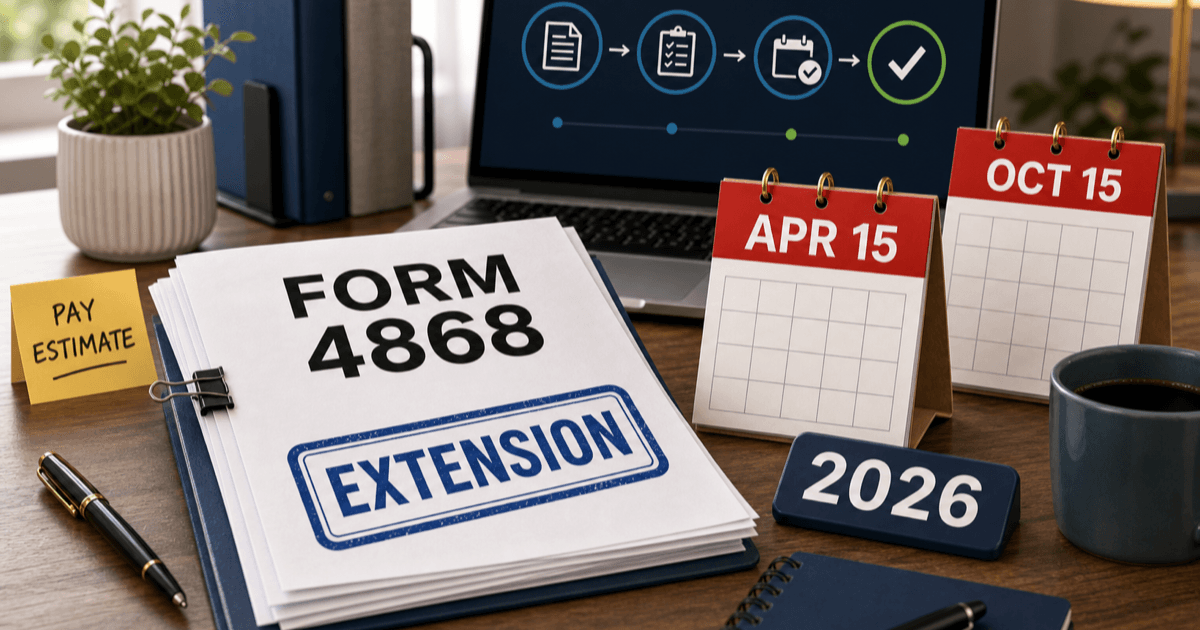
Form 4868 Deadline 2026
Use this for the individual extension form, online payment extension methods, payment estimates, and October 15 filing deadline.
Read guide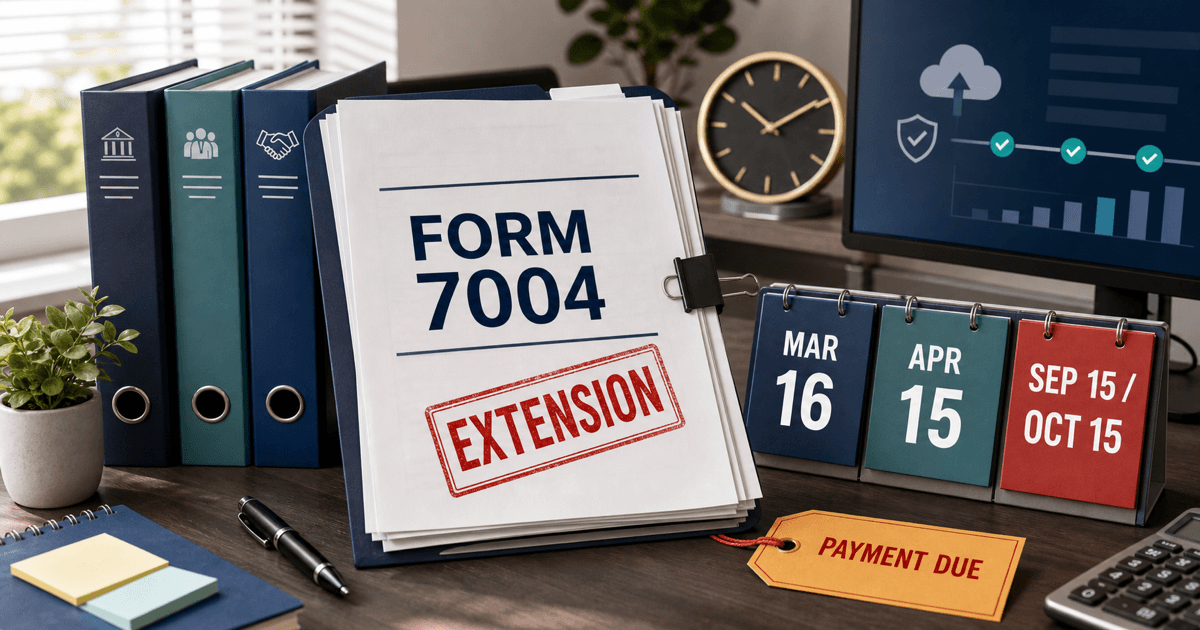
Form 7004 Extension Deadline 2026
Use this when the extension question is about business returns, Form 1065, Form 1120-S, Form 1120, Form 1041, e-file proof, and payment rules.
Read guide
Form 2553 Deadline 2026
Use this to avoid treating Form 2553 as an extension form; S corporation election timing has its own 2 months and 15 days rule.
Read guide
S Corporation Tax Deadline 2026
Use this when a shareholder return is waiting on an extended S corporation Form 1120-S or Schedule K-1.
Read guideSources & References
- 1.IRS - Get an Extension To File Your Tax Return(Accessed June 2026)
- 2.IRS - About Form 4868(Accessed June 2026)
- 3.IRS - Publication 509, Tax Calendars(Accessed June 2026)
- 4.IRS - Failure to File Penalty(Accessed June 2026)
- 5.IRS - Failure to Pay Penalty(Accessed June 2026)
- 6.IRS - Payment Plans and Installment Agreements(Accessed June 2026)
- 7.IRS - Direct Pay With Bank Account(Accessed June 2026)
- 8.IRS - Refunds(Accessed June 2026)