
Form 2553 Deadline 2026: S Corporation Election Due Date, Late Election Relief, and Filing Checklist
A detailed 2026 Form 2553 deadline guide for S corporation elections. Covers March 16, 2026 for calendar-year elections, the 2 months and 15 days rule, new entities, LLC S elections, shareholder consent, late-election relief, eligibility rules, fiscal-year examples, Form 1120-S timing, official video search notes, and a practical filing checklist.

Guide Oversight & Review Policy
CalculatorWallah guides are written to explain calculator assumptions, source limitations, and when users should move from a rough estimate to an official rule, institution policy, or clinician conversation.
Reviewed by Jitendra Kumar, Founder & Editorial Standards Lead. Page updated May 8, 2026. Trust-critical pages are reviewed when official rates or rules change. Evergreen calculator guides are checked on a recurring quarterly or annual cycle depending on topic volatility. Topic ownership: Sales tax and tax-sensitive estimate tools, Education and GPA planning calculators, Health, protein, and screening-formula pages, Platform-wide publishing standards and methodology.
On This Page
Form 2553 Deadline 2026
The Form 2553 deadline in 2026 depends on the tax year the S corporation election is meant to affect. For a typical calendar-year entity that wanted S corporation treatment effective January 1, 2026, Form 2553 was normally due by Monday, March 16, 2026. The 2-month-and-15-day date was March 15, but March 15, 2026 was a Sunday, so the practical deadline moved to the next business day.
This guide is updated as of May 8, 2026. That means the main calendar-year 2026 election deadline has already passed. If an entity still wants S corporation status for 2026, the next step is not simply filing late and hoping it works. Review whether the entity qualifies for late S corporation election relief, whether every required shareholder consent is complete, and whether the business has acted consistently with the intended S corporation status.
Countdown Timer
The tracked 2026 IRS deadline sequence is complete.
Calendar Year
March 16, 2026
For S status effective January 1, 2026, the normal deadline was March 16, 2026 after the Sunday adjustment.
Core Rule
2 months and 15 days
Form 2553 is generally due no more than 2 months and 15 days after the tax year begins, or during the preceding tax year.
Not an Extension
Form 7004 does not help
Form 7004 can extend certain business returns, but it does not extend the S corporation election deadline.
Quick Answer
If you wanted S corporation treatment starting January 1, 2026, the normal federal Form 2553 deadline was March 16, 2026. If you missed it, determine whether late-election relief applies before deciding the election is lost. If you are planning S status for January 1, 2027, you can generally file Form 2553 during 2026 or by March 15, 2027.
2026 Form 2553 Deadline Table
Most owners search for the Form 2553 deadline because they are thinking about a calendar year. Calendar-year timing is important, but it is not the only case. Fiscal-year, short year, and newly formed entities need to count from the start of the tax year the election should affect.
2026 Form 2553 Deadline Table
| Intended Effective Date | Normal Form 2553 Deadline | Applies To | Practical Action |
|---|---|---|---|
| January 1, 2026 | March 16, 2026 | Most calendar-year entities seeking S status for all of 2026 | This deadline has passed as of this May 8, 2026 update. Review late-election relief or plan a 2027 election. |
| February 1, 2026 | April 15, 2026 | Fiscal-year or short-year election beginning February 1, 2026 | This deadline has passed as of this update. Preserve proof if filed, or evaluate late-election relief. |
| March 1, 2026 | May 15, 2026 | Fiscal-year or short-year election beginning March 1, 2026 | Confirm eligibility, signatures, consent, and delivery proof immediately if this is the intended tax-year start. |
| July 1, 2026 | September 15, 2026 | Fiscal-year or short-year election beginning July 1, 2026 | Use the summer to verify entity classification, shareholders, payroll setup, and state S election rules. |
| October 1, 2026 | December 15, 2026 | Fiscal-year or short-year election beginning October 1, 2026 | Finish consent and accounting-period review before year-end filings and payroll close compete for attention. |
| January 1, 2027 | March 15, 2027 | Most calendar-year entities planning S status for 2027 | A calendar-year 2027 election can generally be filed during 2026 or by March 15, 2027. |
The Form 2553 Deadline Rule
IRS Form 2553 instructions describe the basic timing rule this way in practical terms: file the election no more than 2 months and 15 days after the beginning of the tax year the election is to take effect, or file it any time during the preceding tax year. If the form is made after that period, the election is generally treated as made for the following tax year unless late-election relief applies.
For a calendar-year entity, the tax year starts January 1. Two months after January 1 brings the timing to March 1, and the additional 15 days points to March 15. In 2026, March 15 was a Sunday, so the practical calendar-year deadline was March 16, 2026 under the usual weekend and legal-holiday filing rule described in IRS calendar guidance.
Preceding Year
Early filing is allowed
An eligible entity planning a January 1, 2026 S election generally could file Form 2553 during 2025 instead of waiting until early 2026.
Late Filing
Not always fatal
A late Form 2553 often requires late-election relief analysis. The details matter more than the date alone.
Who Files Form 2553
Form 2553 is used by a corporation or eligible entity to elect to be treated as an S corporation for federal tax purposes. In practice, it is commonly used by closely held corporations and by LLCs that want federal S corporation taxation after they confirm the entity is eligible.
The election affects how the business reports income, deductions, credits, shareholder allocations, payroll, and distributions. It does not create a new legal entity by itself. A state-law corporation remains a corporation. A state-law LLC remains an LLC legally, even if it is treated as an S corporation for federal tax purposes.
The election also does not replace normal operating work. If the election is accepted, the entity generally files Form 1120-S, issues shareholder Schedule K-1, handles payroll for owner-employees, and follows federal and state tax deadlines that apply to S corporations.
S Corporation Eligibility Rules to Check First
Timely filing is only one part of a valid S election. IRS S corporation guidance lists basic eligibility limits. Before relying on Form 2553, confirm the entity is eligible and that no shareholder, equity, or entity classification issue blocks the election.
Entity
Domestic corporation or eligible entity
The business generally must be a domestic corporation or eligible entity that can elect S corporation status.
Shareholders
100 shareholder limit
The corporation generally cannot have more than 100 shareholders, with family and counting rules that may need careful review.
Owner Type
Only eligible shareholders
Shareholders generally must be individuals, certain estates, certain trusts, or certain exempt organizations. Partnerships and corporations are usually not eligible.
Residency
No nonresident alien shareholders
A nonresident alien shareholder can prevent S corporation eligibility.
Equity
Only one class of stock
Different economic rights can create a second class of stock problem even if documents do not use that phrase.
Special Entities
Not an ineligible corporation
Certain financial institutions, insurance companies, and other excluded corporations cannot make the election.
Calendar-Year 2026 S Election Planning
For most small businesses, the headline date is March 16, 2026. That was the deadline for a calendar-year S election effective January 1, 2026. If Form 2553 was filed by that date with the required information and consents, the entity should preserve the signed form, proof of filing, and IRS acceptance letter.
If the entity did not file by March 16, 2026, do not assume Form 7004 or the later Form 1120-S deadline fixes the issue. Form 2553 is the election. Form 1120-S is the annual S corporation return after the election is accepted. Form 7004 can extend the annual return, but it does not retroactively create S corporation status.
Calendar-year owners planning ahead should also look at 2027. If January 1, 2027 is the intended effective date, Form 2553 can generally be filed during 2026 or by March 15, 2027. Filing during 2026 gives more time to correct rejections, finish payroll setup, and coordinate state S election or pass-through entity tax decisions.
New Entities, LLCs, and Short-Year Elections
New corporations and LLCs often miss the Form 2553 deadline because formation, bank accounts, EIN setup, payroll registration, and bookkeeping happen at the same time. The deadline is still tied to the beginning of the tax year the election is meant to affect. If the effective tax year starts March 1, 2026, a normal deadline of May 15, 2026 can be relevant. If it starts July 1, 2026, September 15, 2026 can be relevant.
LLCs deserve extra care. IRS Form 2553 instructions explain that an eligible entity can use Form 2553 to be treated as a corporation and elect S corporation status as of the S election effective date. That can make a separate Form 8832 unnecessary in many routine cases, but not every LLC fact pattern is routine. Multi-member LLC operating agreements, preferred economics, foreign members, entity members, community-property ownership, and state tax rules can all change the analysis.
If the entity already existed before 2026 but is now trying to switch tax status, review the current and prior classification, balance sheet, shareholder or member history, tax year, and whether a late or prospective election is cleaner than forcing a retroactive effective date.
Late Form 2553 and S Election Relief
A missed Form 2553 deadline does not automatically mean the entity can never be an S corporation for the intended year. The IRS Form 2553 instructions include late S corporation election relief procedures. Those procedures are fact-specific and should be applied from the current instructions, not from memory or a generic template.
In practical terms, late relief commonly focuses on whether the entity intended to be an S corporation by the requested effective date, whether it failed to qualify solely because Form 2553 was not timely filed, whether there was reasonable cause, whether the entity acted diligently to correct the failure, and whether the entity and shareholders acted consistently with S corporation treatment.
Late relief can be powerful, but it is not a substitute for eligibility. If the entity had an ineligible shareholder, a second class of stock, missing consent, or inconsistent tax reporting, those issues need separate correction before assuming a late election will be accepted.
What Happens After IRS Acceptance
Once the S election is accepted, the deadline work changes. The entity generally needs to file Form 1120-S each year, provide Schedule K-1 to shareholders, keep a clean balance sheet, track stock basis, separate wages from distributions, and meet payroll tax obligations for employees and owner-employees.
For a calendar-year S corporation reporting 2026 activity, the 2026 Form 1120-S return generally comes due in March 2027. A future Form 7004 extension can extend that return filing deadline, but again, it does not extend the original S election deadline. Keep the two concepts separate in every tax calendar.
Annual Return
Form 1120-S
The accepted S corporation generally files Form 1120-S and issues Schedule K-1 to shareholders each year.
Payroll
Owner wages need controls
Reasonable compensation, Form 941 deposits and returns, W-2 reporting, and state payroll accounts are separate from the election form.
Shareholders
Basis and K-1 planning
Shareholders need K-1 information, stock basis records, and individual estimated-tax or withholding planning.
States
Check state elections
Some states follow the federal S election. Others require separate elections, payments, annual reports, or pass-through entity tax decisions.
Common Form 2553 Deadline Mistakes
Form 2553 is short, but the surrounding timing and eligibility rules create avoidable problems. These are the mistakes most likely to create rejection, late-election cleanup, or filing inconsistency.
Watch
Counting from the wrong date
The deadline is tied to the beginning of the tax year the election should affect, not the day the owner started thinking about payroll or distributions.
Watch
Assuming Form 7004 extends the S election
A business return extension can extend Form 1120-S filing time after S status exists. It does not create extra time to file Form 2553.
Watch
Missing a shareholder consent
A valid election needs the required shareholder consent signatures, including owners who held shares during the pre-election period covered by the instructions.
Watch
Ignoring eligibility before filing
Ineligible shareholders, too many shareholders, a second class of stock, or an ineligible corporation can cause the election to fail even if the form is on time.
Watch
Treating LLC status as automatic
An LLC must still be an eligible entity and satisfy S corporation rules. State tax and legal classification rules may not match the federal tax election.
Watch
Waiting for IRS acceptance before payroll planning
Owner wages, withholding, Form 941 deposits, W-2 reporting, and reasonable compensation planning need lead time even while acceptance is pending.
Form 2553 Filing Checklist
Use this checklist before submitting Form 2553, before relying on S corporation status, or when cleaning up a late election.
Before Preparing Form 2553
- Confirm the exact tax year the S election should affect.
- Check whether the entity is a domestic corporation or eligible entity.
- Verify there are no more than 100 shareholders and no ineligible shareholders.
- Review stock, operating agreement, distributions, debt, and economics for one-class-of-stock problems.
- Confirm whether the entity needs a separate state S election or state entity-level tax registration.
When Completing the Form
- Use the legal name, EIN, address, tax year, effective date, and officer information that match entity records.
- Get the required shareholder consents and preserve the signed consent section with permanent records.
- For LLCs, confirm the federal classification effect and whether any Form 8832 question needs adviser review.
- If late, follow the current Form 2553 instructions for late-election relief language and supporting facts.
Submission and Proof
- Use the current IRS instructions for where and how to submit the form.
- Save fax confirmation, certified mail receipt, private delivery proof, or other submission evidence.
- Keep a complete signed copy of Form 2553, consents, operating documents, and late-relief support.
- Track IRS acceptance or rejection and follow up before the first Form 1120-S filing deadline.
After Acceptance
- Set up owner-employee payroll, withholding, deposits, and Form 941 workflows.
- Calendar Form 1120-S, Schedule K-1, W-2, 1099, estimated-tax, and state deadlines.
- Document reasonable compensation and distributions separately.
- Tell bookkeepers and tax preparers the effective date so income and expense reporting stays consistent.
Official Video Search Note
The project standard is to look for official or institutional videos and embed one when a suitable video exists. For this update, no suitable official IRS, government, institutional, or educational video specifically explaining the Form 2553 deadline or S corporation election filing mechanics was found. Because the available deadline authority is in written IRS Form 2553 instructions and IRS S corporation guidance, this article does not embed an unrelated creator video.
Use the written IRS resources linked in the source section for the binding filing rules, then use professional tax advice for entity-specific late-election relief, shareholder eligibility, payroll, and state election questions.
Form 2553 Deadline FAQ
The FAQ section covers the March 16, 2026 calendar-year deadline, early filing during the preceding year, late-election relief, Form 7004 confusion, LLC S elections, shareholder consent, eligibility, 2027 planning, and post-acceptance Form 1120-S obligations.
Trust and Update Notes
This article was built from IRS Form 2553 guidance, IRS Form 2553 instructions, IRS S corporation eligibility guidance, IRS Publication 509, IRS Form 1120-S resources, and IRS Form 7004 instructions reviewed in May 2026. It is written for deadline planning and filing workflow decisions. It is not a substitute for the current IRS instructions, state revenue agency rules, operating agreement review, payroll advice, or a tax adviser reviewing entity-specific facts.
Before filing or relying on an S election, confirm the effective date, tax year, shareholder history, shareholder eligibility, consent signatures, one-class-of-stock status, state S election treatment, late-relief conditions, submission proof, and acceptance status.
Frequently Asked Questions
Related Calculators
Date Duration Calculator
Count 2 months and 15 days from the tax-year start date, then calendar follow-up dates for acceptance, payroll setup, and Form 1120-S filing.
Use Date Duration CalculatorFederal Income Tax Calculator
Model owner-level federal tax when comparing Schedule C, partnership, C corporation, and S corporation outcomes.
Use Federal Income Tax CalculatorSelf-Employment Tax Calculator
Compare self-employment tax exposure before and after an S corporation wage and distribution structure.
Use Self-Employment Tax CalculatorPaycheck Calculator
Plan reasonable owner-employee wages, withholding, and payroll cash flow after S corporation status is accepted.
Use Paycheck CalculatorFICA Tax Calculator
Estimate Social Security and Medicare tax on S corporation owner-employee wages before payroll is configured.
Use FICA Tax CalculatorRelated Guides

S Corporation Tax Deadline 2026
Use this after the S election question to plan Form 1120-S, Schedule K-1, payroll, extensions, and shareholder filing dates.
Read guide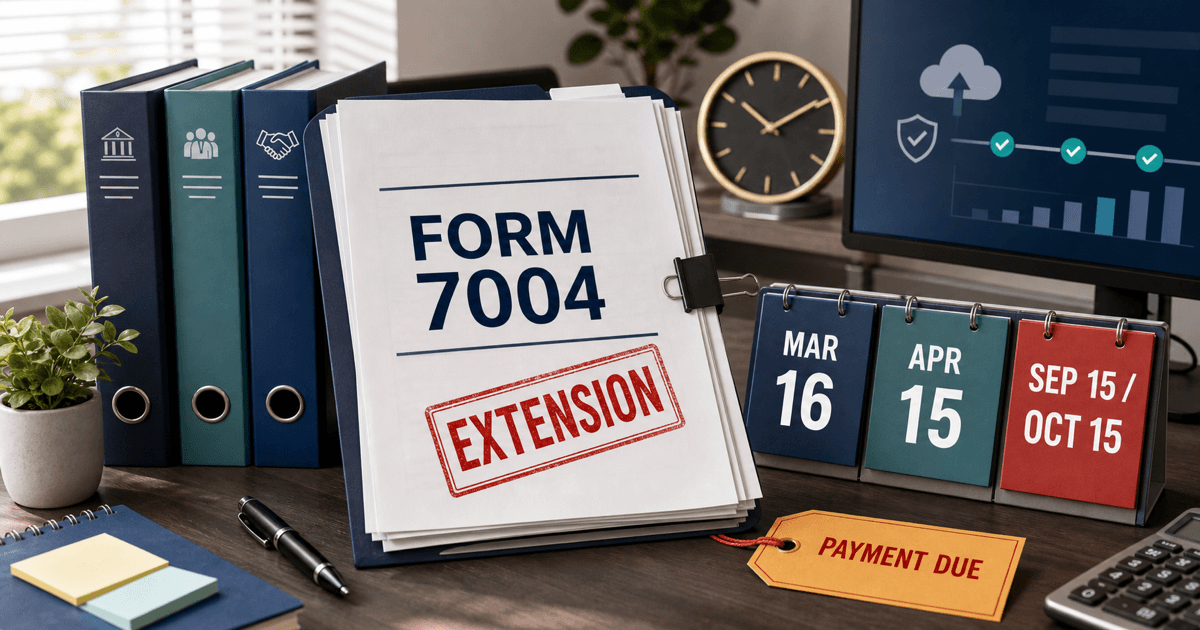
Form 7004 Extension Deadline 2026
Use this for business return extensions after S status exists, while keeping in mind that Form 7004 does not extend Form 2553.
Read guideSources & References
- 1.IRS - About Form 2553(Accessed May 2026)
- 2.IRS - Instructions for Form 2553(Accessed May 2026)
- 3.IRS - S Corporations(Accessed May 2026)
- 4.IRS - Publication 509, Tax Calendars(Accessed May 2026)
- 5.IRS - About Form 1120-S(Accessed May 2026)
- 6.IRS - Instructions for Form 1120-S(Accessed May 2026)
- 7.IRS - Instructions for Form 7004(Accessed May 2026)