Startup Tax Deadlines 2026: 83(b), EIN, Payroll, 1099, 1065, 1120-S, 1120, R&D Credit, Extensions, and Estimated Taxes
A practical 2026 startup tax deadline guide covering founder 83(b) elections, EIN setup, Form 2553, Schedule C, Form 1065, Form 1120-S, Form 1120, Form 7004, payroll Form 941, W-2, 1099-NEC, R&D payroll tax credit timing, BOI status, state filings, and official IRS video guidance.
Guide Oversight & Review Policy
CalculatorWallah guides are written to explain calculator assumptions, source limitations, and when users should move from a rough estimate to an official rule, institution policy, or clinician conversation.
Jitendra Kumar, Founder & Editorial Standards Lead. Updated June 25, 2026. Scope: Sales tax and tax-sensitive estimate tools, Education and GPA planning calculators, Health, protein, and screening-formula pages, Platform-wide publishing standards and methodology.
Tax credentialed review: Named internal reviewer: Iliyas Khan, Chief Operating Officer. External credentialed professional review is still required before this page is treated as professional advice.
Internal tax and sales-tax methodology reviewer. Review scope: calculator assumptions, labels, source context, workflow clarity, and compliance-sensitive disclaimers.
Relevant review context: CalculatorWallah tax and sales-tax calculator workflow owner; Source-first review of IRS, state revenue, rate, and filing-sensitive references; Compliance-sensitive labels, assumptions, and user-facing disclaimer review.
Required professional credentials: CPA, Enrolled Agent, licensed tax professional. Scope: tax formulas, jurisdiction assumptions, withholding language, filing-sensitive examples, and compliance caveats.
This page is educational planning support. A named CPA, EA, or licensed tax professional should review the page before it is positioned as tax advice or used for filing decisions.
Professional Review Status
This YMYL page has internal methodology review, but no external credentialed professional review is recorded yet.
- Reliance status
- Credentialed tax review required before professional reliance
- Required credentials
- CPA, Enrolled Agent, licensed tax professional
- Review scope
- tax formulas, jurisdiction assumptions, withholding language, filing-sensitive examples, and compliance caveats
Current reviewer: Iliyas Khan, Internal tax and sales-tax methodology reviewer.
This page is educational planning support. A named CPA, EA, or licensed tax professional should review the page before it is positioned as tax advice or used for filing decisions.
On This Page
Startup Tax Deadlines 2026
Startup tax deadlines in 2026 are not just annual return dates. A startup calendar can include a rolling 30-day Section 83(b) election window, EIN and payroll setup, Form 2553 S election timing, Form 1065, Form 1120-S, Form 1120, Form 941, W-2, 1099-NEC, R&D payroll tax credit elections, extensions, estimated taxes, state annual reports, and investor reporting.
This article is updated as of June 25, 2026. The March 16 pass-through and April 15 individual/C corporation original filing dates and the June 15 estimated-tax date have passed for many calendar-year startups. The next common federal dates are July 31, 2026 for Q2 Form 941, September 15, 2026 for extended pass-through returns and Q3 estimates, and October 15, 2026 for many extended individual and C corporation returns.
Countdown Timer
The tracked 2026 IRS deadline sequence is complete.
Founder Equity
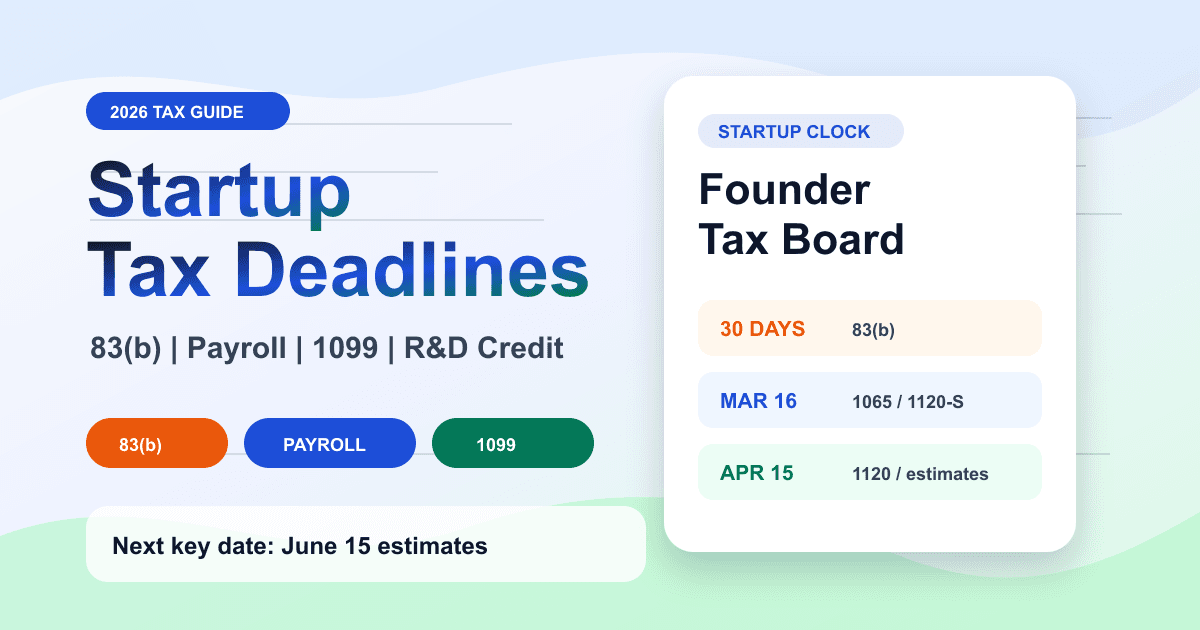
83(b) is a rolling 30-day clock
Restricted stock and similar founder equity can create a 30-day election deadline that does not wait for the annual tax return.
Entity Choice
March 16 or April 15
Calendar-year startup partnerships and S corporations generally used March 16, while C corporations and Schedule C founders generally used April 15.
Operating Calendar
Payroll, 1099s, R&D, states
Hiring founders or employees adds Form 941, payroll deposits, W-2s, state withholding, and possibly Form 8974 for R&D payroll credits.
Quick Startup Actions
Build the calendar from formation documents, tax classification, cap table events, payroll start date, contractor payments, R&D credit plans, state registrations, and investor reporting. A missed founder equity deadline can matter as much as a missed annual return.
Important 2026 Startup Tax Dates
A startup deadline table needs annual return dates and rolling operating deadlines. The table below focuses on common federal dates and startup-specific items; state franchise taxes, annual reports, payroll deposits, sales tax, and investor documents need separate review.
2026 Startup Deadline Table
| Date | Category | Deadline | Applies To | Action |
|---|---|---|---|---|
| Rolling 30 days | Founder Equity | Section 83(b) election after restricted property transfer | Founders, early employees, advisors, and service providers receiving restricted stock or similar property | Use Form 15620 or compliant election paperwork and track the transfer date immediately. This is not an annual deadline. |
| Before Payroll | Formation Setup | EIN, payroll accounts, Form W-4, Form I-9, and state setup | Startups hiring founders, employees, or other workers | Get federal and state accounts ready before wages are paid, deposits are due, or payroll returns begin. |
| February 2, 2026 | Payroll and 1099 | Many 2025 W-2, W-3, 1099-NEC, Form 940, and Q4 Form 941 actions | Startups that paid employees, founders, contractors, advisors, or reportable vendors in 2025 | This date has passed. Reconcile payroll, option-administration data, contractor files, and vendor forms. |
| March 16, 2026 | Pass-Through and Election | Calendar-year Form 1065, Form 1120-S, and many Form 2553 actions | Startup partnerships, multi-member LLCs, S corporations, and corporations electing S status | File the return, provide Schedule K-1 where required, file Form 7004 if eligible, or review late S election relief. |
| April 15, 2026 | Annual Returns | Schedule C startup activity, calendar-year Form 1120, and extension forms | Sole founder businesses, pre-incorporation Schedule C activity, and calendar-year C corporations | File Form 1040 with Schedule C or Form 1120, request the right extension, and pay expected tax. |
| April 15, 2026 | Estimated Tax | First 2026 federal estimated-tax installment | Founders, pass-through owners, sole proprietors, and calendar-year corporations with estimates | Pay the 2026 estimate separately from any 2025 balance due or extension payment. |
| April 30, 2026 | Payroll | First quarter 2026 Form 941 due | Startups with employees or founder payroll | Reconcile wages, withholding, Social Security, Medicare, deposits, payroll provider data, and Form 8974 if applicable. |
| June 15, 2026 | Estimated Tax | Second 2026 federal estimated-tax installment | Many founders, pass-through owners, and corporations making estimated payments | Update projections for revenue, payroll, R&D spend, investor financing, credits, option exercises, and withholding. |
| July 31, 2026 | Payroll | Second quarter 2026 Form 941 due | Many startups with payroll | Check payroll deposits, state withholding, unemployment, benefit adjustments, and R&D payroll credit forms. |
| September 15, 2026 | Extended Returns | Extended Form 1065 and Form 1120-S due | Calendar-year startup partnerships and S corporations with valid Form 7004 extensions | File the completed return and provide owner Schedule K-1 data for founder and investor tax returns. |
| September 15, 2026 | Estimated Tax | Third 2026 federal estimated-tax installment | Many founders, pass-through owners, and corporations making estimates | Recalculate after fundraising, payroll changes, sales, R&D credit review, and equity-compensation events. |
| October 15, 2026 | Extended Returns | Extended Form 1040 and calendar-year Form 1120 due | Schedule C founders with Form 4868 and C corporations with valid Form 7004 extensions | File the completed return. The extension did not move the original payment deadline. |
| November 2, 2026 | Payroll | Third quarter 2026 Form 941 due | Many startups with payroll | October 31, 2026 is a Saturday, so the practical next-business-day date is Monday, November 2, 2026. |
| January 15, 2027 | Estimated Tax | Fourth 2026 individual estimated-tax installment | Many founders, pass-through owners, and sole proprietors | Use full-year startup income, losses, equity income, wages, withholding, credits, and safe-harbor review before paying. |
Startup Deadline Control Map: Event Clocks, Not Just Tax Dates
Startup deadlines are triggered by documents and operating events as much as by calendar dates. A better calculator workflow starts with the event clock: equity transfer, S election effective date, first payroll, R&D credit election, state registration, and BOI status. The practical formula is deadline owner = trigger date + required form + proof file + follow-up date.
Startup Deadline Control Map
| Clock | Trigger | Calculator Use | Evidence to Save |
|---|---|---|---|
| Rolling 30-day equity clock | Restricted stock or similar property transfer date for a founder, employee, advisor, or service provider. | Use the deadline calendar immediately; do not wait for payroll, books, or the annual return to be ready. | Signed grant or purchase documents, board approval, valuation support, cap table entry, and mailing proof. |
| S election clock | Tax year the startup wants S corporation status to affect, plus shareholder consent readiness. | Use the Form 2553 guide and LLC tax election calculator before assuming an S election is worth making. | Form 2553, consents, EIN match, shareholder eligibility, operating agreement review, and submission proof. |
| Payroll launch clock | First founder or employee wage run, not the end of the quarter. | Use paycheck, FICA, and payroll deposit calculators before wages are approved or Form 941 is due. | Payroll register, Form W-4, state account setup, deposit confirmations, benefits, and Form 941 workpapers. |
| R&D credit clock | Qualified small business credit election on the timely filed income tax return, then payroll claim timing. | Use the deadline calendar to tie Form 6765, extension status, Form 8974, and Form 941 quarters together. | Research records, payroll records, Form 6765, Form 8974, Form 941, and extension acceptance. |
| State and BOI status clock | State registration, foreign qualification, franchise tax, annual report, payroll state setup, or non-U.S. reporting-company facts. | Use federal calculators for cash planning, then verify current state and FinCEN rules separately. | State portal confirmations, registered-agent records, franchise tax proof, and current FinCEN BOI status review. |
Use the Tax Deadline Calendar for event clocks, the LLC Tax Election Comparison Calculator before Form 2553 decisions, and the Payroll Tax Deposit Schedule Calculator before founder wages start.
Formation and First 30-Day Startup Deadlines
Some startup deadlines start before the first tax return is drafted. IRS startup guidance emphasizes choosing a business structure, choosing a tax year, applying for an EIN when needed, keeping records, and setting up employee forms when hiring begins.
EIN and Tax Year
Set the tax identity early
Open federal and state tax accounts before payroll, banking, vendor onboarding, investor diligence, or return preparation depends on them.
83(b)
30 days from property transfer
If founders or early employees receive restricted stock, the Section 83(b) review starts from the transfer date, not the next April filing season.
S Election
Form 2553 has early timing
A corporation seeking S corporation status for a calendar year generally cannot wait until the tax return deadline to think about Form 2553.
Payroll Start
Register before wages
Founder payroll can create federal deposits, Form 941, state withholding, unemployment, benefits, and workers compensation deadlines.
Startup Deadlines by Entity Type
Startups often change tax posture as they grow: a founder may begin with Schedule C consulting activity, form a Delaware C corporation, run an LLC partnership with co-founders, or elect S corporation status. Each path has a different federal return calendar.
Schedule C Founder
Form 1040 with Schedule C
Original calendar-year 2025 filing and payment date was April 15, 2026. Form 4868 can extend filing, not payment.
Startup Partnership
Form 1065 and K-1s
Calendar-year 2025 Form 1065 was generally due March 16, 2026, with a common extended filing date of September 15.
S Corporation Startup
Form 1120-S and payroll issues
Calendar-year 2025 Form 1120-S generally used March 16 and September 15. Reasonable compensation and payroll records need separate review.
C Corporation Startup
Form 1120
Calendar-year 2025 Form 1120 was generally due April 15, 2026, with a common extended filing deadline of October 15 when Form 7004 was valid.
Founder Equity and 83(b) Deadlines
The most startup-specific federal deadline is often the Section 83(b) election. IRS Form 15620 states that the election must be filed no later than 30 days after the property is transferred. The form also references the weekend and legal holiday rule under IRC section 7503.
This deadline can apply when founders, employees, advisors, or service providers receive property subject to vesting or a substantial risk of forfeiture. It is not a universal requirement and is not always beneficial, so startups should coordinate legal, tax, board, valuation, and cap table records before issuing equity.
Payroll, Contractors, W-2, and 1099 Startup Dates
A startup that pays founder salaries or employees can quickly move into employer tax obligations: payroll deposits, Form 941, W-2, state withholding, unemployment, benefits, and payroll provider controls. A startup using contractors, advisors, agencies, or fractional finance teams should collect W-9s and reconcile 1099-NEC reporting before year end.
Founder Payroll
Salary creates payroll filings
Once founders become employees, wages can trigger withholding, Social Security, Medicare, federal deposits, Form 941, W-2, and state payroll filings.
Contractors
Advisors and vendors need W-9 controls
Developer contractors, design agencies, fractional CFOs, marketers, and advisors can create Form 1099-NEC or other information reporting obligations.
Startup R&D Credit and Payroll Tax Timing
Many startups care about the qualified small business payroll tax credit for increasing research activities. IRS Form 6765 is used to figure and claim the research credit and to elect the payroll tax credit. The Form 6765 instructions say the payroll tax credit election must be made on or before the due date of the originally filed income tax return, including extensions.
After the election is made on Form 6765, an eligible startup claims the payroll tax credit against employment taxes with Form 8974 attached to the employment tax return, such as Form 941. The timing therefore ties the income tax return, extension decision, and payroll return calendar together.
BOI, State, Franchise Tax, and Annual Report Dates
Current FinCEN guidance says entities created in the United States and their beneficial owners are exempt from BOI reporting under the Corporate Transparency Act. Foreign entities registered to do business in the United States can still have BOI obligations. Because BOI rules changed materially in 2025, startups should check current FinCEN guidance before relying on older compliance checklists.
State deadlines are often more important for startups than founders expect. Delaware franchise tax, state annual reports, foreign qualification, registered-agent renewals, payroll withholding, unemployment, sales tax, local business licenses, and R&D or jobs credits can all use separate calendars.
Estimated Tax Dates for Startup Founders and Entities
Estimated-tax obligations can exist at the founder level, pass-through owner level, or C corporation level. Founders with consulting income, pass-through income, stock compensation, option exercises, or insufficient wage withholding should review their own payment coverage.
For many calendar-year individual taxpayers, 2026 federal estimated-tax installments are due April 15, June 15, September 15, 2026, and January 15, 2027. Corporations generally use the 15th day of the fourth, sixth, ninth, and twelfth months of the tax year.
Startup Extension Rules
Startups use different extension forms depending on the return. Form 7004 applies to many business returns, including Form 1065, Form 1120-S, and Form 1120. Form 4868 applies to many individual returns, including a founder filing Schedule C with Form 1040.
Extensions generally extend filing time, not payment time. They also do not extend a rolling 83(b) deadline, W-2 and 1099 furnishing obligations, payroll deposit dates, state annual reports, or investor reporting needs.
What To Do If a Startup Deadline Was Missed
If a 2026 startup deadline was missed, identify exactly what was missed: Form 15620, Form 2553, Form 1065, Form 1120-S, Form 1120, Form 941, W-2, 1099-NEC, Form 6765, Form 8974, estimated tax, state franchise tax, or another filing. The fix depends on the deadline.
Step 1
Separate rolling and annual deadlines
A late 83(b) election is different from a late annual return, late payroll return, late S election, or late state annual report.
Step 2
File and pay what can be fixed
Submit the missing return or correction, pay what can be paid, and preserve e-file, mailing, and payment confirmations.
Step 3
Protect founders and investors
Late K-1s, payroll forms, 1099s, equity elections, and state good-standing issues can affect fundraising and diligence.
Step 4
Rebuild the compliance calendar
Add recurring controls for equity grants, extensions, estimates, payroll, state annual reports, R&D credits, and investor tax packages.
Startup Filing Checklist
Use this checklist before issuing equity, hiring workers, filing returns, claiming credits, extending deadlines, or closing an investor diligence package. The goal is to tie every deadline to the right entity, founder, payroll account, stock record, return, extension, and state filing.
Formation and Equity
- Confirm entity type, tax classification, tax year, EIN, state registrations, and payroll setup before operations scale.
- Track every restricted stock or early-exercise transfer date for 83(b) review within 30 days.
- Keep board approvals, cap table records, stock purchase agreements, vesting schedules, valuations, and option ledgers together.
Return and Extension Calendar
- Map the startup to Schedule C, Form 1065, Form 1120-S, Form 1120, or another return before using a date.
- Use Form 7004 for many business return extensions and Form 4868 for individual Schedule C extensions.
- Do not treat a filing extension as a payment extension.
Payroll and Contractors
- Review founder wages, employee onboarding, Form W-4, Form I-9, payroll deposits, and Form 941 timing before payroll runs.
- Collect W-9 forms from contractors, advisors, and vendors before year-end 1099 deadlines.
- Reconcile stock compensation, bonuses, benefits, reimbursements, and accountable plans with payroll records.
Credits, States, and Investors
- Review Form 6765 and Form 8974 timing if the startup may use the qualified small business payroll tax credit.
- Check state franchise tax, annual report, foreign qualification, sales tax, payroll withholding, and unemployment deadlines.
- Prepare K-1s, investor reporting, QSBS support, R&D records, and board materials before the return deadline.
Calculator Tools for Startup Founders
CalculatorWallah tools do not file Form 15620, prepare cap table records, file Form 2553, prepare Form 1065, Form 1120-S, Form 1120, Form 6765, Form 8974, Form 941, W-2, or 1099 forms. They can support planning around founder income tax, self-employment tax, payroll tax, employee withholding, and cash set aside before filing or payment dates.
Founder Tax
Income, equity, and estimates
Use owner-level calculators after founder wages, pass-through income, stock income, deductions, credits, and withholding are credible enough to model.
Payroll
FICA and withholding
Use payroll calculators as planning aids, while actual payroll deposits, Form 941, and state filings remain tied to payroll records and official systems.
Official IRS Videos
I looked for official IRS video material relevant to startup deadline planning. The IRS Tax Calendar video is relevant for recurring due-date controls, and the Small Business Self-Employed Tax Center video is relevant because startup tax setup depends on business structure, records, forms, employees, and IRS small business guidance.
IRS: Tax Calendar
Official IRS video about using IRS calendar tools. Use current written Publication 509 and form instructions for exact 2026 dates.
IRS: Small Business Self-Employed Tax Center
Official IRS video introducing small business and self-employed tax resources, including business structure, records, forms, payroll, and tax centers.
Startup Tax Deadline FAQ System
The short answer is that no single 2026 startup tax deadline applies to every startup. The safer answer is to confirm formation date, tax classification, founder equity transfer dates, payroll start date, contractor payments, R&D credit elections, return form, tax year, state filings, and investor reporting obligations.
Schema, Trust, and Update Notes
This page is structured for Article, FAQ, source citation, reviewer, related calculator, and VideoObject markup. It uses IRS and FinCEN written sources for startup setup, Form 15620, Publication 509, Publication 583, Form 2553, Form 1065, Form 1120-S, Form 1120, Form 7004, Form 941, Form 6765, Form 8974, BOI guidance, and official IRS video context.
CalculatorWallah tools do not file tax returns, make 83(b) elections, create cap tables, determine valuation, classify workers, decide LLC tax status, calculate every payroll deposit, handle state taxes, or replace a CPA, enrolled agent, tax attorney, startup counsel, payroll provider, state agency, FinCEN, or official IRS source. Refresh this article when IRS instructions, FinCEN rules, state calendars, disaster relief, equity compensation rules, R&D credit rules, or business tax law changes affect 2026 deadlines.
Frequently Asked Questions
Related Calculators
Self-Employment Tax Calculator
Estimate self-employment tax for founder consulting income, sole proprietors, and pre-incorporation Schedule C activity.
Use Self-Employment Tax CalculatorFederal Income Tax Calculator
Model founder-level income tax after wages, equity income, pass-through income, deductions, and credits.
Use Federal Income Tax CalculatorFICA Tax Calculator
Estimate Social Security and Medicare taxes for founder payroll, employee wages, and payroll planning.
Use FICA Tax CalculatorPaycheck Calculator
Review founder and employee withholding, net pay, and payroll assumptions before Form 941 dates.
Use Paycheck CalculatorTax Refund Calculator
Compare withholding, estimated payments, credits, startup income, and founder-level tax exposure.
Use Tax Refund CalculatorTax Deadline Calendar 2026-2027
Map formation, 83(b), payroll, Form 2553, return, extension, and state dates in one startup calendar.
Use Tax Deadline Calendar 2026-2027Payroll Tax Deposit Schedule Calculator
Plan payroll deposit timing after founder or employee wages begin.
Use Payroll Tax Deposit Schedule CalculatorLLC Tax Election Comparison Calculator
Compare LLC default, S corporation, and C corporation tax treatment before a startup changes filing calendars.
Use LLC Tax Election Comparison CalculatorSources & References
- 1.IRS - Starting a Business(Accessed June 2026)
- 2.IRS - Checklist for Starting a Business(Accessed June 2026)
- 3.IRS - Publication 583, Starting a Business and Keeping Records(Accessed June 2026)
- 4.IRS - Publication 509, Tax Calendars(Accessed June 2026)
- 5.IRS - Form 15620, Section 83(b) Election(Accessed June 2026)
- 6.IRS - About Form 2553(Accessed June 2026)
- 7.IRS - About Form 1065(Accessed June 2026)
- 8.IRS - About Form 1120-S(Accessed June 2026)
- 9.IRS - About Form 1120(Accessed June 2026)
- 10.IRS - About Form 7004(Accessed June 2026)
- 11.IRS - About Form 941(Accessed June 2026)
- 12.IRS - About Form 6765(Accessed June 2026)
- 13.IRS - About Form 8974(Accessed June 2026)
- 14.FinCEN - Beneficial Ownership Information Reporting(Accessed June 2026)
- 15.IRS - IRS Small Business Self-Employed Tax Center YouTube Video Script(Accessed June 2026)