
Late Filing and Late Payment Penalty Calculator
Estimate common IRS failure-to-file and failure-to-pay penalties from unpaid tax, filing date, payment date, extension status, and penalty-rate scenario.
Last Updated: May 24, 2026
Enter the federal tax balance unpaid by the original return due date.
A valid extension delays the filing deadline, not the payment deadline.
For most 2025 individual returns, use April 15, 2026.
The filing penalty counts each month or part of a month after the filing deadline.
Use the date the original unpaid balance is fully paid.
Most taxpayers use the standard 0.5% monthly failure-to-pay rate.
Estimated Total Penalty
$750.00
Failure To File Penalty
$675.00
Failure To Pay Penalty
$75.00
Penalty As % Of Unpaid Tax
15.00%
Filing Months Late
3
Payment Months Late
3
The filing and payment penalties both use the original return due date because no valid filing extension is selected. IRS interest is not included because it compounds daily and can change each quarter.
Filing deadline used
April 15, 2026
Payment deadline used
April 15, 2026
Overlap months
3 months where both penalties may overlap.
Important Disclaimer
This calculator provides an educational estimate for planning and comparison only. It is not tax, legal, financial, medical, lending, insurance, payroll, compliance, or institutional advice and it is not an official determination. Rules, rates, eligibility, formulas, and source data can change or depend on facts not captured here. Verify the result against official sources and qualified professional guidance before filing, paying, diagnosing, borrowing, investing, hiring, or making a compliance-sensitive decision.
Professional Review Status
This YMYL page has internal methodology review, but no external credentialed professional review is recorded yet.
- Reliance status
- Credentialed tax review required before professional reliance
- Required credentials
- CPA, Enrolled Agent, licensed tax professional
- Review scope
- tax formulas, jurisdiction assumptions, withholding language, filing-sensitive examples, and compliance caveats
Current reviewer: Iliyas Khan, Internal tax and sales-tax methodology reviewer.
This page is educational planning support. A named CPA, EA, or licensed tax professional should review the page before it is positioned as tax advice or used for filing decisions.
Tax credentialed review: professional reliance limit
This page is educational planning support. A named CPA, EA, or licensed tax professional should review the page before it is positioned as tax advice or used for filing decisions. Results should be treated as a preliminary estimate, not a filing instruction, diagnosis, product recommendation, eligibility decision, or compliance sign-off. Required professional review: CPA, Enrolled Agent, licensed tax professional. Source expectation: Review should cite current IRS, state revenue department, payroll-tax, or official tax authority sources where applicable.
Checked by Iliyas Khan
Late Filing and Late Payment Penalty Calculator is checked for formula labels, source links, and result limits.
Iliyas Khan, Chief Operating Officer. Updated May 24, 2026. Scope: tax calculators.
Tax credentialed review: Named internal reviewer: Iliyas Khan, Chief Operating Officer. External credentialed professional review is still required before this page is treated as professional advice.
Internal tax and sales-tax methodology reviewer. Review scope: calculator assumptions, labels, source context, workflow clarity, and compliance-sensitive disclaimers.
Relevant review context: CalculatorWallah tax and sales-tax calculator workflow owner; Source-first review of IRS, state revenue, rate, and filing-sensitive references; Compliance-sensitive labels, assumptions, and user-facing disclaimer review.
Required professional credentials: CPA, Enrolled Agent, licensed tax professional. Scope: tax formulas, jurisdiction assumptions, withholding language, filing-sensitive examples, and compliance caveats.
This page is educational planning support. A named CPA, EA, or licensed tax professional should review the page before it is positioned as tax advice or used for filing decisions.
How To Use The Late Filing and Late Payment Penalty Calculator
Step 1: Enter unpaid tax
Use the federal tax balance that was unpaid by the original return due date. Penalties are usually based on unpaid tax, not total tax before withholding and credits.
Step 2: Enter due, filing, and payment dates
The calculator counts each month or part of a month after the relevant deadline. Filing and payment can have different deadlines when a valid extension exists.
Step 3: Select extension and payment scenario
Choose whether a valid filing extension applies and whether the standard, installment-agreement, or levy-notice payment penalty rate is most relevant.
Step 4: Review the penalty breakdown
Use the failure-to-file, failure-to-pay, and total penalty estimates for planning. Confirm actual IRS notices and interest separately.
How This Calculator Works
This calculator estimates the two common federal income-tax penalties that appear when a taxpayer files late, pays late, or does both. The failure-to-file penalty is generally 5% of unpaid tax for each month or part of a month the return is late, capped at 25%. The failure-to-pay penalty is generally 0.5% of unpaid tax for each month or part of a month the balance remains unpaid, also capped at 25%.
When both penalties apply in the same month, the IRS reduces the failure-to-file penalty by the failure-to-pay penalty for that month. Under the standard 0.5% failure-to-pay rate, that makes the overlap month 4.5% for late filing plus 0.5% for late payment.
If the return is more than 60 days late, a minimum failure-to-file penalty can apply. For returns due in 2026, IRS guidance lists the minimum as $525 or 100% of unpaid tax, whichever is less. The calculator applies that minimum when it is larger than the regular percentage-based filing penalty.
IRS Late Filing and Late Payment Penalties: What To Know
Failure to file is usually more expensive than failure to pay
The late filing penalty is usually much larger than the late payment penalty. That is why filing as soon as possible often matters even if you cannot pay the entire balance immediately. Filing can stop the failure-to-file penalty from growing while the failure-to-pay penalty continues at the lower monthly rate.
A valid extension can help with the filing side. Use the IRS Tax Extension Deadline Calculator to confirm the filing deadline and payment deadline. The extension may delay the filing penalty, but it usually does not delay the payment penalty.
How the monthly penalty count works
IRS penalties generally count each month or part of a month after the deadline. That means filing one day late can count as one month for penalty purposes. This calculator follows that planning convention: it counts partial months after the relevant deadline instead of prorating by exact days.
The failure-to-file clock uses the original filing deadline unless a valid filing extension applies. The failure-to-pay clock uses the original payment due date because an extension to file does not normally extend the time to pay.
Penalty rates and caps
| Penalty | Common rate | Common cap |
|---|---|---|
| Failure to file | 5% per month or part month | 25% of unpaid tax |
| Failure to pay | 0.5% per month or part month | 25% of unpaid tax |
| Approved payment plan | 0.25% per month in qualifying months | 25% of unpaid tax |
| After final levy notice period | 1% per month in qualifying months | 25% of unpaid tax |
Interest is separate from penalties
The calculator intentionally excludes interest. IRS interest on unpaid balances compounds daily and can change quarterly. Interest can also apply to penalties after assessment or notice rules. Use the penalty estimate as a planning layer, then compare it with IRS notices or current IRS interest-rate guidance.
If your late payment happened because estimated payments were missed during the year, use the Estimated Tax Payment Due Date Calculator to plan the next deadline before the balance grows further.
Penalty relief may be available
IRS penalty relief can apply in some cases. Common paths include first-time penalty abatement, reasonable cause, statutory exceptions, and administrative relief. Relief is fact-specific, so a calculator cannot decide whether you qualify. It can, however, help you estimate the amount at stake before reviewing IRS relief rules or speaking with a tax professional.
Keep the research moving with IRS Tax Extension Deadline Calculator, Tax Refund Calculator 2026, Estimated Tax Payment Due Date Calculator, and FICA Tax Calculator.
Frequently Asked Questions
Related Calculators
IRS Tax Extension Deadline Calculator
Check the extension request deadline, extended filing deadline, and payment deadline.
Use IRS Tax Extension Deadline CalculatorTax Refund Calculator 2026
Estimate refund or balance due after withholding, credits, and estimated payments.
Use Tax Refund Calculator 2026Estimated Tax Payment Due Date Calculator
Find your next estimated tax due date and split remaining payments across IRS deadlines.
Use Estimated Tax Payment Due Date CalculatorFICA Tax Calculator
Calculate Social Security and Medicare taxes with 2026 thresholds.
Use FICA Tax CalculatorRelated Guides

Form 1040 Deadline 2026
Use this for the April 15 Form 1040 filing and payment deadline, October 15 extension date, late-filing cleanup, and 1040-specific checklist.
Read guide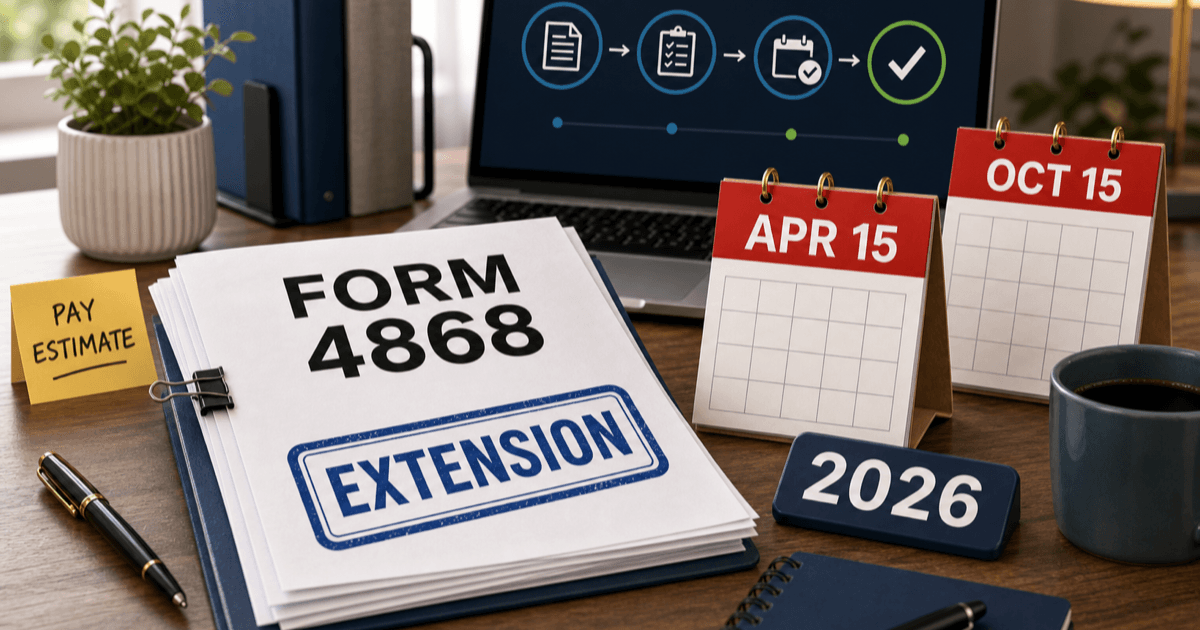
Form 4868 Deadline 2026
Use this for individual tax extension timing, the April 15 Form 4868 request deadline, October 15 extended filing date, payment estimates, online extension methods, and proof of filing.
Read guide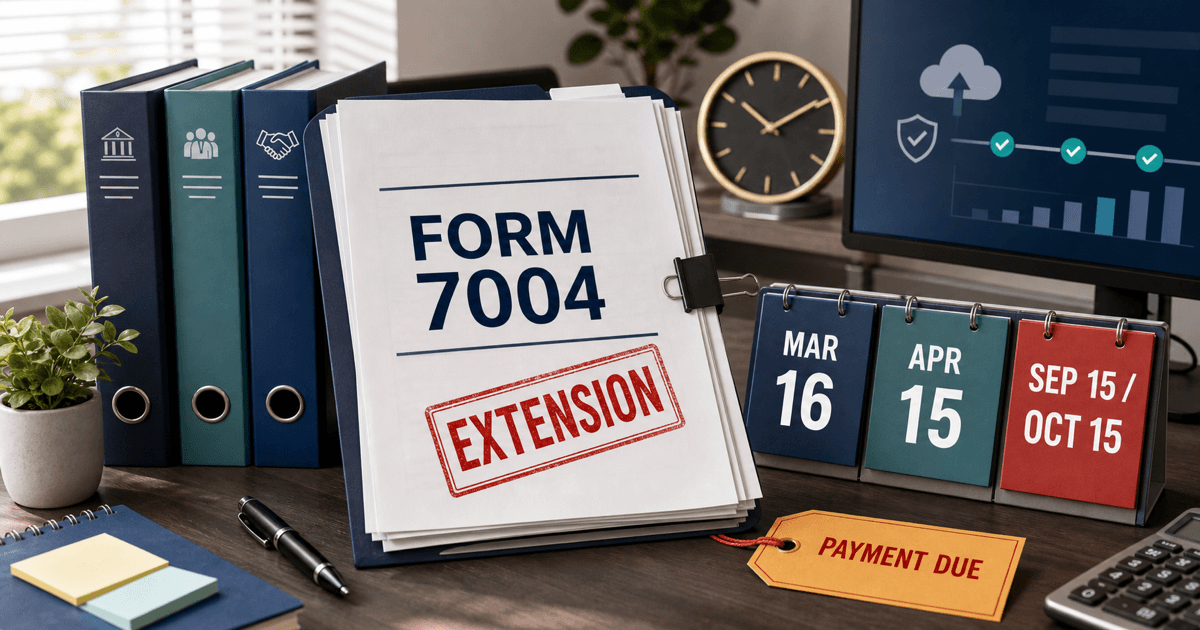
Form 7004 Extension Deadline 2026
Use this for business extension due dates, March 16 and April 15 Form 7004 deadlines, September 15 and October 15 extended filing dates, e-file rules, and no-extension-to-pay cleanup.
Read guide
Form 2553 Deadline 2026
Use this for S corporation election timing, the March 16 calendar-year deadline, 2 months and 15 days rule, shareholder consent, LLC S elections, late-election relief, and Form 1120-S follow-through.
Read guideSources & References
- 1.IRS - Failure to File Penalty(Accessed May 2026)
- 2.IRS - Failure to Pay Penalty(Accessed May 2026)
- 3.IRS - Penalty Relief(Accessed May 2026)
- 4.IRS - Interest(Accessed May 2026)