
Quarterly Tax Payment Calculator for Freelancers
Estimate what to pay each quarter from freelance revenue, business expenses, self-employment tax, federal safe harbor, withholding, payments already made, and optional state tax.
Last Updated: May 24, 2026
Use gross 1099, client, platform, or business receipts before expenses.
Include ordinary and necessary expenses before estimating net profit.
Optional W-2 wages, spouse income, or other taxable income for federal brackets.
Use W-2 withholding, refundable credits, or other federal tax already prepaid.
Total 2026 federal Form 1040-ES payments already made.
Enter 0 if you only want a federal estimate.
Optional state or local estimated payments already made.
Used for the 100% or 110% prior-year federal safe-harbor test.
Higher-income taxpayers may need 110% of prior-year tax for safe harbor.
Use YYYY-MM-DD to split the remaining target across upcoming 2026 due dates.
Suggested Next Quarterly Payment
$10,473.61
Combined Remaining Target
$20,947.22
Federal Remaining Target
$16,947.22
Estimated State / Local Remaining
$4,000.00
Self-Employment Tax
$11,303.64
Federal Income Tax
$7,526.60
Federal Safe Harbor Target
$16,947.22
Suggested Tax Reserve Rate
28.54%
Net freelance profit
$80,000.00 after projected business expenses.
Safe harbor status
More federal estimated tax needed.
Next IRS due date
September 15, 2026 for Q3 2026 freelance income.
Payments remaining
2 upcoming estimated-tax installments in this model.
Important Disclaimer
This calculator provides an educational estimate for planning and comparison only. It is not tax, legal, financial, medical, lending, insurance, payroll, compliance, or institutional advice and it is not an official determination. Rules, rates, eligibility, formulas, and source data can change or depend on facts not captured here. Verify the result against official sources and qualified professional guidance before filing, paying, diagnosing, borrowing, investing, hiring, or making a compliance-sensitive decision.
Professional Review Status
This YMYL page has internal methodology review, but no external credentialed professional review is recorded yet.
- Reliance status
- Credentialed tax review required before professional reliance
- Required credentials
- CPA, Enrolled Agent, licensed tax professional
- Review scope
- tax formulas, jurisdiction assumptions, withholding language, filing-sensitive examples, and compliance caveats
Current reviewer: Iliyas Khan, Internal tax and sales-tax methodology reviewer.
This page is educational planning support. A named CPA, EA, or licensed tax professional should review the page before it is positioned as tax advice or used for filing decisions.
Tax credentialed review: professional reliance limit
This page is educational planning support. A named CPA, EA, or licensed tax professional should review the page before it is positioned as tax advice or used for filing decisions. Results should be treated as a preliminary estimate, not a filing instruction, diagnosis, product recommendation, eligibility decision, or compliance sign-off. Required professional review: CPA, Enrolled Agent, licensed tax professional. Source expectation: Review should cite current IRS, state revenue department, payroll-tax, or official tax authority sources where applicable.
Checked by Iliyas Khan
Quarterly Tax Payment Calculator for Freelancers is checked for formula labels, source links, and result limits.
Iliyas Khan, Chief Operating Officer. Updated May 24, 2026. Scope: tax calculators.
Tax credentialed review: Named internal reviewer: Iliyas Khan, Chief Operating Officer. External credentialed professional review is still required before this page is treated as professional advice.
Internal tax and sales-tax methodology reviewer. Review scope: calculator assumptions, labels, source context, workflow clarity, and compliance-sensitive disclaimers.
Relevant review context: CalculatorWallah tax and sales-tax calculator workflow owner; Source-first review of IRS, state revenue, rate, and filing-sensitive references; Compliance-sensitive labels, assumptions, and user-facing disclaimer review.
Required professional credentials: CPA, Enrolled Agent, licensed tax professional. Scope: tax formulas, jurisdiction assumptions, withholding language, filing-sensitive examples, and compliance caveats.
This page is educational planning support. A named CPA, EA, or licensed tax professional should review the page before it is positioned as tax advice or used for filing decisions.
How To Use The Quarterly Tax Payment Calculator For Freelancers
Step 1: Enter projected freelance revenue and expenses
Use expected 2026 gross freelance receipts and ordinary business expenses. The calculator converts those inputs into estimated net freelance profit.
Step 2: Add filing status and other income
Choose your filing status and add W-2 wages, spouse income, or other taxable income when it affects federal tax brackets and Medicare surtax exposure.
Step 3: Subtract payments already made
Enter federal withholding, refundable credits, federal estimated payments, and optional state or local estimated payments already made.
Step 4: Review the next payment amount
Use the suggested payment as a planning target for the next IRS due date, then adjust if your actual income is seasonal or materially different from the projection.
How This Calculator Works
This freelancer quarterly tax calculator starts with projected gross freelance revenue and business expenses to estimate net profit. It then applies self-employment tax logic for Social Security and Medicare, calculates a federal income-tax estimate using 2026 filing-status brackets and the standard deduction, and combines those federal tax layers.
The calculator then compares the estimated current-year federal tax with the prior-year safe-harbor target. When a prior-year total tax amount is provided, the annual federal target is the smaller of 90% of projected current-year federal tax or 100% of prior-year tax. For higher-income taxpayers, the prior-year test is increased to 110%.
Finally, the tool subtracts federal withholding and estimated payments already made, adds any optional state or local tax reserve, and divides the remaining target across the estimated-tax due dates still ahead of the as-of date.
Quarterly Taxes For Freelancers: What To Know
Freelance quarterly taxes cover more than income tax
Freelancers often underestimate quarterly taxes because they think only about ordinary federal income tax. In reality, independent workers also need to plan for self-employment tax, which covers Social Security and Medicare. For many freelancers, self-employment tax is the first major tax layer to reserve for because it applies before deductions and credits are fully considered.
For a deeper SE-tax-only view, use the Self-Employment Tax Calculator. This quarterly tool uses the same core concept but focuses on payment timing and remaining installments.
IRS estimated tax due dates for regular calendar-year freelancers
| 2026 income period | Federal estimated payment due date | Planning note |
|---|---|---|
| January 1 to March 31 | April 15, 2026 | First regular freelancer estimated payment |
| April 1 to May 31 | June 15, 2026 | Shorter second IRS payment period |
| June 1 to August 31 | September 15, 2026 | Good time to update year-to-date profit |
| September 1 to December 31 | January 15, 2027 | Final regular 2026 estimated payment |
To focus only on due-date timing, use the Estimated Tax Payment Due Date Calculator. To check penalty exposure from late or uneven payments, use the Estimated Tax Underpayment Penalty Calculator.
Safe harbor is a planning floor, not a perfect final tax estimate
Federal safe harbor rules are designed to reduce underpayment penalty risk. They do not guarantee that the final tax return will show no balance due. A freelancer with fast income growth may satisfy a prior-year safe harbor and still owe tax at filing because the current-year tax bill is higher than the safe-harbor target.
That is why many freelancers track two numbers: a minimum federal safe-harbor payment target and a cash-flow reserve based on the full current-year tax estimate. The reserve approach is more conservative, especially when revenue is rising or state taxes are material.
A practical freelancer tax workflow
Update this calculator after each major contract, price change, or expense shift. Save a percentage of every client payment into a dedicated tax account, then true up the reserve before each IRS due date. The suggested tax reserve rate can help set that transfer percentage, but it should be reviewed quarterly.
If you also have W-2 income, withholding can reduce or even replace estimated tax payments. If your spouse has payroll withholding, increasing that withholding can be an easier way to cover household tax than making separate estimated payments. Compare final refund or balance due with the Tax Refund Calculator 2026.
Keep the research moving with Self-Employment Tax Calculator, Estimated Tax Payment Due Date Calculator, Estimated Tax Underpayment Penalty Calculator, and FICA Tax Calculator.
Frequently Asked Questions
Related Calculators
Self-Employment Tax Calculator
Estimate SE tax, deductible half, federal tax, and quarterly baseline.
Use Self-Employment Tax CalculatorEstimated Tax Payment Due Date Calculator
Find your next IRS estimated tax deadline and split remaining payments.
Use Estimated Tax Payment Due Date CalculatorEstimated Tax Underpayment Penalty Calculator
Check estimated-tax safe harbor and approximate Form 2210 penalty exposure.
Use Estimated Tax Underpayment Penalty CalculatorFICA Tax Calculator
Calculate Social Security and Medicare taxes with 2026 thresholds.
Use FICA Tax CalculatorRelated Guides

Form 1040 Deadline 2026
Use this for the April 15 Form 1040 filing and payment deadline, October 15 extension date, late-filing cleanup, and 1040-specific checklist.
Read guide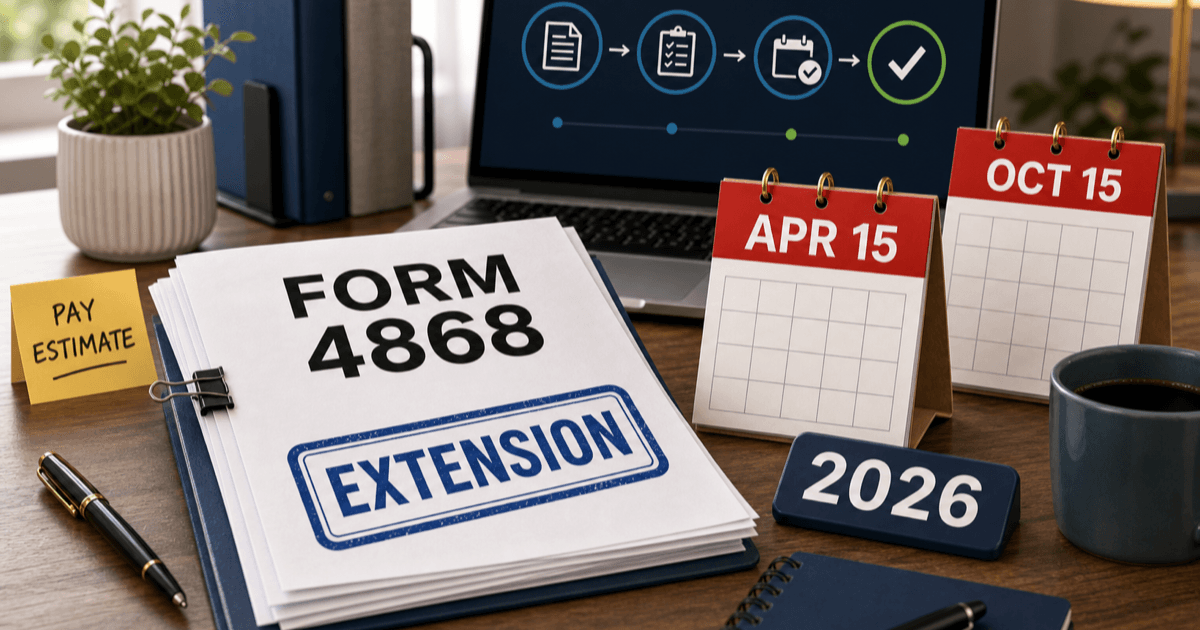
Form 4868 Deadline 2026
Use this for individual tax extension timing, the April 15 Form 4868 request deadline, October 15 extended filing date, payment estimates, online extension methods, and proof of filing.
Read guide
Form 7004 Extension Deadline 2026
Use this for business extension due dates, March 16 and April 15 Form 7004 deadlines, September 15 and October 15 extended filing dates, e-file rules, and no-extension-to-pay cleanup.
Read guide
Form 2553 Deadline 2026
Use this for S corporation election timing, the March 16 calendar-year deadline, 2 months and 15 days rule, shareholder consent, LLC S elections, late-election relief, and Form 1120-S follow-through.
Read guideSources & References
- 1.IRS - Self-Employed Individuals Tax Center(Accessed May 2026)
- 2.IRS - Form 1040-ES, Estimated Tax for Individuals(Accessed May 2026)
- 3.IRS - Publication 505, Tax Withholding and Estimated Tax(Accessed May 2026)
- 4.Social Security Administration - Contribution and Benefit Base(Accessed May 2026)