IRS Payment Plan Monthly Cost Calculator
Estimate the monthly cost of an IRS short-term payment plan or long-term installment agreement, including setup fee, interest, and failure-to-pay penalty assumptions.
Last Updated: May 24, 2026
Use the unpaid tax balance before new setup fees, interest, and penalties.
Optional current assessed penalties and interest already shown on your IRS notice.
Monthly direct debit installment agreement requested online.
Optional payment made before the monthly plan starts.
Use 6 or fewer months for short-term plans; longer terms model monthly installments.
IRS underpayment rates change quarterly. Default uses 7% for 2026 planning.
Approved individual installment agreements commonly use 0.25% per month when the return was filed on time.
Estimated Monthly Payment
$388.05
Estimated Total Paid
$13,969.97
Interest Over Plan
$1,365.02
Failure-to-Pay Penalty
$582.96
IRS Setup Fee Used
$22.00
Cost Above Tax Balance
$1,969.97
Starting Plan Balance
$12,022.00
Approx. Monthly Charge Rate
0.83%
Modeled term
36 monthly payments.
Plan fee
Long-term direct debit, apply online: $22.00 setup fee in this estimate.
Interest and penalty
This model applies daily interest and monthly penalty estimates until payoff.
Final balance
$0.01 remaining after the modeled payment schedule.
Important Disclaimer
This calculator provides an educational estimate for planning and comparison only. It is not tax, legal, financial, medical, lending, insurance, payroll, compliance, or institutional advice and it is not an official determination. Rules, rates, eligibility, formulas, and source data can change or depend on facts not captured here. Verify the result against official sources and qualified professional guidance before filing, paying, diagnosing, borrowing, investing, hiring, or making a compliance-sensitive decision.
Professional Review Status
This YMYL page has internal methodology review, but no external credentialed professional review is recorded yet.
- Reliance status
- Credentialed tax review required before professional reliance
- Required credentials
- CPA, Enrolled Agent, licensed tax professional
- Review scope
- tax formulas, jurisdiction assumptions, withholding language, filing-sensitive examples, and compliance caveats
Current reviewer: Iliyas Khan, Internal tax and sales-tax methodology reviewer.
This page is educational planning support. A named CPA, EA, or licensed tax professional should review the page before it is positioned as tax advice or used for filing decisions.
Tax credentialed review: professional reliance limit
This page is educational planning support. A named CPA, EA, or licensed tax professional should review the page before it is positioned as tax advice or used for filing decisions. Results should be treated as a preliminary estimate, not a filing instruction, diagnosis, product recommendation, eligibility decision, or compliance sign-off. Required professional review: CPA, Enrolled Agent, licensed tax professional. Source expectation: Review should cite current IRS, state revenue department, payroll-tax, or official tax authority sources where applicable.
Checked by Iliyas Khan
IRS Payment Plan Monthly Cost Calculator is checked for formula labels, source links, and result limits.
Iliyas Khan, Chief Operating Officer. Updated May 24, 2026. Scope: tax calculators.
Tax credentialed review: Named internal reviewer: Iliyas Khan, Chief Operating Officer. External credentialed professional review is still required before this page is treated as professional advice.
Internal tax and sales-tax methodology reviewer. Review scope: calculator assumptions, labels, source context, workflow clarity, and compliance-sensitive disclaimers.
Relevant review context: CalculatorWallah tax and sales-tax calculator workflow owner; Source-first review of IRS, state revenue, rate, and filing-sensitive references; Compliance-sensitive labels, assumptions, and user-facing disclaimer review.
Required professional credentials: CPA, Enrolled Agent, licensed tax professional. Scope: tax formulas, jurisdiction assumptions, withholding language, filing-sensitive examples, and compliance caveats.
This page is educational planning support. A named CPA, EA, or licensed tax professional should review the page before it is positioned as tax advice or used for filing decisions.
How To Use The IRS Payment Plan Monthly Cost Calculator
Step 1: Enter the IRS balance
Use the unpaid tax shown on your notice or return. If penalties and interest are already assessed, enter them separately.
Step 2: Choose the payment plan type
Select the short-term, long-term, direct debit, non-direct debit, or low-income fee scenario that best matches how you expect to apply.
Step 3: Set the payoff term and rates
Enter the number of months, IRS interest rate, and monthly failure-to-pay penalty rate. Defaults reflect common 2026 planning assumptions.
Step 4: Review the monthly cost
Use the estimated monthly payment, total interest, penalty, setup fee, and total paid to compare payoff options.
How This Calculator Works
This calculator models an IRS payment plan by starting with your unpaid tax balance, adding any current penalties and interest, adding the selected IRS setup fee, and subtracting any upfront payment. It then estimates the monthly payment needed to bring the balance to zero over the payoff term you choose.
Each modeled month adds estimated daily-compounded IRS interest and a monthly failure-to-pay penalty before applying the monthly payment. The penalty model includes a 25% cap against the starting tax balance, but actual IRS calculations can differ because assessment dates and payment allocation rules matter.
The output is best used for planning and comparison: shorter payoff terms, direct debit setup fees, and larger upfront payments usually reduce total cost. The final IRS payoff should always be confirmed through your IRS online account, notice, or an IRS representative.
IRS Payment Plans: Costs, Fees, Interest, And Penalties
A payment plan gives time, but it does not freeze the balance
An IRS payment plan can prevent a cash-flow crisis by spreading a tax balance over time. It does not normally stop interest or all penalties. IRS guidance says interest and some penalty charges continue until the balance is paid in full, so the true cost is more than the original tax shown on the return.
If you are also trying to understand the penalty side before choosing a plan, compare this tool with the Late Filing and Late Payment Penalty Calculator.
IRS payment plan setup fees
| Plan scenario | Setup fee used | Planning note |
|---|---|---|
| Short-term online plan | $0 | Pay in 180 days or less |
| Short-term phone, mail, or in person | $107 | Non-online short-term request |
| Long-term direct debit online | $22 | Often the lowest regular long-term fee |
| Long-term non-direct debit online | $69 | Monthly payments not through direct debit |
| Long-term phone, mail, or in person | $107 to $178 | Fee depends on direct debit vs non-direct debit |
| Qualifying low-income taxpayers | $0 or $43 | Waived or reduced fee depending on payment method |
Short-term plan vs monthly installment agreement
A short-term payment plan can be attractive when you can pay within 180 days, especially if you apply online and avoid a setup fee. The tradeoff is that the required monthly cash flow can be high because the payoff window is short. A long-term installment agreement lowers the monthly payment but usually increases total interest and penalties.
The best plan is usually the fastest one you can actually maintain. Missing payments can create new problems, while a longer term that fits your budget may cost more but be more realistic. Use the upfront payment and payoff-term inputs to test several paths.
Interest and failure-to-pay penalty assumptions
IRS underpayment interest rates can change quarterly and are compounded daily. The default 7% annual rate is a current planning assumption from IRS 2026 interest-rate guidance. If the IRS publishes a new quarterly rate, update the rate input before using the result for planning.
The calculator defaults to a 0.25% monthly failure-to-pay penalty because IRS guidance says the penalty is reduced to that rate for individuals who filed on time and have an approved payment plan. If you do not qualify for that reduced rate, change the penalty input to match your facts.
Prevent the next balance due
A payment plan solves a past-due balance, but it does not fix current-year withholding or estimated tax. If the same underpayment pattern continues, you can end up with a new balance while still paying the old one. Employees should review W-4 withholding, and freelancers should review quarterly estimated payments.
Use the W-4 Withholding Adjustment Calculator or the Quarterly Tax Payment Calculator for Freelancers to reduce the chance of repeating the cycle.
Keep the research moving with Late Filing and Late Payment Penalty Calculator, Tax Refund Calculator 2026, IRS Tax Extension Deadline Calculator, and FICA Tax Calculator.
Frequently Asked Questions
Related Calculators
Late Filing and Late Payment Penalty Calculator
Estimate IRS failure-to-file and failure-to-pay penalties before setting a payoff plan.
Use Late Filing and Late Payment Penalty CalculatorTax Refund Calculator 2026
Estimate federal refund or amount due after withholding, credits, and payments.
Use Tax Refund Calculator 2026IRS Tax Extension Deadline Calculator
Check filing-extension timing and the original payment deadline.
Use IRS Tax Extension Deadline CalculatorFICA Tax Calculator
Calculate Social Security and Medicare taxes with 2026 thresholds.
Use FICA Tax CalculatorRelated Guides

Form 1040 Deadline 2026
Use this for the April 15 Form 1040 filing and payment deadline, October 15 extension date, late-filing cleanup, and 1040-specific checklist.
Read guide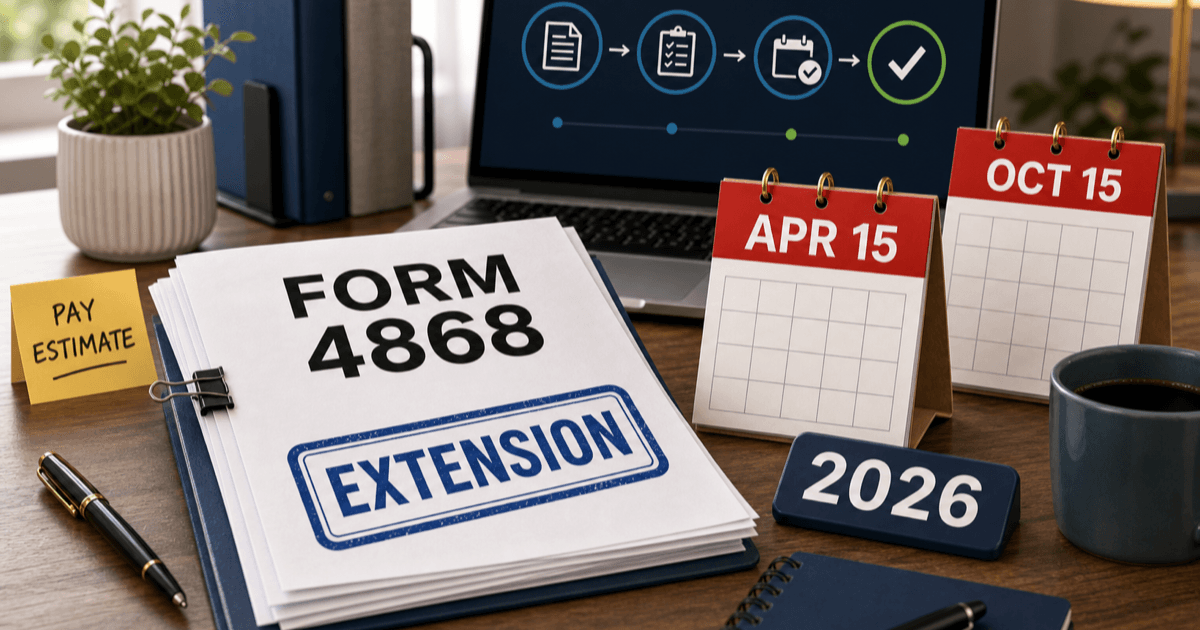
Form 4868 Deadline 2026
Use this for individual tax extension timing, the April 15 Form 4868 request deadline, October 15 extended filing date, payment estimates, online extension methods, and proof of filing.
Read guide
Form 7004 Extension Deadline 2026
Use this for business extension due dates, March 16 and April 15 Form 7004 deadlines, September 15 and October 15 extended filing dates, e-file rules, and no-extension-to-pay cleanup.
Read guide
Form 2553 Deadline 2026
Use this for S corporation election timing, the March 16 calendar-year deadline, 2 months and 15 days rule, shareholder consent, LLC S elections, late-election relief, and Form 1120-S follow-through.
Read guideSources & References
- 1.IRS - Payment Plans and Installment Agreements(Accessed May 2026)
- 2.IRS - Online Payment Agreement Application(Accessed May 2026)
- 3.IRS - Failure to Pay Penalty(Accessed May 2026)
- 4.IRS - Quarterly Interest Rates(Accessed May 2026)