
Tax Debt Payoff vs Installment Plan Calculator
Compare an aggressive tax-debt payoff against an IRS installment plan using current setup-fee choices, interest assumptions, failure-to-pay penalties, payoff time, and total cost.
Last Updated: May 24, 2026
Enter the current balance shown on your IRS notice or online account.
Paying what you can now lowers future interest and penalties.
Use this for an aggressive payoff without modeling an approved installment agreement.
Use the monthly payment you would request or can afford under an IRS plan.
IRS underpayment interest changes quarterly. Update this field if the current rate changes.
IRS user fees depend on how you apply, payment method, and low-income status.
Lower Cost Strategy
Self-payoff costs less
Cost Difference
$918 self-payoff savings
Self-Payoff Time
7 months
Installment Time
33 months
Self-payoff path
- Total paid
- $12,401
- Interest
- $201
- Failure-to-pay penalties
- $201
- Final payment
- $1,401
IRS installment plan path
- Total paid
- $13,319
- Interest
- $864
- Reduced payment-plan penalties
- $432
- Setup fee
- $22
Fastest path
Self-payoff is faster. Paying more upfront or monthly generally reduces total charges.
Payment-plan tradeoff
An approved plan can reduce the monthly failure-to-pay penalty, but interest continues until the balance is paid.
Payment warning
Both modeled payments reduce the balance under the current assumptions.
Important Disclaimer
This calculator provides an educational estimate for planning and comparison only. It is not tax, legal, financial, medical, lending, insurance, payroll, compliance, or institutional advice and it is not an official determination. Rules, rates, eligibility, formulas, and source data can change or depend on facts not captured here. Verify the result against official sources and qualified professional guidance before filing, paying, diagnosing, borrowing, investing, hiring, or making a compliance-sensitive decision.
Professional Review Status
This YMYL page has internal methodology review, but no external credentialed professional review is recorded yet.
- Reliance status
- Credentialed tax review required before professional reliance
- Required credentials
- CPA, Enrolled Agent, licensed tax professional
- Review scope
- tax formulas, jurisdiction assumptions, withholding language, filing-sensitive examples, and compliance caveats
Current reviewer: Iliyas Khan, Internal tax and sales-tax methodology reviewer.
This page is educational planning support. A named CPA, EA, or licensed tax professional should review the page before it is positioned as tax advice or used for filing decisions.
Tax credentialed review: professional reliance limit
This page is educational planning support. A named CPA, EA, or licensed tax professional should review the page before it is positioned as tax advice or used for filing decisions. Results should be treated as a preliminary estimate, not a filing instruction, diagnosis, product recommendation, eligibility decision, or compliance sign-off. Required professional review: CPA, Enrolled Agent, licensed tax professional. Source expectation: Review should cite current IRS, state revenue department, payroll-tax, or official tax authority sources where applicable.
Checked by Iliyas Khan
Tax Debt Payoff vs Installment Plan Calculator is checked for formula labels, source links, and result limits.
Iliyas Khan, Chief Operating Officer. Updated May 24, 2026. Scope: tax calculators.
Tax credentialed review: Named internal reviewer: Iliyas Khan, Chief Operating Officer. External credentialed professional review is still required before this page is treated as professional advice.
Internal tax and sales-tax methodology reviewer. Review scope: calculator assumptions, labels, source context, workflow clarity, and compliance-sensitive disclaimers.
Relevant review context: CalculatorWallah tax and sales-tax calculator workflow owner; Source-first review of IRS, state revenue, rate, and filing-sensitive references; Compliance-sensitive labels, assumptions, and user-facing disclaimer review.
Required professional credentials: CPA, Enrolled Agent, licensed tax professional. Scope: tax formulas, jurisdiction assumptions, withholding language, filing-sensitive examples, and compliance caveats.
This page is educational planning support. A named CPA, EA, or licensed tax professional should review the page before it is positioned as tax advice or used for filing decisions.
How To Use The Tax Debt Payoff vs Installment Plan Calculator
Step 1: Enter the current IRS balance
Use the balance shown in your IRS online account, notice, transcript, or most recent payoff information.
Step 2: Add the lump sum you can pay now
Enter the amount you can safely send immediately before comparing future monthly payoff paths.
Step 3: Compare monthly payment options
Enter the monthly amount you could pay without an approved installment agreement and the lower monthly amount you would request under a plan.
Step 4: Choose the fee and interest assumptions
Select the IRS setup-fee scenario and update the annual interest rate if the IRS quarterly underpayment rate changes.
How This Calculator Works
The calculator compares two modeled paths. The self-payoff path applies the upfront payment, then estimates monthly interest and the regular failure-to-pay penalty while you pay the higher monthly amount. The installment-plan path applies the same upfront payment, adds the selected setup fee, then estimates interest and the reduced payment-plan penalty while you pay the lower monthly amount.
The model uses a monthly approximation for readability. IRS interest is actually compounded daily, and IRS penalties can depend on exact notice dates, assessed tax, payment allocation rules, penalty caps, and whether an installment agreement is approved. Treat the result as a planning comparison, not a final payoff quote.
If a payment amount is too low to cover modeled monthly charges, the calculator flags that risk. In that case, increase the monthly payment, send a larger upfront amount, or compare the result with a formal IRS payment-plan estimate.
Tax Debt Payoff vs IRS Installment Plan: What Changes The Total Cost
Paying faster usually reduces total cost
IRS guidance is direct: if you cannot pay the full balance by the original deadline, the unpaid amount can keep accruing interest and late-payment penalties. Paying in full as soon as you can usually minimizes additional charges. The practical question is whether the faster payoff amount is realistic without causing a new cash-flow problem.
Use this calculator when you want to compare a high monthly payoff against a smaller installment-plan payment. If the higher payment clears the balance quickly, it may cost less overall even though an installment plan can reduce the failure-to-pay penalty rate for eligible individuals.
Why the installment plan can still cost more
An installment agreement can make tax debt manageable by spreading the balance over time. But it does not normally freeze the balance. IRS payment-plan guidance says interest and penalties continue until the balance is paid in full, and long-term plans can also include setup fees.
| Cost factor | Self-payoff path | Installment-plan path |
|---|---|---|
| Monthly payment | Usually higher | Usually lower |
| Failure-to-pay penalty | Modeled at 0.5% per month | Modeled at 0.25% per month when approved |
| Interest | Continues until paid | Continues until paid |
| Setup fee | $0 in this comparison | Varies by IRS plan type and payment method |
Setup fees matter, but payoff speed matters more
IRS long-term payment-plan fees differ by application method and payment method. Online direct debit agreements have a lower standard setup fee than non-direct-debit or phone/mail/in-person requests. Qualifying low-income taxpayers may qualify for a waiver or reimbursement. The fee matters, but the number of months the balance remains unpaid often has a larger effect on total cost.
If you already know you need a formal agreement, compare this result with the IRS Payment Plan Monthly Cost Calculator to test a fixed payoff term and monthly payment requirement.
Avoid creating a second tax problem
Paying old tax debt aggressively is useful only if you can also stay current. Employees should review payroll withholding before increasing old-balance payments. Freelancers, gig workers, landlords, and investors should make sure quarterly estimated taxes are covered while the old balance is being paid.
For the next return, use the W-4 Withholding Adjustment Calculator or the Quarterly Tax Payment Calculator for Freelancers so a new balance does not build while you are paying the old one.
Keep the research moving with IRS Payment Plan Monthly Cost Calculator, Late Filing and Late Payment Penalty Calculator, Tax Document Checklist Builder, and FICA Tax Calculator.
Frequently Asked Questions
Related Calculators
IRS Payment Plan Monthly Cost Calculator
Estimate monthly IRS payment plan cost with fees, interest, and penalties.
Use IRS Payment Plan Monthly Cost CalculatorLate Filing and Late Payment Penalty Calculator
Estimate IRS failure-to-file and failure-to-pay penalties from late dates.
Use Late Filing and Late Payment Penalty CalculatorTax Document Checklist Builder
Gather tax forms, notices, payments, and records before contacting the IRS.
Use Tax Document Checklist BuilderFICA Tax Calculator
Calculate Social Security and Medicare taxes with 2026 thresholds.
Use FICA Tax CalculatorRelated Guides

Form 1040 Deadline 2026
Use this for the April 15 Form 1040 filing and payment deadline, October 15 extension date, late-filing cleanup, and 1040-specific checklist.
Read guide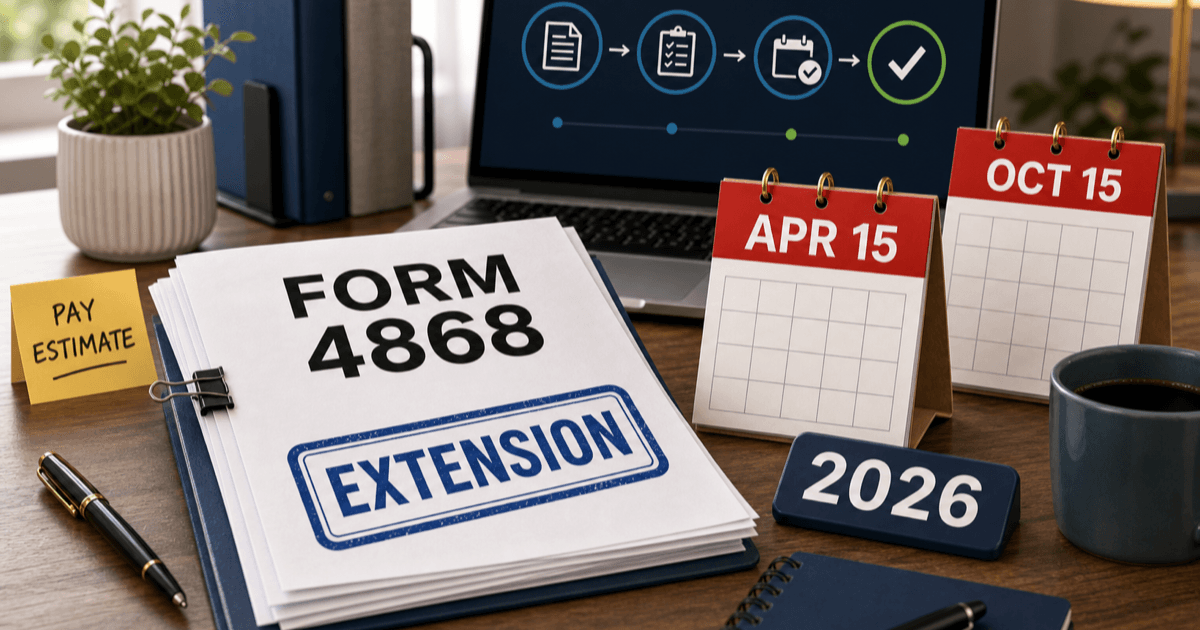
Form 4868 Deadline 2026
Use this for individual tax extension timing, the April 15 Form 4868 request deadline, October 15 extended filing date, payment estimates, online extension methods, and proof of filing.
Read guide
Form 7004 Extension Deadline 2026
Use this for business extension due dates, March 16 and April 15 Form 7004 deadlines, September 15 and October 15 extended filing dates, e-file rules, and no-extension-to-pay cleanup.
Read guide
Form 2553 Deadline 2026
Use this for S corporation election timing, the March 16 calendar-year deadline, 2 months and 15 days rule, shareholder consent, LLC S elections, late-election relief, and Form 1120-S follow-through.
Read guideSources & References
- 1.IRS - Payment Plans and Installment Agreements(Accessed May 2026)
- 2.IRS - Failure to Pay Penalty(Accessed May 2026)
- 3.IRS - Quarterly Interest Rates(Accessed May 2026)
- 4.IRS - Payments(Accessed May 2026)